


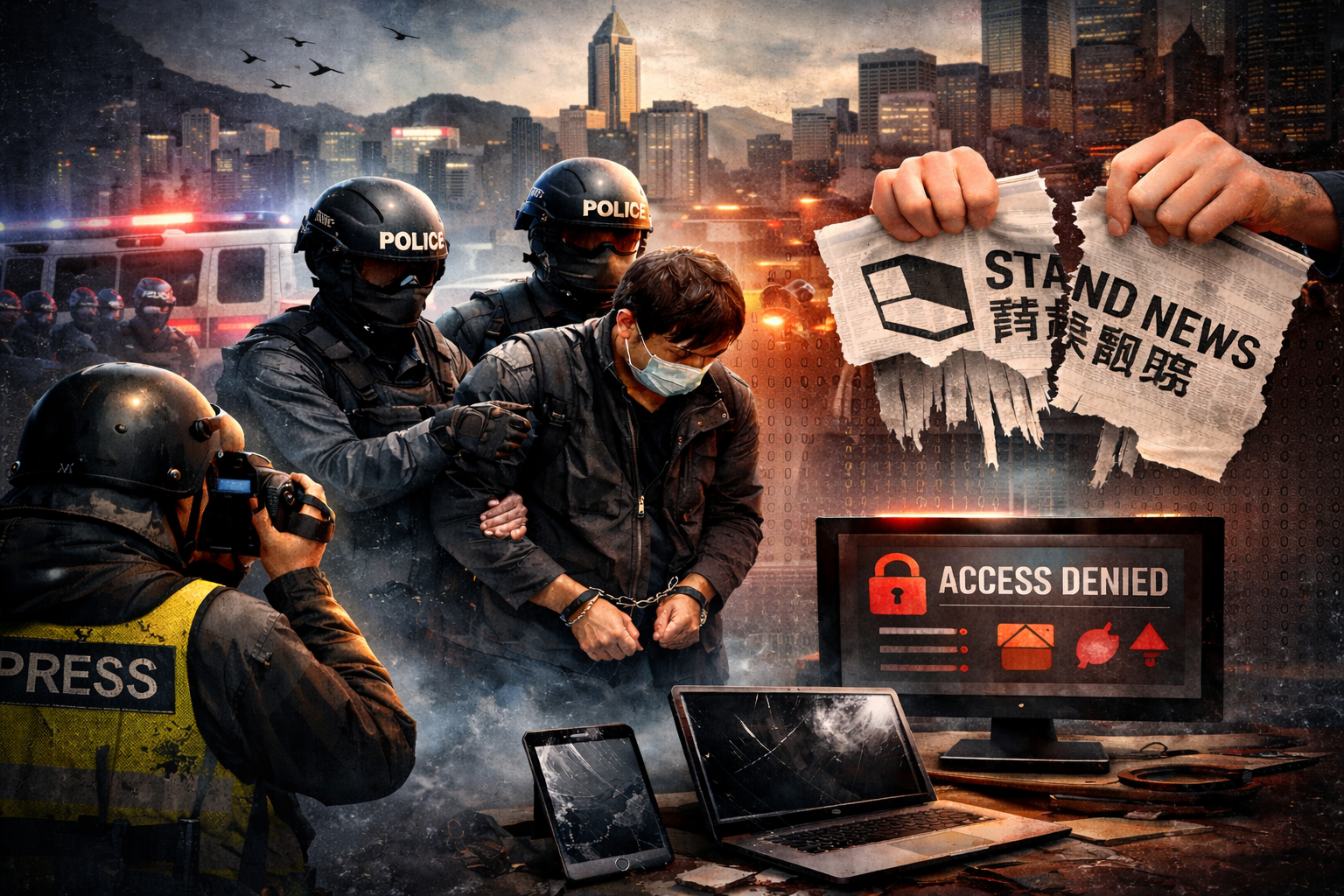
The closure of Stand News in December 2021 is often remembered as another chapter in Hong Kong’s shrinking civic space. That reading, while accurate, is incomplete. What unfolded that morning was not merely the suppression of a media outlet. It was a demonstration of a new and more efficient method of control—one that eliminates independent journalism without formally abolishing press freedom.
Nothing about the Stand News operation appeared chaotic or unlawful. On the contrary, it was meticulous, procedural, and conspicuously orderly. More than 200 police officers carried out a coordinated raid. Editors and board members were arrested under sedition provisions. Assets worth tens of millions of Hong Kong dollars were frozen. Computers, phones, and reporting materials were seized. Within hours, the newsroom was paralysed. By nightfall, Stand News no longer existed.
At no point did the authorities announce a ban on journalism. No decree was issued declaring the end of press freedom. Instead, journalism was rendered operationally impossible.
This distinction matters. Modern repression does not always arrive through overt prohibition. It often works better when it adopts the appearance of routine governance.
Performance, not necessity
From a policing perspective, the scale of the Stand News raid was unnecessary. There was no armed confrontation, no public disorder, and no immediate threat that justified the deployment of hundreds of officers. The size of the operation was not about enforcement efficiency. It was about visibility.
The raid was designed to be seen by journalists, editors, publishers, advertisers, and civil society actors. Its purpose extended beyond the individuals arrested that day. It functioned as a signal that independent journalism had become a category of risk.
This use of law enforcement as performance is not incidental. Visibility magnifies deterrence. A small, quiet investigation would have achieved limited effect. A mass operation, widely photographed and reported, reshapes behaviour across an entire sector.
Financial suffocation as a strategy
The decisive moment in the Stand News episode was not the arrests. It was the freezing of assets.
By cutting off access to funds, the state achieved immediate and irreversible outcomes. The organisation could no longer pay staff, maintain servers, seek legal counsel, or continue publishing. Closure followed not because a court had ruled on guilt, but because survival had become mathematically impossible.
This approach collapses the distinction between investigation and punishment. In theory, enforcement is meant to follow judicial determination. In practice, the outcome—silencing—was secured before any verdict could be reached.
Financial tools have become a central instrument in contemporary governance. They are efficient, difficult to contest quickly, and devastating in effect. When applied to media organisations, they remove the need for censorship laws. A newsroom without resources cannot function, regardless of its legal status.
Erasing memory, not just output
Equally significant was the speed with which Stand News’s digital presence disappeared. Articles, archives, and social media accounts vanished almost overnight. Years of reporting were removed from public access. This was not merely the shutdown of a publication. It was the deletion of a historical record.
Journalism does not only inform the present. It preserves memory. When archives are erased, accountability becomes harder to pursue, and the past becomes easier to rewrite. The rapid disappearance of Stand News’s body of work demonstrated how fragile digital memory can be when state power is applied without restraint.
The message extended beyond one newsroom: information can be removed as quickly as it is produced.
A carefully chosen target
Stand News was not selected at random. Following the earlier closure of Apple Daily, it had emerged as one of the most prominent remaining platforms offering pro-democracy reporting. It was professional, widely read, and symbolically important.
At the same time, it lacked the scale or international backing that might have complicated enforcement. This combination made it an ideal target. Eliminating it would generate maximum signalling value at manageable cost.
The consequences were immediate. Within days, Citizen News announced it would shut down voluntarily, citing concerns for staff safety amid a deteriorating media environment. No order was issued. No raid followed. The outcome was induced.
This is how demonstrative repression functions. The state does not need to act against every outlet. It needs only to act visibly against a few.
Discipline without decrees
Supporters of the Stand News operation maintain that it was a lawful action taken under existing statutes, and that press freedom remains protected so long as journalism does not cross legal boundaries. Formally, this defence rests on a narrow reading of legality.
Yet the facts complicate that claim. When enforcement produces irreversible effects before judicial scrutiny, the distinction between law enforcement and discipline blurs. The process itself becomes the punishment.
This model is particularly effective because it preserves plausible deniability. Authorities can insist that no ban exists, that courts remain independent, and that journalists are free to operate within the law. Meanwhile, the costs of testing those boundaries have been made unmistakably high. Fear does not need to be declared when it can be demonstrated.
Convergence by design
The methods employed against Stand News mirror practices long observed in mainland China, where visible enforcement actions are used to deter dissent and enforce ideological conformity. Arrests, financial pressure, and organisational dismantling function as reminders of state authority rather than steps toward adjudication.
Hong Kong’s adoption of similar tactics marked a decisive shift. The city’s governance style did not change overnight through constitutional amendments alone. It changed through practice—through how power was applied, how speed was prioritised, and how outcomes were secured irrespective of legal timelines. The convergence is not rhetorical. It is operational.
The end state
What remains in Hong Kong today is not an absence of journalism, but a transformed media environment. Outlets still exist. Stories are still published. Yet the boundaries of permissible inquiry have narrowed, enforced not by explicit censorship but by rational calculation.
Editors weigh legal and financial risk before commissioning work. Reporters avoid subjects that could draw attention. Investigations go unwritten, not because they are banned, but because the consequences of pursuing them have been demonstrated in real time.
This is repression refined. It relies less on force than on foresight. Once the lesson has been learned, repetition becomes unnecessary.
An erasure meant to be remembered
The paradox of the Stand News raid is that its visibility ensured it would not be forgotten. The scale, speed, and finality of the operation were designed to leave an imprint—not just on those directly affected, but on the media ecosystem as a whole.
In shutting down a newsroom, the authorities staged a warning. The facts of that warning—the numbers involved, the financial chokehold, the disappearance of archives—continue to shape behaviour long after the officers left the building.
Hong Kong did not ban the press. It demonstrated something more effective: how to make independent journalism untenable without ever saying so.