


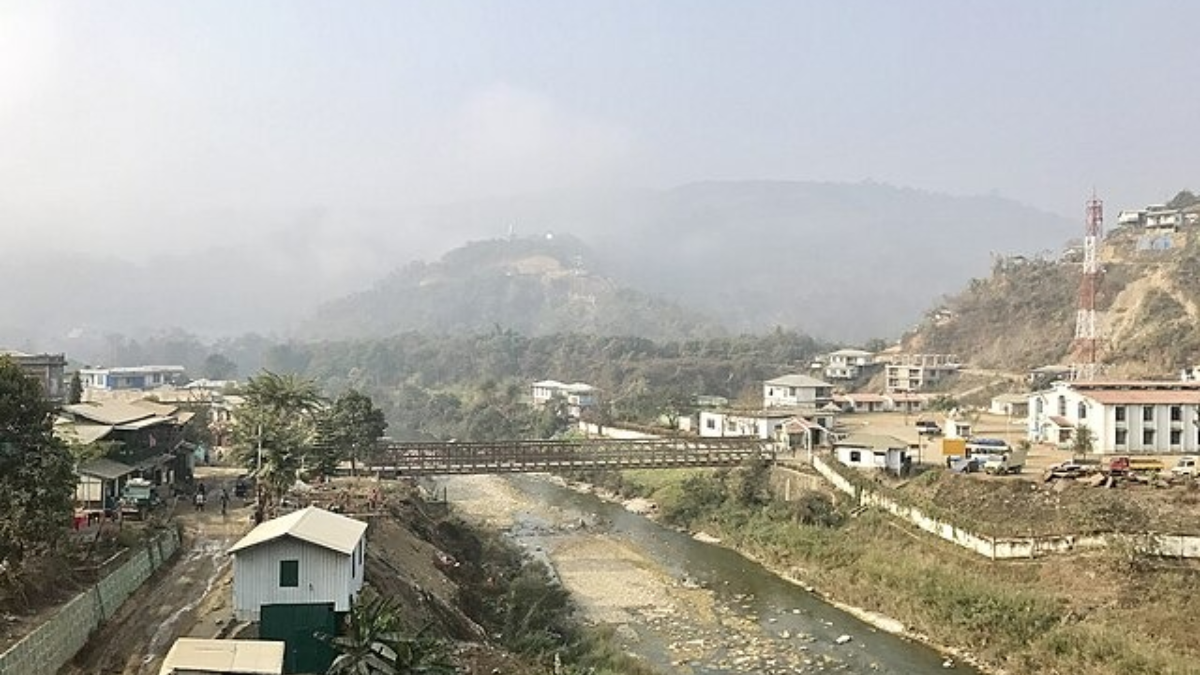
Northeast India has always been one of the most complex human landscapes on earth, with over 200 ethnic groups, hundreds of languages and dialects, and centuries of distinct cultural histories layered atop one another. Analysts have long called it a “mosaic.”
In 2026, however, that mosaic is cracking. What was once a region defined by localised insurgencies and deep-rooted questions of identity has become something far more complicated.
In this geopolitical pressure cooker, internal tensions and external threats no longer stay in their separate lanes. They feed each other. The most consequential shift is that the line between internal security and external threat has effectively dissolved.
The Northeast, connected to the rest of India by the narrow Siliguri Corridor, nicknamed the “Chicken’s Neck,” has become a space where demographic fears, cross-border chaos, and foreign interference all converge at once. What happens here doesn’t stay here. The national security implications are enormous.
Myanmar—The Crisis Next Door
To understand what’s driving the Northeast’s current instability, start with Myanmar. The 2021 military coup set off a civil war that shows no signs of ending. The Tatmadaw, Myanmar’s military, has been fighting a growing coalition of ethnic armed organisations across the country, and the result is a vast governance vacuum stretching right up to India’s doorstep.
India shares 1,643 kilometres of border with Myanmar. That border has always been porous, communities on both sides have cultural and familial ties going back generations, and a policy called the Free Movement Regime was designed to honour that reality by allowing cross-border mobility. But what was meant to facilitate normal life has increasingly been exploited.
Insurgent groups like ULFA and the People’s Liberation Army of Manipur have used the permeability to maintain safe havens, keep supply lines open, and operate across the border with a degree of freedom that a more tightly controlled frontier wouldn’t permit.
India is now in the process of rethinking and dismantling the Free Movement Regime—a quiet acknowledgement that a framework designed for peacetime simply doesn’t work when the other side of the border is a war zone.
Meanwhile, the refugee crisis is real and growing.
Mizoram and Manipur have absorbed significant numbers of people fleeing the violence in Myanmar. Humanly speaking, these are people with nowhere else to go. Administratively speaking, the strain on local systems is becoming hard to manage.
Manipur: Where Demography Becomes a Weapon
Nowhere is the pressure more visible than in Manipur, and nowhere is it more politically charged. In the Northeast, population numbers are never just statistics. They determine who owns land, whose culture survives, and who holds political power.
When those numbers shift, communities notice and mobilise. The influx of Kuki-Chin communities fleeing Myanmar’s violence has landed in the middle of a tension that was already stretched thin. The Meitei community, concentrated in the Imphal Valley, has long felt numerically significant but geographically boxed in.
Their fear isn’t abstract; it’s about demographic dilution, about being slowly surrounded. For the Kuki and Naga communities living in the hills, the fear is deeply personal—that the land their ancestors lived and died on is slowly slipping away and that the political voice they fought hard to have is being quietly diminished. These are questions about whether a way of life will still exist for the next generation. It doesn’t help that tribal groups in the region are also navigating their own tensions—overlapping claims to territory, competing histories, and old wounds that never fully healed.
In that kind of environment, trust is thin, and patience is thinner. So when the violence of 2023 finally broke out, it didn’t come from nowhere. It came from years, decades, really, of communities feeling unheard, unseen, and increasingly threatened. The explosion was sudden. The pressure building toward it was not. This is precisely the moment insurgent groups step in, and they are shrewd about it.
They don’t show up simply as armed men with guns and grievances. They show up as protectors, as the only ones, they claim, willing to stand between a community and everything it fears losing. When people feel abandoned by the state, that offer is hard to refuse. Hence, militancy doesn’t just find recruits. It finds believers. Demographic anxiety amplifies instability.
Drones, Foreign Fighters and the Globalisation of Conflict
One of the most unsettling developments in this region is something that might sound like it belongs in a different part of the world entirely: the arrival of drone warfare. Reports have surfaced about a figure named Matthew Aaron VanDyke, an American. His alleged role in training Myanmar-based insurgent groups in drone warfare points to a broader trend of the globalisation of tactical knowledge.
Techniques deployed across multiple conflict zones, such as Libya, Syria, and more recently Ukraine, including First-Person View (FPV) drones, are now diffusing into the Indo-Myanmar borderlands. This matters for several reasons.
Drone technology is cheap, effective, and relatively easy to deploy. It dramatically upgrades what a small, poorly resourced militant group can accomplish. But beyond the hardware, the presence of foreign trainers and facilitators signals something deeper: this region is no longer insulated from global conflict ecosystems. It is connected to them. This is what security analysts call “grey-zone warfare”—activity that falls below the threshold of open military conflict, where responsibility is hard to pin down, and deniability is built into the model.
What this model requires is not state sponsors with a clear chain of command but freelance operatives, private contractors, and ideologically motivated individuals willing to travel. And they are traveling here.
Drugs, Money, and the Insurgency Economy
There is another layer to this—one that rarely makes headlines but quietly sustains much of the violence. The Northeast shares a border with Myanmar, which forms part of the Golden Triangle, one of the world’s most prolific drug-producing regions. The rise of synthetic drugs, particularly methamphetamine, has made this proximity more consequential than ever. The relationship between drug trafficking and insurgency is structural. Trafficking generates money.
Money buys weapons, pays fighters, and funds operations that couldn’t otherwise survive. In return, instability provides exactly the kind of ungoverned space that trafficking networks need to function. Criminal syndicates and militant groups have become so intertwined in some areas that it’s genuinely difficult to tell where one ends and the other begins.
Transit routes through Manipur and Mizoram act as pipelines, moving drugs from production centres in Myanmar into Indian markets and beyond. This isn’t a problem that fencing alone can solve.
The Governance Tightrope
India’s response to all of this, the National Register of Citizens, expanded border fencing, and increased surveillance, reflects a genuine and understandable security logic. But governance in the Northeast has never been straightforward, and heavy-handed approaches carry their own risks. The region’s history is not simple.
Decades of missionary activity, educational transformation, and shifting political identities have created communities whose relationships with the Indian state are complicated and, in some cases, fragile.
If security measures feel exclusionary, if people believe they are being treated as suspects rather than citizens, the result can be exactly the opposite of what’s intended: deeper alienation, stronger identity-based resistance, and fertile ground for the very groups the state is trying to suppress. The central dilemma is real: do too little, and structural vulnerabilities go unaddressed.
Too much intervention, applied in the wrong way, risks hardening the very fractures it was intended to fix.
The Bigger Geopolitical Picture
It would be a mistake to look at the Northeast in isolation. This region sits at the intersection of competing great-power interests, and those interests don’t stay politely outside the border. China’s expanding influence in Myanmar, including documented links to armed groups like the United Wa State Army, adds a strategic dimension to the region’s instability that goes well beyond local grievances.
The presence of Western private actors in the conflict zone adds yet another layer. The Northeast is not generating instability in a vacuum. Global rivalries are watching their fractures closely, and some are actively exploiting them.
What a Real Solution Looks Like
There is no single answer here, and anyone claiming otherwise isn’t being serious. The Northeast’s challenges are the product of multiple systems failing at the same time—demographic pressures, cross-border conflict, technological escalation and geopolitical competition all feeding into each other. Border management needs to move beyond static fencing toward genuinely dynamic surveillance—real-time intelligence coordination, anti-drone capabilities, technology that can actually keep pace with what insurgent groups are deploying.
Engagement with Myanmar, difficult as it is, must continue pragmatically—India cannot achieve eastern stability if its neighbour remains a war zone. And critically, internal reconciliation—genuinely addressing the grievances driving communities apart—must be treated not as a soft afterthought but as the centrepiece of the entire strategy.
Why This Matters
The Northeast is not the periphery. It is central to India’s Act East policy, to its connectivity ambitions across Southeast Asia, and to its own internal coherence as a nation. In an era when local conflicts are increasingly shaped by global forces, this region represents one of India’s most complex and consequential tests.
The stakes are high enough that getting it wrong carries cascading consequences far beyond the region itself. But getting it right requires something harder than deploying troops or building fences—it requires recognising that what’s happening in the Northeast is not simply a security problem. It is a strategic systems challenge, and it demands a response that matches that complexity.