


Pakistan is publicly calling for peace in the Iran war. Privately, according to multiple officials and defence analysts, it may be helping America fight it.
The outlines of a covert military relationship between Islamabad and Washington have been emerging for weeks — pieced together from the accounts of current and former officials across several countries, regional intelligence sources, and analysts watching data streams that, individually, prove nothing, but collectively point in a consistent direction.
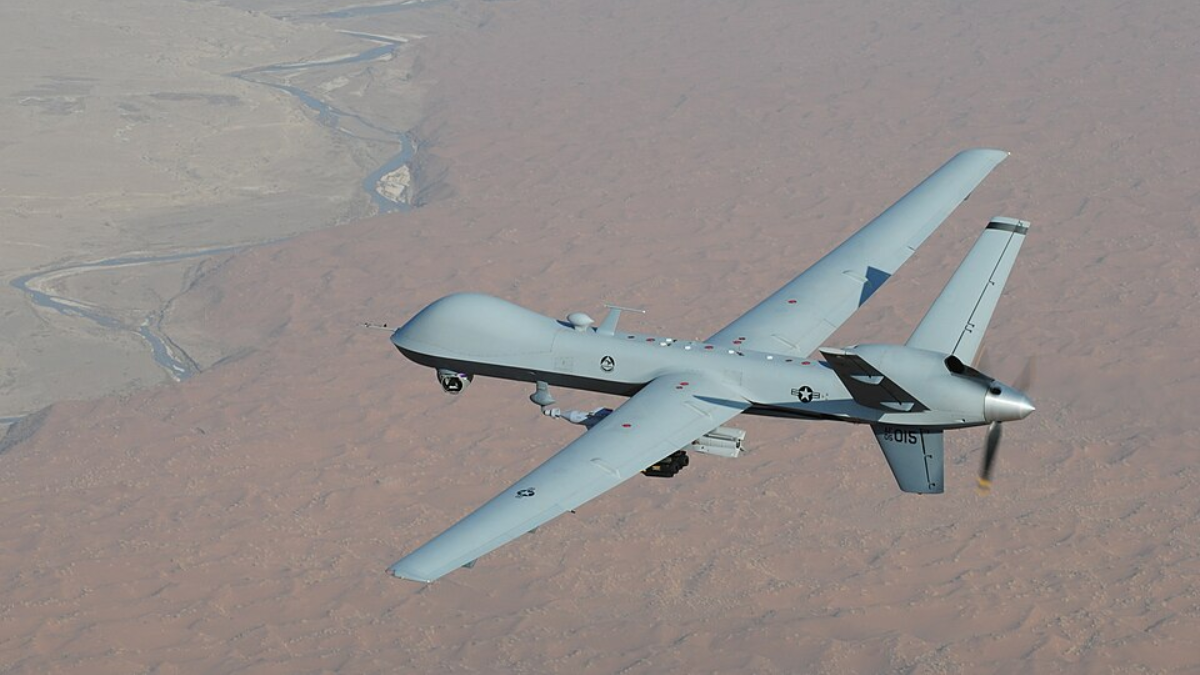
The allegations are specific. Pakistani airspace has been made available to American surveillance and strike assets, including the MQ-9B drone. Pakistan Air Force F-16s, recently upgraded with equipment that makes them operationally compatible with US Navy carrier air wings, have been flying in support of American carrier operations over the Arabian Sea. And Pakistani naval vessels, deployed since March under a merchant protection mission, have been sharing the positional data of Iranian ships with US forces.
Pakistan’s Foreign Ministry has denied all of it. “Pakistan maintains a policy of non-involvement,” one official statement read. No request for operational access, officials said, had ever been made by Washington.
The denials have not settled the matter. Those who dispute them point first not to any intercepted communication or satellite photograph, but to a procurement document.
In December 2025 — eleven weeks before hostilities between the United States and Iran began — the US Defence Security Cooperation Agency notified Congress of a $686 million arms sale to Pakistan. The package included 92 Link-16 communications terminals and Mode 5 IFF cryptographic equipment for the Pakistani F-16 fleet. To those familiar with military hardware, the significance was immediate.
Link-16 is the data-link standard used by US Navy carrier air wings. Mode 5 IFF is the identification system that allows aircraft to distinguish friend from foe at beyond-visual-range during combat. Neither has an obvious application in Pakistan’s long-running counterterrorism operations along the Afghan border. Both are exactly what you would need if Pakistani jets were going to fly alongside American ones.
The maritime picture tells a similar story. Pakistan launched Operation Muhafiz-ul-Bahr on 9 March 2026, dispatching P-3C Orion maritime patrol aircraft to protect Pakistani merchant shipping following the partial closure of the Strait of Hormuz. But officials from a regional intelligence service observed the aircraft operating well beyond the ranges needed for merchant escort, spending significant time in areas where Iranian Revolutionary Guard Corps naval assets were active. The P-3C is purpose-built to detect, track, and classify surface vessels across vast ocean areas — exactly the surveillance capability American planners would need in a theatre where Gulf states have closed their doors and US forces are operating almost entirely from carriers.
The strategic logic behind such an arrangement is not difficult to reconstruct. The United States is fighting a war in the Gulf with almost no regional basing access. Pakistan, meanwhile, emerged from a bruising military confrontation with India in May 2025 in urgent need of restored standing in Washington. It possesses airspace, coastline, and intelligence assets that fill specific gaps in American operational reach. The question, as one analyst put it, was never whether a deal would be struck, but what Pakistan would receive in return.
The apparent answer includes the F-16 upgrade package, inclusion in a new AMRAAM missile production contract, and what sources describe as quiet American diplomatic backing — among it, reportedly, President Trump’s decision to extend the Iran ceasefire on 21 April at Pakistani request.
Whether that return is worth the risk remains an open question. Iran has not publicly accused Pakistan of operational complicity. If it does — and if the accusations are backed by evidence — the consequences for a country that has spent months presenting itself to the Muslim world as a neutral peacemaker could be severe. That calculation was made in Rawalpindi. Whether it was made correctly is something only time, and Tehran, will determine.