


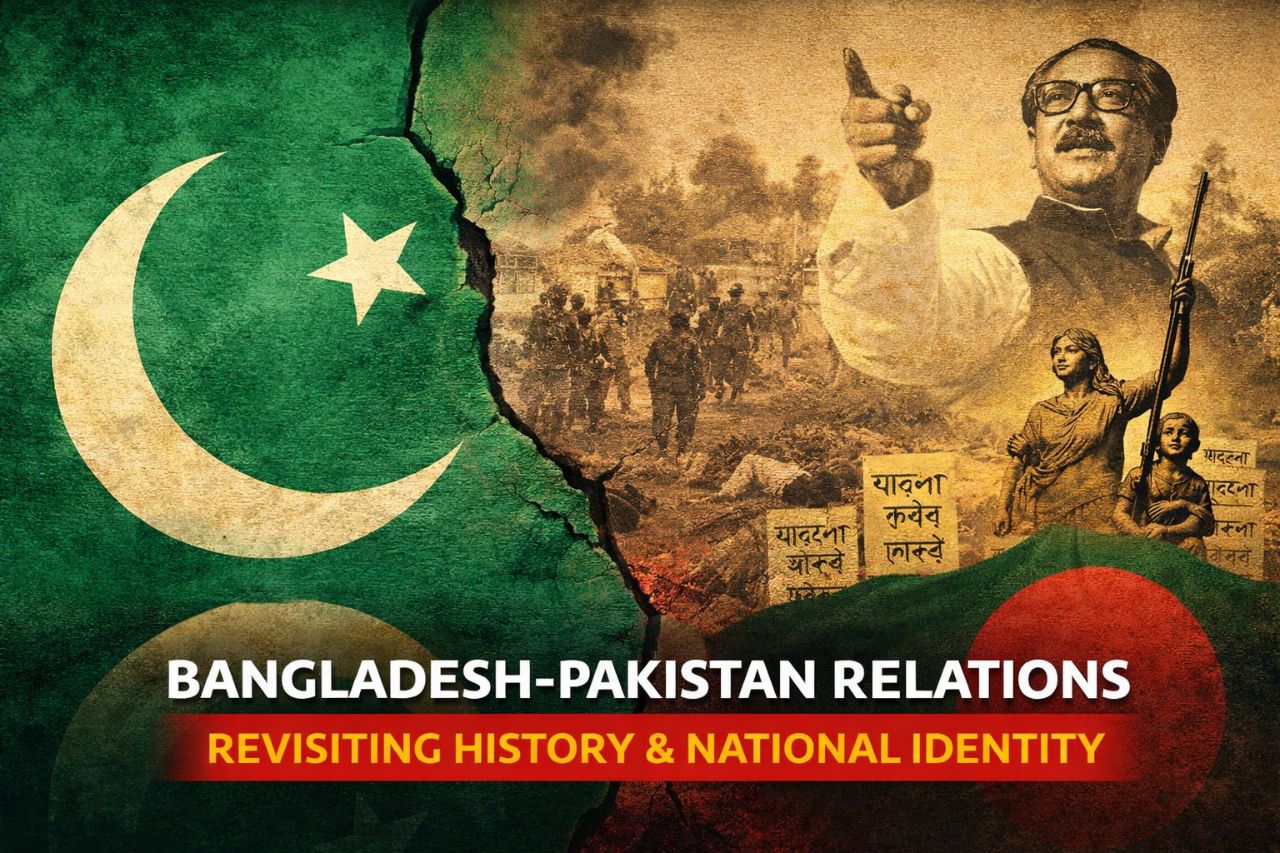
Bangladesh currently stands at a critical juncture, navigating significant domestic challenges that include severe economic pressures and intensifying political tension.
Amidst this period of difficulty, the nation has been receiving offers of assistance from various global partners.
However, the prospect of Bangladesh forming closer diplomatic and economic ties with Pakistan, while perhaps not entirely surprising to some observers, given their shared religious heritage, raises profound strategic and historical concerns.
This potential diplomatic shift risks forgetting history, which is the very foundation of the Bangladeshi state and its independent identity.
How Bangladesh National Identity is the Antithesis of Pakistan
It is a widely accepted international perception that robust bilateral partnerships are primarily built upon a shared national identity, or interest, or both.
The linkages between Bangladesh and Pakistan, as per accepted international norms, are considered disjointed, as there is a stark difference in interest and identities of both nations.
The understanding worldwide, therefore, is clear that it was the Bengali people, possessing a vibrant culture and a distinct language, who forged Bangladesh, which is distinctly separate from the Pakistani national identity.
The historical record of Bangladesh offers undeniable proof that cultural and linguistic allegiance superseded religious solidarity in the journey toward independence.
How Language, not Religion, Forms Bangladesh’s Foundation
The Bangla language and the foundational 1952 Language Movement it inspired served as the clear testing point for this truth.
This movement, where students and civilians gave their lives demanding recognition for their mother tongue, demonstrated a clear prioritising of Bengali ethnic identity over the religious-based concept of Pakistani nationhood.
The historically inclusive and vibrant culture of Bengal, a convergence of diverse traditions spanning millennia, stands in sharp and illuminating contrast to the often rigid, centralised, and militarised national narrative imposed by the Pakistani ruling elite.
There is simply no authentic, deep-seated cultural or ethnic resemblance between the two nations.
Consequently, any contemporary effort to deepen ties based purely on a shared faith is demonstrably cosmetic; it is rather a political deception designed strictly to serve a present-day agenda than reflecting any genuine historical affinity.
This superficial agreement, which is driven only by current needs, must be strictly tested against the evidence of history.
How Denied Justice, Historical Wounds Fester For Bangladesh
For the political leadership in Dhaka, pursuing friendly relations with Islamabad without first securing justice for the past constitutes a profound betrayal of the national sacrifice made by millions.
The period spanning the 1950s and 1960s was characterised by the systemic economic exploitation of East Pakistan by the ruling elite seated in West Pakistan.
This amounted to a colonial-style economic drain where the wealth generated in East Pakistan was consistently diverted to fuel the development and infrastructure of West Pakistan.
This exploitation was not merely a minor grievance; it was the primary fuel that powered the independence movement, culminating in the horrific events of the 1971 Genocide.
The launch of Operation Searchlight in March 1971 initiated a campaign of systematic slaughter.
The deliberate and widespread terror campaigns, including the targeted elimination of Bengali intellectuals, students, and nationalists, represent an act of state-sponsored brutality that is unparalleled in the region’s modern history.
To unilaterally disregard these atrocities, to overlook the absence of a genuine and formal Pakistani apology for the genocide, or to waive the long-standing issue of non-repatriation of East Pakistan’s assets, is to willfully abandon the moral high ground established by the millions who suffered and died.
It is a historical and moral giving up of standards that would undermine the very legitimacy of the nation’s struggle.
How Failed Pakistan Brings Down Bangladesh
Furthermore, most of the observers opine that any alleged helping hand offered by Pakistan today, whether economic, social, or military, must be viewed with strong strategic doubt.
Such proposals are intrinsically and primarily driven by self-interest, not selflessness.
Economically, the facts are clear that Bangladesh has emerged as a remarkable economic success story in South Asia, vastly outperforming Pakistan on nearly all key development metrics, including GDP growth, social indicators, and garment exports.
Islamabad, currently struggling with high public debt, chronic political instability, and a weak domestic growth model, is not a viable, credible economic partner.
It simply cannot offer sustainable aid that would genuinely benefit Dhaka; rather, it seeks to capitalise on Bangladesh’s hard-won stability and impressive growth trajectory.
Tying Bangladesh’s buoyant future to Pakistan’s troubled, debt-ridden past is a clear strategic mistake.
Why Bangladesh Should Keep Fundamentalism Far Away
Socially, closer alignment carries the grave risk of importing the loyalty and political fundamentalism that have destabilised and spread within Pakistan’s political landscape.
This potential cultural and social import would pose a direct and serious threat to Bangladesh’s hard-won diverse and secular values, which were core tenets of its independence movement.
The observers, therefore, caution present leadership in Bangladesh to exercise strategic restraint and wisdom before contemplating any drastic, unrealistic decision that could strategically bind the nation’s thriving future to Pakistan’s historical burdens.
The true lesson of 1971 is that cultural nationalism, non-alignment, and robust economic independence are the indispensable pillars upon which national success must be built and sustained.
The future for Bangladesh will only be bleak if this foundational lesson is ignored.
Why Bangladesh’s Present Leadership Must Worry About Legacy
The responsibility now rests heavily with the nation and its dynamic youth to resolutely reject political posturing or diplomatic maneuvers that attempt to obscure the violent truth of their national birth.
Their focus must remain singularly fixed on national progress, fostering a strong, inclusive, and globally competitive economy, upholding the secular and democratic values enshrined in their founding principles, and ultimately ensuring permanent preservation of a truly independent nation.
The strategic imperative, therefore, should be to look forward, to progress, and emphatically, not backward.