


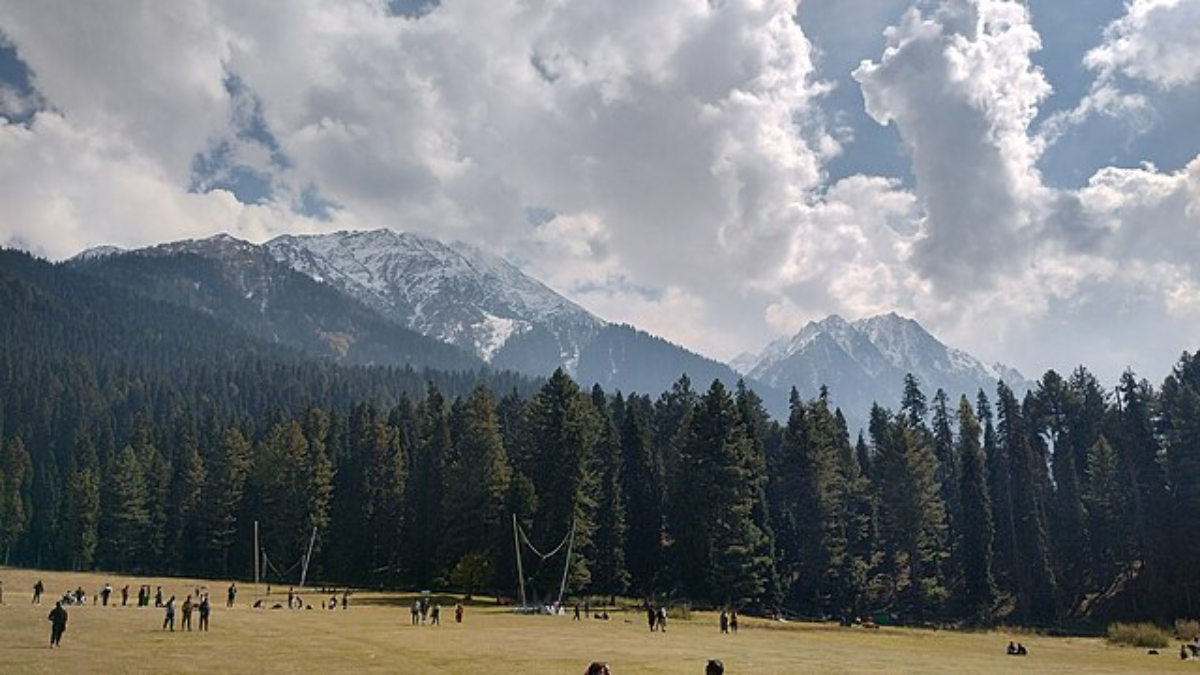
One year ago, gunmen walked out of the pine forests above Baisaran Valley and opened fire on tourists sitting in a meadow. Twenty-six people were killed, among them Lieutenant Vinay Narwal of the Indian Navy, six days into his honeymoon, Corporal Tagehalying of the Indian Air Force, and Adil Hussain Shah, a local pony operator who died shielding the very visitors he made his living from. The attack not only killed people, but it also killed a season.
Tourist arrivals in Jammu and Kashmir fell from 2.36 crore in 2024 to roughly 1.78 crore in 2025. April alone had drawn over two lakh visitors before the attack. By May and June, hotels stood empty, pony lines were idle, and the houseboat owners of Dal Lake stared at still water and unpaid bills. The wound cut deepest not in government balance sheets but in the daily lives of the hundreds of thousands of Kashmiris—guides, drivers, weavers, shopkeepers—whose livelihoods run entirely on the goodwill of visitors willing to make the journey.
That goodwill is fragile. It is also, right now, beginning to return.
Spring 2026 is seeing a cautious but genuine revival.
Gulmarg, Sonamarg, and Pahalgam are registering tourists again. Bookings for summer indicate growing confidence.
Visitors arriving at Razdan Top on the eve of this anniversary paused in silence to honour the dead, and then said they had come anyway, because Kashmir deserved to be seen. That is not sentiment. That is the most powerful economic signal the Valley has received in a year.
But confidence, once broken, does not simply mend with time. It must be actively rebuilt, and that requires confronting, without flinching, the security architecture that failed on April 22, 2025.
The nearest CRPF base to Baisaran is four to five kilometres away, on a track that takes forty minutes to navigate. The attackers had reconnoitred the site the day before and sheltered overnight barely two kilometres from the meadow. The assault lasted nearly two hours. These are not acceptable gaps in a destination that draws lakhs of civilians.
The path forward demands investment on multiple fronts. Remote tourist sites—meadows, trekking trails, high-altitude passes—require permanent security pickets, not reactive deployment after an incident. Real-time surveillance infrastructure, including drone monitoring of forest approaches to popular destinations, must become standard.
The new QR-code registration system, which has already brought over 7,000 service providers into a digital tracking network, is a meaningful step, but it is a beginning rather than an endpoint. Intelligence sharing at the district level, between local police, CRPF, and the Army, must be close to seamless, because the men who killed 26 tourists had been in the area for at least twenty-four hours before anyone raised an alarm.
Tourism is the economy in Kashmir.
One year on, the memorial on the banks of the Lidder River stands in black marble with 26 names carved into it. The most honest tribute India can pay to those names is not a candle, however sincere, but a commitment that no tourist destination in this country is left unguarded, unstaffed, and unprepared.
What the Pahalgam incident made abundantly clear is that the terrorist threat in Kashmir is deliberate, adaptive, and patient. The Resistance Front did not stumble upon a crowded meadow. It selected one, studied it, pre-positioned its operatives, and waited for the moment of maximum civilian exposure.
That level of planning points to an apparatus that continues to function with operational sophistication—drawing on cross-border sanctuaries, trained handlers, and a logistics chain that moved armed men through hundreds of kilometres of Indian territory undetected.
The neutralisation of the three Baisaran attackers in July 2025 was justice, but it was not closure. The network’s leadership remains intact. The ideology that recruits, radicalises, and dispatches men to shoot tourists in meadows has not been dismantled.
Improvised explosive devices continued to surface along infiltration routes through late 2025, and a car bomb detonated near the Red Fort in November of that year as a reminder that the threat does not confine itself to the Valley.
Most terrorist organisations possess the institutional capacity for mass civilian targeting that survives decapitation strikes, designations, and diplomatic pressure.
Counterterrorism, in this context, is a permanent condition of governance in a region where the enemy is neither defeated nor deterred, only, at best, temporarily degraded.