


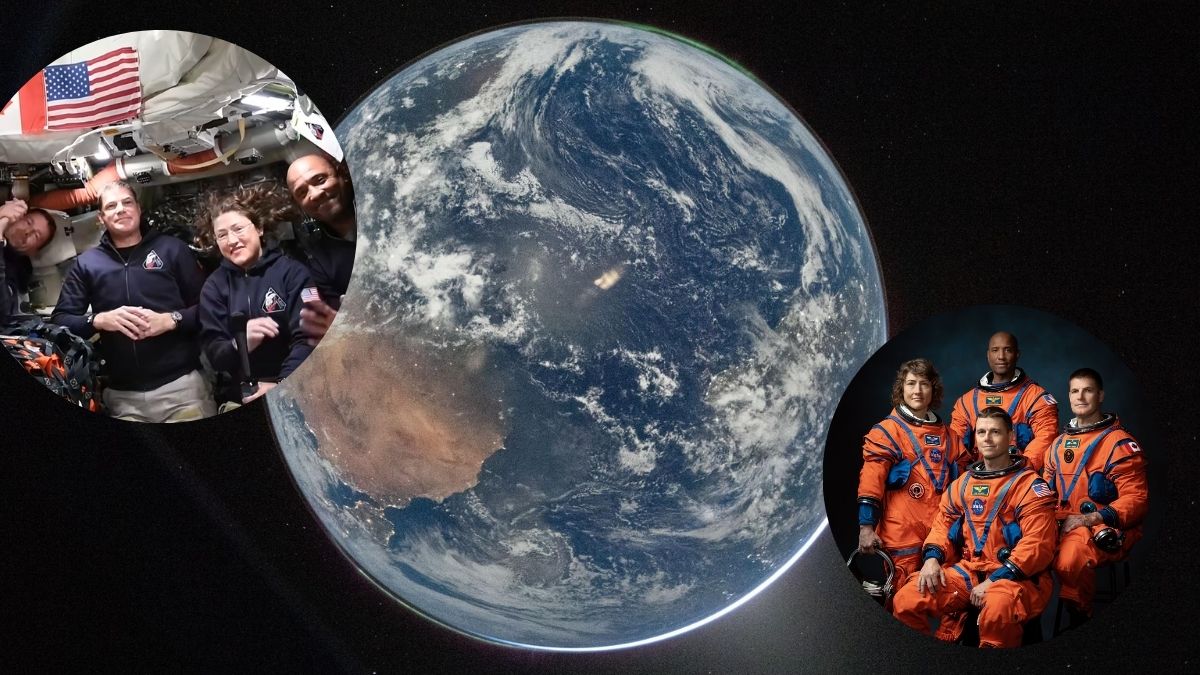
The Artemis II crew began Flight Day 5 with a critical systems test as they moved closer to the Moon, flying about 65,235 miles from the lunar surface. The day’s primary objective focused on evaluating the Orion Crew Survival System suit, a vital component designed to protect astronauts during emergencies and high-risk phases of flight.
NASA astronauts Reid Wiseman, Victor Glover, Christina Koch, and CSA astronaut Jeremy Hansen carried out a full sequence of operations, including donning and pressurising the suits, performing leak checks, simulating seat entry procedures, along with testing mobility, and ability to eat and drink in microgravity.
The suits are engineered to provide life support in case of cabin depressurisation, while also supporting astronauts during launch, re-entry, and splashdown. These spacesuits are also designed in a way that enhances mobility, communication, and thermal regulation. Sunday’s test offered engineers valuable insights into how the suits perform during extended wear in space conditions.
What are the next key milestones for the crew?
As the mission progresses, the crew is set to undertake several crucial steps – conduct an outbound trajectory correction burn, receive final lunar science observation targets, enter the Moon’s gravitational sphere of influence.
These milestones will set the stage for the mission’s most anticipated phase, the lunar flyby scheduled for Monday, April 6.
Artemis II mission day 4: What did the crew accomplish?
On Flight Day 4, the astronauts focused on final preparations for the lunar flyby, while also conducting technical tests to support mission safety and performance. The crew continued manual piloting demonstrations to assess spacecraft handling, conducted a 24-hour acoustics test to analyse onboard sound conditions, and reviewed a list of lunar surface targets identified by NASA’s science team.
The spacecraft was approximately 110,700 miles from the Moon at the time, steadily approaching its destination.
During earlier mission activities, astronauts Christina Koch and Jeremy Hansen manually controlled the Orion spacecraft for 41 minutes, testing six degrees of freedom (full motion control), three degrees of freedom (limited movement control).
These tests help engineers understand how the spacecraft performs in deep space, ensuring astronauts can safely take manual control if needed.
Another round of piloting tests is scheduled later in the mission to gather more data from different crew perspectives.
What will happen during the historic lunar flyby?
The Artemis II mission will reach a major milestone with a six-hour lunar flyby on April 6, offering a unique vantage point unlike previous missions. Some of the key highlights include Orion passing at a distance of 4,066 miles from the Moon, the crew observing the entire lunar disk, including polar regions.
Moreover, the astronauts will photograph and study impact craters, lava plains, along with surface fractures and ridges. They will analyse variations in colour, brightness, and texture to better understand the Moon’s composition and evolution.
Will the crew witness any rare space events?
Yes. They are set to see one of the most remarkable moments – a solar eclipse observed from space. As the Sun, Moon, and spacecraft align, the Artemis II crew will see the Sun disappear behind the Moon. They will study the solar corona (Sun’s outer atmosphere), and may also observe meteoroid impacts on the lunar surface.
This provides rare scientific opportunities not possible from Earth.
How far will Artemis II travel compared to Apollo missions?
The Artemis II mission is set to surpass historic Apollo-era records. Its expected maximum distance from Earth is 252,757 miles, exceeding Apollo 13’s record of 248,655 miles. This makes Artemis II one of the deepest human spaceflight missions in history.
Artemis II is NASA’s first crewed mission to the Moon in over 50 years, aimed at testing the Orion spacecraft and systems with astronauts onboard, demonstrating deep-space human operations, preparing for future Artemis missions, including lunar landings, and laying the groundwork for long-term human presence on the Moon and eventual missions to Mars.
Artemis II builds on the success of the uncrewed Artemis I in 2022. It is NASA’s first mission with crew aboard the SLS (Space Launch System) rocket and Orion spacecraft.