


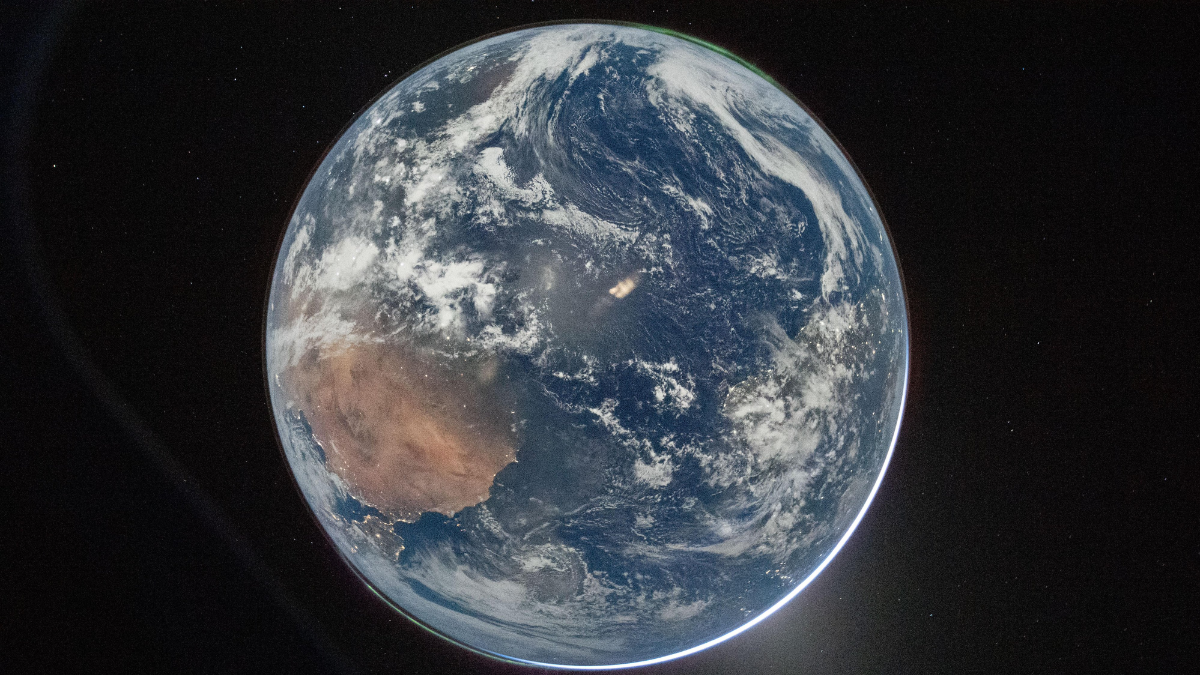
Artemis II Mission Commander Reid Wiseman has captured the first two images downlinked from NASA’s Artemis II crew—a pair of stunning photographs of Earth shot through the window of the Orion capsule as the crew charts a path toward the Moon.
Downlinking is the process of transmitting data from a spacecraft down to receivers on Earth. In the images, Earth appears whole and luminous against the darkness of deep space—vivid blues and browns filling the frame.
“There are two auroras (top right and bottom left), and zodiacal light (bottom right) is visible as the Earth eclipses the Sun,” NASA said.
The picture of Earth was taken by Wiseman from the Orion spacecraft’s window after completing the translunar injection burn. On board are NASA astronauts Reid Wiseman, Victor Glover, and Christina Koch, along with Canadian Space Agency astronaut Jeremy Hansen. The crew has named their Orion spacecraft ‘Integrity’.
On April 2, Orion’s main engine fired for roughly six minutes in a maneuver called the translunar injection burn, breaking the spacecraft free of Earth’s orbit and setting it on course for the Moon—the first time in more than 50 years that humans have ventured this far from home.
Humans have left Earth’s orbit for the first time since December 1972. The Artemis II crew is the first to venture this far from the earth in more than 50 years.
“Reid, Victor, Christina, and Jeremy now are on a precise trajectory toward the Moon,” NASA said.
The mission launched from Kennedy Space Center in Florida at 6:35 p.m. EDT on April 1. Following liftoff, Orion spent roughly 24 hours in a high Earth orbit, some 46,000 miles above the planet, while engineers on the ground completed key systems checks before clearing the crew for the translunar burn.
The planned 10-day test flight includes a lunar flyby on April 6, during which the astronauts will photograph the lunar surface, including sections of the Moon’s far side that no human has ever directly seen.
“Although the lunar far side will only be partially illuminated during the flyby, the conditions should create shadows that stretch across the surface, enhancing relief and revealing depth, ridges, slopes, and crater rims that are often difficult to detect under full illumination,” NASA said on its official website.
NASA on X: “We see our home planet as a whole, lit up in spectacular blues and browns. A green aurora even lights up the atmosphere. That’s us, together, watching as our astronauts make their journey to the Moon. https://t.co/6JkKufBgtJ” / X
The mission is part of a Golden Age of innovation and exploration, which will see NASA sending Artemis astronauts on increasingly challenging missions to explore more of the Moon for scientific discovery and economic benefits, as well as to build on our foundation for the first crewed missions to Mars, according to NASA.
Artemis II builds on the success of the uncrewed Artemis I in 2022. It is NASA’s first mission with crew aboard the SLS (Space Launch System) rocket and Orion spacecraft.