


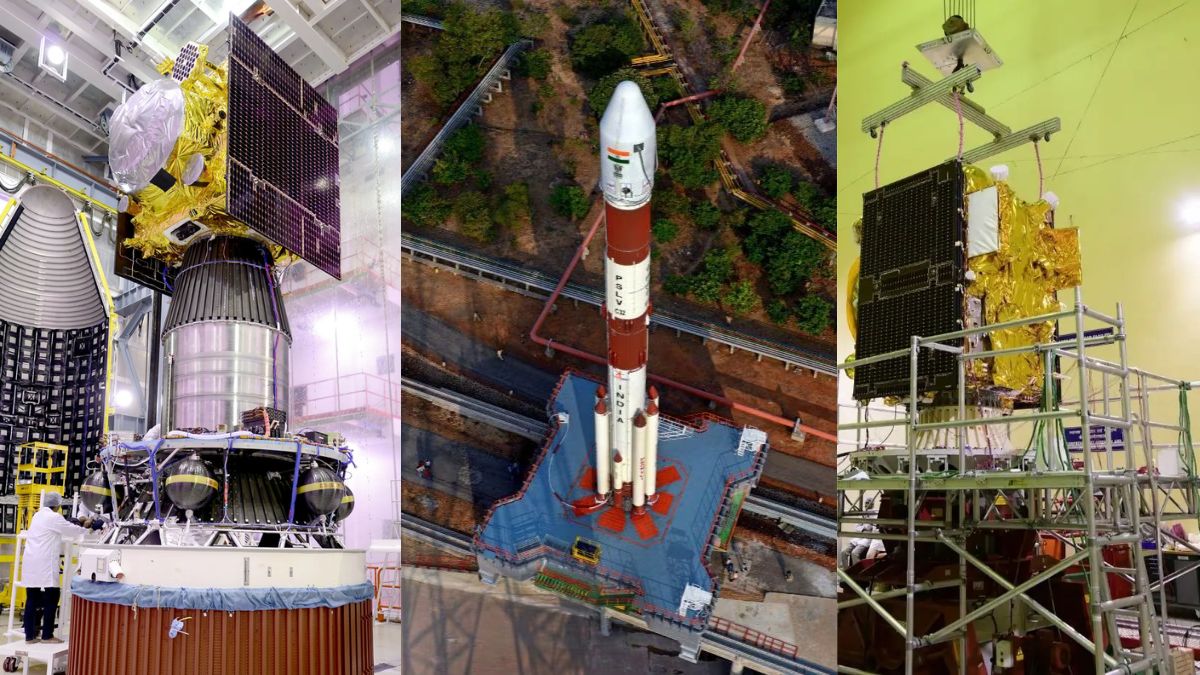
India’s indigenous navigation system, NavIC, suffered a major outage after one of the constellation’s four satellites failed after 10 years in orbit, disrupting public services such as the railways and the military.
The Indian Regional Navigation Satellite System 1F (IRNSS-1F), launched on March 10, 2016, failed after its last functional atomic clock malfunctioned, Indian Space Research Organisation (ISRO) officials said.
The IRNSS-1F suffered a setback at the end of its 10-year mission. It has been operating with only one of its three onboard atomic clocks in recent years, officials said.
NavIC requires at least four satellites to be fully functional and provide navigation services for critical government operations, including the railways and the armed forces.
“On 13th March 2026, the procured on-board atomic clock stopped functioning. However, the satellite will continue to function in orbit for various societal applications to provide one-way broadcast messaging services,” the ISRO’s statement on Friday (March 13, 2026) said.
“IRNSS-1F satellite launched in March 2016 has completed its design mission life of 10 years on 10th March 2026,” the online statement on ISRO’s website noted.
Since July 2013, ISRO has put 11 satellites into orbit for the Rs 2,250-crore NavIC system. Of these, six satellites have failed to date due to defective imported atomic clocks in the early years and orbital issues on other occasions.
In parliamentary replies to members’ questions in 2025, the Indian government stated that only four of the 11 NavIC satellites were operational for global positioning, navigation, and timing services, while the remaining satellites were in suboptimal use.
“As of now, 11 satellites have been put in orbit. Some of them are not functioning,” Minister of State for the PMO, Jitendra Singh, said in a reply in the Lok Sabha on July 23, 2025.
“At present, four satellites provide Position, Navigation, and Timing (PNT) services; four satellites are used for one-way message broadcasting; one satellite has been decommissioned after its end-of-life service. Two satellites could not reach the intended orbit,” he added.
Following the reported failure of IRNSS 1-F, the only functional NavIC satellites for PNT services are IRNSS 1-B, IRNSS 1-L, and IRNSS 1-J (NVS-01). “Location services provided by the NavIC system in India are going to be affected,” ISRO officials said.
In the parliamentary reply mentioned earlier, the government noted that “around 12,000 trains are targeted for tracking in real-time using NavIC and other GNSS constellations” and “around 8,700 trains are already equipped with NavIC along with other GNSS constellations.”
Apart from IRNSS-1F, IRNSS-1A launched on July 1, 2013, IRNSS-1C put in orbit on October 16, 2014, IRNSS-1D launched on March 28, 2015, IRNSS-1E on January 20, 2016, and IRNSS-1G on April 28, 2016, have suffered atomic clock failures.
The errors in the atomic clock on these satellites skew the positioning data by several hundred kilometres. Keeping accurate time is what enables navigation systems to determine the position on Earth through an assessment of delays in signal transmission from the satellite to the Earth stations.
ISRO began work on the IRNSS programme in 1999 during the Kargil war, when the Indian military could not use the US-owned Global Positioning System (GPS) to locate its soldiers.
The Indian government had told the Parliament in July 2025 that ISRO was working on the next-generation NavIC satellite, NVS-03, to be launched by the end of that year. “Subsequently, with a gap of six months, NVS-04 and NVS-05 are planned to be launched,” it had said.
But these timelines could not be met after the PSLV C61 failed on May 18, 2025. ISRO now plans to launch these next-generation satellites “to augment NavIC base layer constellation with enhanced features for ensuring continuity of services.”