


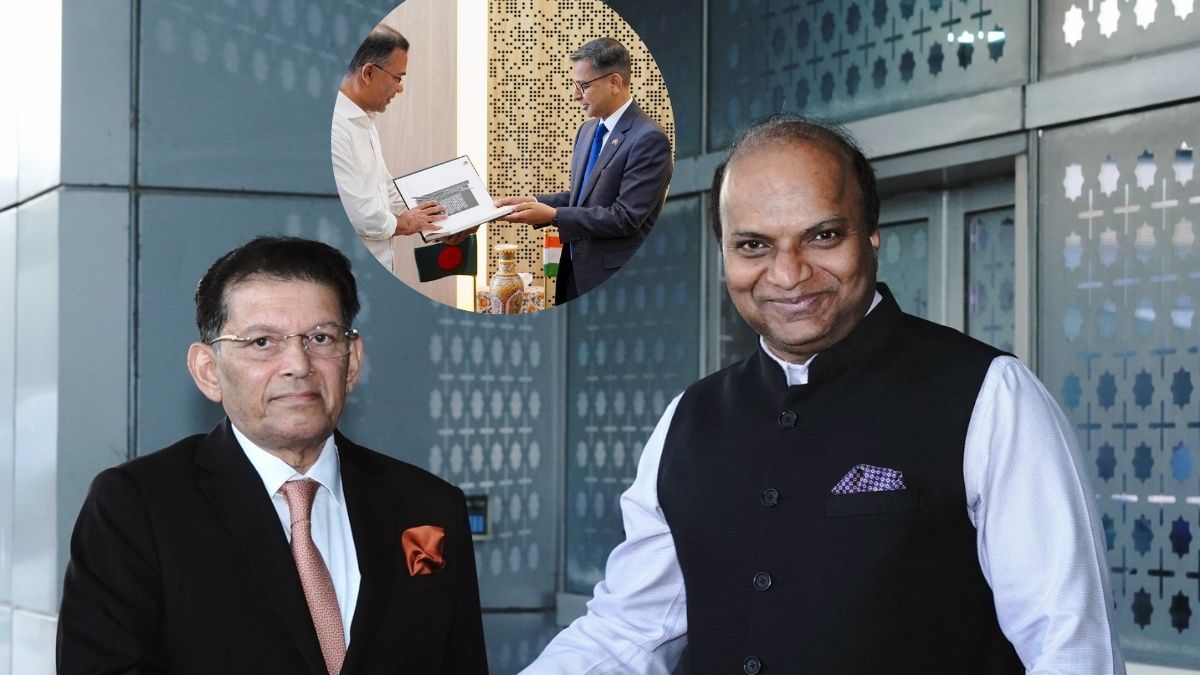
In a significant diplomatic development, Bangladesh’s senior minister Khalilur Rahman has landed in New Delhi, marking his first trip to India in many years, as both countries move to rebuild ties after a prolonged phase of tensions. The visit comes at a crucial moment, with New Delhi and Dhaka attempting to reset relations under Bangladesh’s new political leadership.
Foreign Minister Rahman received a warm welcome on his arrival in New Delhi on Tuesday (April 7, 2026). The Ministry of External Affairs shared that this visit will further bolster India Bangladesh partnership, further adding that India and Bangladesh share warm and historic ties anchored in strong people to people relations.
The latest outreach reflects a renewed willingness on both sides to stabilise ties and explore cooperation in key sectors, even as recent years saw a sharp downturn in bilateral engagement.
Khalilur Rahman India visit: Why is it significant now?
Bangladesh FM Rahman’s visit marks the first high-level ministerial engagement from Bangladesh since Prime Minister Tarique Rahman’s Bangladesh Nationalist Party (BNP) government assumed power in February 2026. This will be the first visit to Delhi by a Cabinet Minister since the BNP Government led by Tarique Rahman.
Speaking ahead of the visit, Khalilur Rahman told Bangladesh Daily Prothom Alo, “I am going to India before attending the Indian Ocean Conference. During the Delhi visit, I will meet India’s external affairs minister S Jaishankar and several other important government representatives. The discussions will focus on the future of relations between the two countries.”
“We want a normal relationship with India based on mutual respect, dignity, and interests,” he added.
What key meetings are lined up in New Delhi?
During his visit, Khalilur Rahman is expected to hold a series of high-level meetings with India’s top leadership, including External Affairs Minister S. Jaishankar, National Security Adviser Ajit Doval, Commerce Minister Piyush Goyal, along with Petroleum and Natural Gas Minister Hardeep Singh Puri.
He will be accompanied by Humayun Kabir, adviser on foreign affairs to Bangladesh Prime Minister Tarique Rahman.
The talks are expected to focus on trade, energy cooperation, security coordination, and broader regional stability, especially as India ramps up emergency supplies to neighbours affected by disruptions caused by the West Asia war.
Indian envoy meets Bangladesh PM Tarique Rahman
Just ahead of the visit, Indian High Commissioner to Bangladesh Pranay Verma met Prime Minister Tarique Rahman in Dhaka, signalling a thaw in ties. According to the Indian High Commission, both sides “discussed bilateral engagement with a focus on people-centric cooperation in multiple domains aligned with the national development priorities of the two countries.”
Verma also conveyed, “India’s intent to work together with the Government and people of Bangladesh by adopting a positive, constructive and forward-looking approach and based on mutual interest and mutual benefit.”
This meeting is being seen as a precursor to deeper diplomatic engagement in the coming months.
What led to the strain in India-Bangladesh relations earlier?
India-Bangladesh ties witnessed a sharp decline after the fall of Sheikh Hasina’s government in 2024 and the subsequent rise of an interim administration led by Muhammad Yunus. During that period, Dhaka pivoted closer to Pakistan, as anti-India rhetoric increased. Moreover, provocative remarks regarding India’s Northeast also triggered strong responses from New Delhi.
These developments led to a significant diplomatic chill between the two neighbours.
Since coming to power earlier this year, PM Tarique Rahman’s BNP government has signalled a shift towards recalibrating foreign policy under its “Bangladesh First” doctrine. While prioritising national interests, Dhaka is now seeking to stabilise relations with India through dialogue and mutual cooperation.
The current diplomatic engagements, including Khalilur Rahman’s visit, suggest a pragmatic approach aimed at rebuilding trust and restoring functional ties. This visit could mark the beginning of a gradual reset in India-Bangladesh relations, with both sides exploring a balanced and forward-looking partnership.