


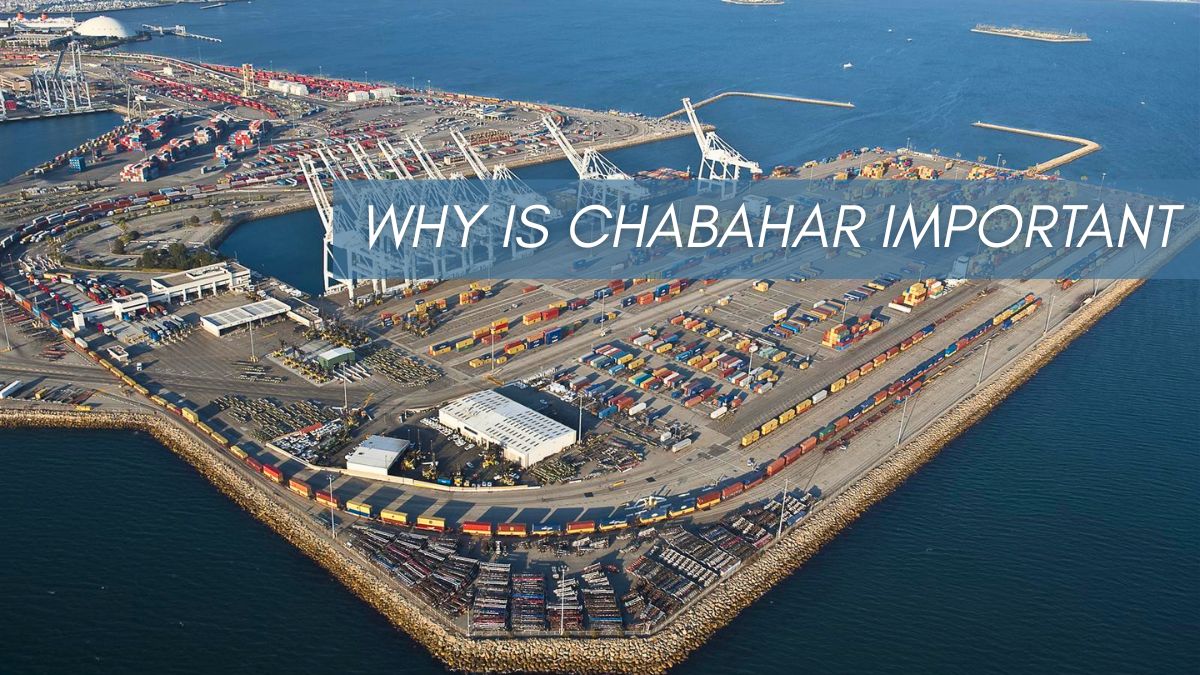
Governments come and go, but projects remain. Some become even so big that even with a change of leadership, their importance remains the same and Iran’s Chabahar Port holds a similar importance to India. India first started interacting with Iran on Chabahar Port around 2003 but a major push was received in the second half of 2014.
It was a little over 10 years ago that India and Iran signed an MoU for the development of Chabahar Port in May 2015. This MOU translated into a formal 10-year Contract for Equipping and Operating the Chabahar Port, which was executed on 23rd May 2016, during Prime Minister Narendra Modi’s visit to Tehran .
Now, as the gulf nation struggles with widespread protests, the crucial Chabahar Port is making headlines, with some reports claiming that the ambitious project has collapsed, based on US President Donald Trump’s recent comments that countries in business with Iran will face 25% tariff.
Has India exited the Chabahar Port project?
This has became the most pressing question after an Economic Times report that India has no other option but to exit the project, in view of Trump’s 25% tariffs on country’s doing business with Iran. India has, however, refuted any such claims while issuing some facts on the project.
India has firmly rejected suggestions that it may scale back or exit its involvement in Iran’s strategically critical Chabahar Port, even as regional instability intensifies and a key US sanctions waiver approaches its expiry. The Ministry of External Affairs (MEA) has made it clear that Chabahar is not a short-term project, but a long-term strategic investment.
Responding to speculation around India’s position, MEA spokesperson Randhir Jaiswal said New Delhi remains engaged with Washington to safeguard its interests as the current US Treasury-issued sanctions waiver, valid until April 26, 2026, nears its deadline.
“As you are aware, on October 28, 2025, the U.S. Department of Treasury issued guidance on a conditional sanctions waiver. We remain engaged with the U.S. side in working out this arrangement,” Jaiswal said, underlining that India’s engagement at Chabahar is ongoing.
Having said so, it must be mentioned here that the MEA didn’t clearly state or acknowledge that India has decided to exit the project, adding that govt of India is talking with US over the issue.
Why is Chabahar Port so important for India
India has already signed a 10-year contract in 2024 to operate a terminal at Chabahar and committed substantial investments, signalling that the project is designed for the long haul rather than as a temporary workaround. At the heart of India’s insistence lies geography and geopolitics.


Located on Iran’s south-eastern coast, Chabahar offers India its only viable western maritime corridor to Afghanistan and Central Asia, bypassing Pakistan, which has long denied India overland transit access. For decades, this constraint has limited India’s trade and strategic outreach westward.
Chabahar effectively removes that choke point, allowing Indian goods to reach landlocked regions without crossing hostile territory. This has been particularly crucial for humanitarian assistance to Afghanistan, where India has already used the port to ship food aid and essential supplies.
Gateway to Central Asia and Europe
Chabahar is not just a port but a key pillar of the International North-South Transport Corridor (INSTC), a multi-modal network linking India to Iran, Russia and Europe via sea, road and rail.
By cutting transit time and costs compared to traditional routes through the Suez Canal, the INSTC enhances India’s trade competitiveness and deepens its integration with Eurasian markets. The port also holds potential as a conduit for energy imports from Iran and Central Asia, helping India diversify supply routes.
The MEA on Friday asserted that India retains full control and continues development, safeguarding its strategic gateway to Afghanistan and Central Asia while bypassing Pakistan, adding that ongoing talks with the US to operationalise and extend this arrangement reflect strong diplomacy.
How Chabahar offers a counterweight in a competitive neighbourhood
Apart from offering an easy access, a gateway to Central Asia and Europe bypassing its nuclear rival Pakistan, Chabahar also has a sharp strategic edge for India. It serves as a counterbalance to China-backed Gwadar Port in Pakistan, developed under the China-Pakistan Economic Corridor (CPEC).
While Gwadar enhances Beijing’s footprint in the Arabian Sea, Chabahar ensures that India retains a strategic presence in the same maritime neighbourhood.
Chabahar also aims to be a game-changer for Indian business by providing proximity with India’s west coast, growth in trade with Central Asia, coastal shipping to help Indian companies save on logistics costs and giving the much needed impetus to petro-chemical, steel etc sectors.
How Iran protests added to the urgency
India’s firm stance on Chabahar comes even as Iran faces severe internal unrest. Protests triggered by economic distress and currency collapse have intensified, prompting New Delhi to closely monitor the security situation.
The MEA has issued multiple advisories asking Indian nationals to avoid travel to Iran and urging those already there to leave using available means, including commercial flights. Around 9,000 Indian nationals, including students, businesspersons, pilgrims, professionals and seafarers, are currently in Iran, Jaiswal said.
He added that the government will take all necessary steps to ensure their safety. Moreover, India has also sought consular access for ten Indian nationals detained by Iranian authorities, following reports that 16 Indian crew members of the vessel MT Valiant Roar were taken into custody by Iran’s Islamic Revolutionary Guard Corps (IRGC).