


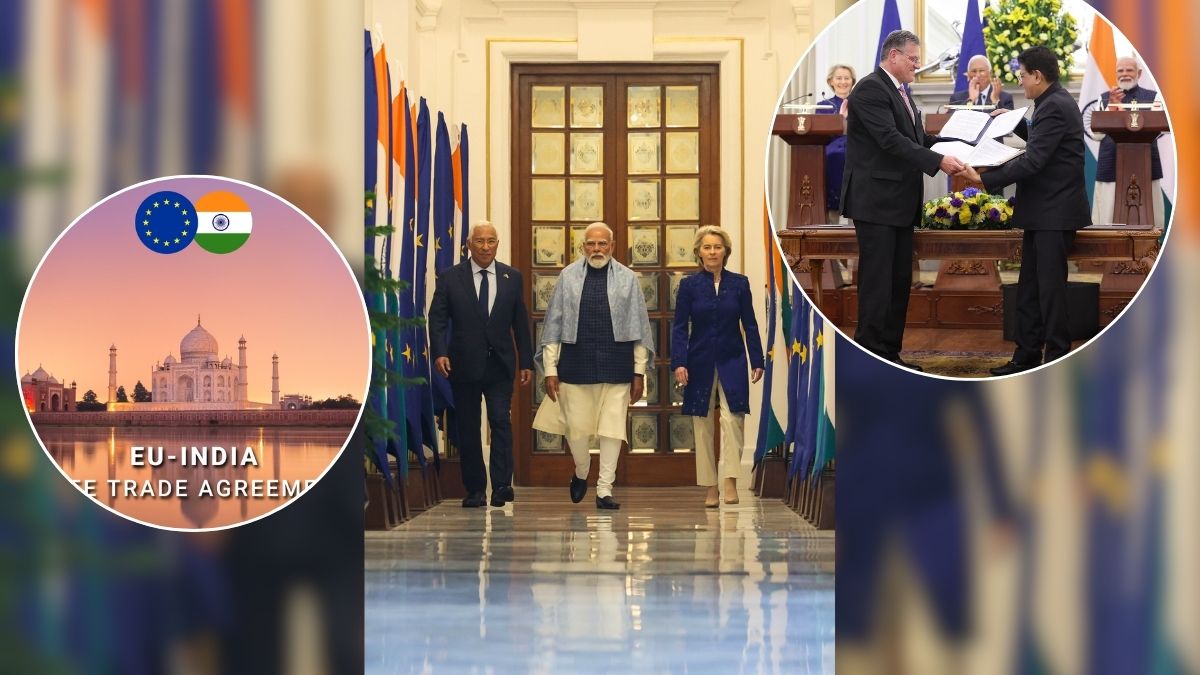
After 18 years of negotiations and a long wait, India and Europe have taken a major step forward with the signing of the highly anticipated trade deal, which is set to open new pathways for growth, investment and strategic cooperation. The deal gives preferential access to over 99% of Indian goods.
India on Tuesday (January 27, 2026) clinched one of its biggest-ever economic breakthroughs with the formal conclusion of the India–European Union Free Trade Agreement (FTA), a deal officials are calling the “mother of all trade deals” for its scale, scope and long-term impact on growth, jobs and consumer prices.


Announced jointly by Prime Minister Narendra Modi and European Commission President Ursula von der Leyen at the 16th India–EU Summit, the agreement marks a historic reset in India’s economic engagement with one of the world’s most powerful trading blocs.
Mother of all deals: Why is India–EU FTA being called a game changer?
The agreement brings together the world’s fourth-largest economy (India) and the second-largest (EU), together accounting for 25% of global GDP and nearly one-third of world trade. For India, it is among the most consequential FTAs ever signed, opening the door to the vast 27-nation European market on unprecedented terms.


After negotiations were relaunched in 2022, the deal caps years of intense diplomacy and signals strong political will on both sides to build a predictable, rules-based and future-ready trade partnership.
How big is India–EU Trade, and how much can it grow?
The European Union is already one of India’s largest trading partners. In 2024–25, goods trade touched Rs 11.5 lakh crore while services trade reached Rs7.2 lakh crore. With tariffs slashed, market access widened and non-tariff barriers addressed, officials expect trade and investment flows to scale up sharply in the coming years.


Prime Minister Narendra Modi said, “Today is a day that will be remembered forever, marked indelibly in our shared history. This is a milestone in our relations which will: Strengthen our economic ties, Create jobs for our youth, Opportunities for our businesses, Foster shared prosperity, Build stronger global supply chains.”
The historic agreement with EU is India’s largest Free Trade Agreement in history and has substantial benefits for the 1.4 billion people of India. It will make access to European markets easier for our farmers and small industries and create new opportunities in manufacturing.
European Commission President Ursula von der Leyen underlined that the the world’s two largest democracies have launched a Security and Defence Partnership. “A platform for stranger cooperation on the strategic issues that matter most – from defence industry to maritime security. This is what trusted partners do.
What does India-EU trade deal makes cheaper?
One of the most visible benefits will be lower prices and greater choice for Indian consumers.
Automobiles: A calibrated, quota-based liberalisation will allow EU carmakers to bring in high-tech, premium vehicles at lower duties, boosting competition.
Currently, an import duty of 100% is levied on European cars like Mercedes, BMW and Audi. Now, as part of the Free Trade Agreement, cars costing more than 15,000 euros (around Rs 16 lakh) will now attract a duty of 40%. This will be further reduced to 10%, slashing prices of these cars by lakhs.
Wines: European wines would also see a price reduction with the India-EU FTA. Currently, India charges an import duty of 150% on imported wine, which will now be reduced to 20%, thereby indicating a significant reduction in prices. However, this isn’t something happening tomorrow and would rather be implemented gradually over a period of 5-10 years.

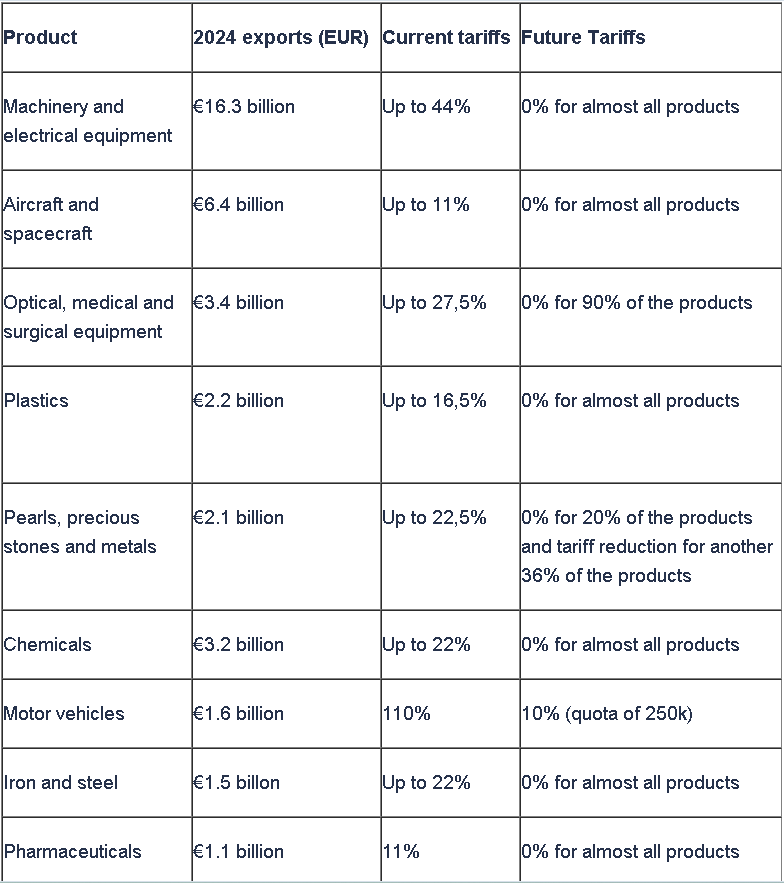
Industrial and engineering goods: Cheaper imports of advanced machinery and components are expected to support Indian manufacturing.
High-end consumer products: Reduced tariffs could lower prices of select European products over time.
At the same time, the deal preserves safeguards for sensitive sectors to protect domestic producers.

Which Indian sectors stand to gain most?
The FTA delivers zero-duty access for up to 99% of Indian exports by value to the EU, which could provide a big boost for labour-intensive industries, including textiles and apparel; leather and footwear; gems and jewellery; marine products; handicrafts; engineering goods and automobiles.
Tariffs of up to 10% on nearly $33 billion of exports will drop to zero once the agreement comes into force, sharply improving India’s competitiveness.
What’s in FTA for farmers and rural India?
India’s agriculture and processed food sectors are set for a major uplift, as the trade deal provides an enhanced access for tea, coffee, spices, fruits, vegetables and processed foods; a stronger export competitiveness and rural income growth; safeguards retained for sensitive sectors such as dairy, cereals and poultry.
The deal is designed to balance export expansion with domestic food security.
What does India-EU trade deal mean for ‘Make in India’?
Commerce and Industry Minister Piyush Goyal said the agreement strengthens the ‘Make in India’ initiative by attracting EU investment into Indian manufacturing, integrating Indian firms into global value chains, opening future export opportunities for India-made automobiles and industrial goods into Europe.
Moreover, India-made products will now find easier entry into one of the world’s most regulated and high-value markets.
Benefits for services and skilled professionals?
Services, India’s fastest-growing export, are also among the biggest winners. India-EU’s historic FTA ensures predictable access for Indian firms across 144 EU services sub-sectors, including IT and IT-enabled services; professional and business services; education and R&D; financial services; tourism and construction.
Crucially, the deal introduces a comprehensive mobility framework, easing short-term business travel and work opportunities for Indian professionals, contractual service suppliers and independent professionals across Europe.
India-EU FTA: Jobs, students and social security
The agreement creates pathways for high-value employment, supporting student mobility and post-study work opportunities. It also opens pathways for opens discussions on Social Security Agreements over the next five years and allows practitioners of Indian traditional medicine to work under home titles in select EU countries.
These measures reinforce India’s position as a global talent hub.

Moreover, the FTA goes well beyond tariffs, covering digital trade and MSMEs; Carbon Border Adjustment Mechanism (CBAM) cooperation; clean technologies, AI and semiconductors; Streamlined customs, SPS and technical standards.
Why does this deal matter strategically for India?
The India–EU FTA is India’s 22nd trade agreement and, alongside FTAs with the UK and EFTA, effectively opens up the entire European market for Indian exporters and entrepreneurs. Aligned with the vision of “Viksit Bharat 2047,” the deal positions India as a trusted, forward-looking global partner.
Unlocking preferential access of $75 billion in exports, the India-EU trade deal abolishes tariff on 9425 lines of Indian exports.