


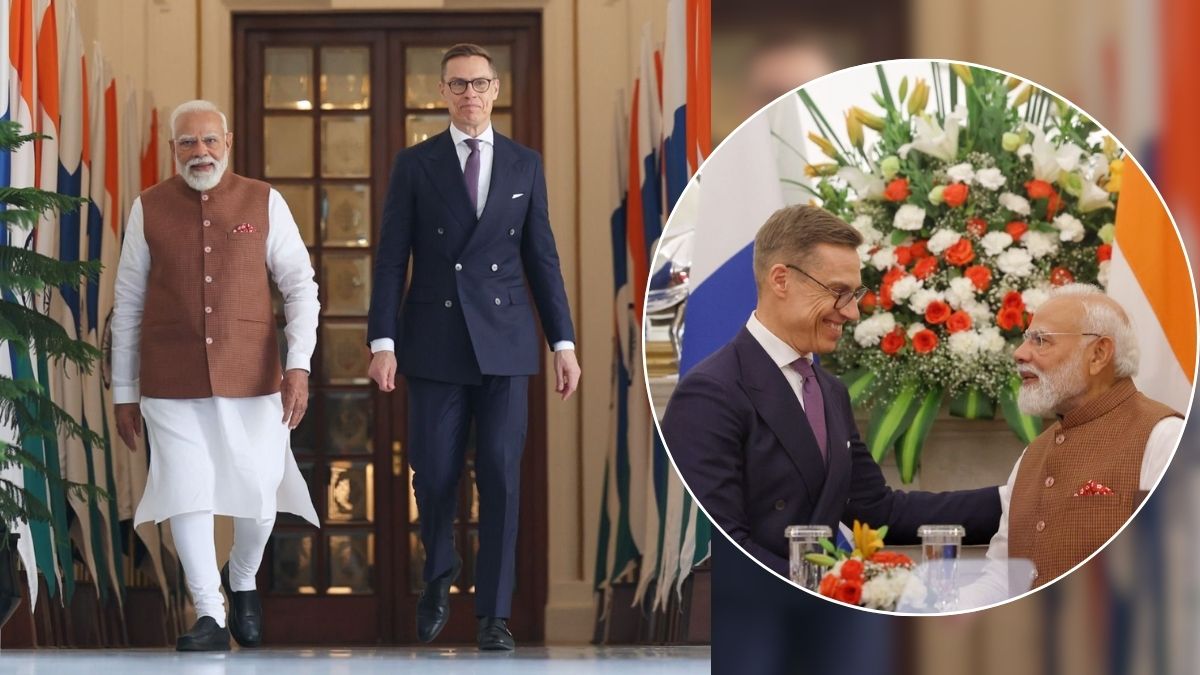
At the beginning of 2026, the historic India-European Union Free Trade Agreement was concluded. Dubbed as ‘mother of all deals’, this agreement will further strengthen trade, investment, and technology cooperation between India and Finland. Taking another step in boosting their ties, Prime Minister Narendra Modi on Thursday (March 5, 2026) met Finnish President Alexander Stubb.
India and Finland are important partners in areas such as digital technology, infrastructure, and sustainability. In their latest meeting, PM Modi and Stubb elevated bilateral ties to a “Strategic Partnership in Digitalization and Sustainability”, marking a major step in India’s engagement with Northern Europe.
The development comes around a month after the landmark India-EU FTA announcement, which is expected to significantly deepen India’s economic and technological collaboration with European nations, including Finland.
PM Modi and Finnish President Stubb held wide-ranging talks covering trade, technology, innovation, mobility, climate cooperation and global security, setting an ambitious roadmap for the next phase of India-Finland relations.
What did PM Modi say about global conflicts?
Amid escalating tensions in West Asia and the ongoing Russia-Ukraine war, Prime Minister Modi reiterated India’s consistent position that diplomacy must prevail over conflict. “India and Finland both believe in the rule of law, dialogue and diplomacy. No issue can be resolved through military conflict alone,” he said in his joint statement after talks.
The Prime Minister emphasised that both countries support swift diplomatic efforts to end conflicts in Ukraine and West Asia, underlining their shared commitment to peace and stability.
What is the new India-Finland Strategic Partnership?
The centrepiece of the meeting was the launch of the Strategic Partnership in Digitalization and Sustainability, designed to strengthen cooperation in advanced technologies and green development. According to PM Modi, the partnership will accelerate collaboration in several cutting-edge sectors, including Artificial Intelligence (AI), 6G telecommunications, quantum computing, clean energy technologies, digital infrastructure.
“This partnership—from AI to 6G telecom, from clean energy to quantum computing—will give momentum to cooperation in many high-tech areas,” PM Modi said.
Calling India an important partner for Finland, President Stubb stated that the state visit will further deepen the cooperation in the fields of trade, the economy, science and innovation. “The newly signed EU–India Free Trade agreement opens new opportunities for both countries,” he added.
How will the India-EU FTA benefit Finland-India ties?
Both leaders highlighted that the India–EU Free Trade Agreement would create fresh opportunities for trade and investment between India and Finland. PM Modi noted that the agreement will strengthen economic cooperation, boost technology partnerships and improve market access for companies in both countries.
Officials said the two sides have also set a target to double bilateral trade by 2030, signalling strong confidence in future economic growth.
PM Modi-Alexander Stubb meeting: What key agreements were signed?
Several memorandums of understanding (MoUs) and cooperation frameworks were signed or renewed to expand collaboration across multiple sectors. Key agreements include:
Migration and Mobility Partnership – This agreement aims to facilitate movement of skilled professionals and students, especially as Finland becomes an increasingly popular destination for Indian tech talent.
Renewal of Environmental Cooperation MoU – The renewed pact expands collaboration in sustainability sectors such as bioenergy, Waste-to-energy technologies, renewable power storage systems, green hydrogen, wind, solar and small hydro energy.
Statistics Cooperation Agreement – The agreement promotes data-sharing, best practices and institutional cooperation in official statistics.
What new initiatives were launched in technology and innovation?
Technology cooperation emerged as a key pillar of the partnership. Major new initiatives include the following:
Joint Working Group on Digitalization – This cross-sectoral platform will promote cooperation in emerging technologies such as 5G, 6G, AI, quantum communications and high-performance computing.
India-Finland Joint Task Force on 6G – The task force will focus on next-generation telecom technologies, an area where Finland is considered a global leader.
Indo-Finland Startup Corridor – The initiative aims to connect startup ecosystems of both countries through joint participation in major innovation events such as Slush Helsinki, Startup Mahakumbh in New Delhi.
How will India-Finland people-to-people ties improve?
To strengthen social and professional exchanges, the two countries also announced steps to enhance mobility and consular cooperation. Key initiatives include establishment of a Consular Dialogue between foreign ministries, expanded opportunities for Indian professionals and students in Finland, enhanced collaboration between universities, startups and research institutions.
India and Finland also agreed to co-host the World Circular Economy Forum in India in 2026, in collaboration with the Finnish Innovation Fund SITRA and India’s Ministry of Environment, Forest and Climate Change. The event is expected to become a major global platform for promoting sustainable economic models and circular economy practices.