


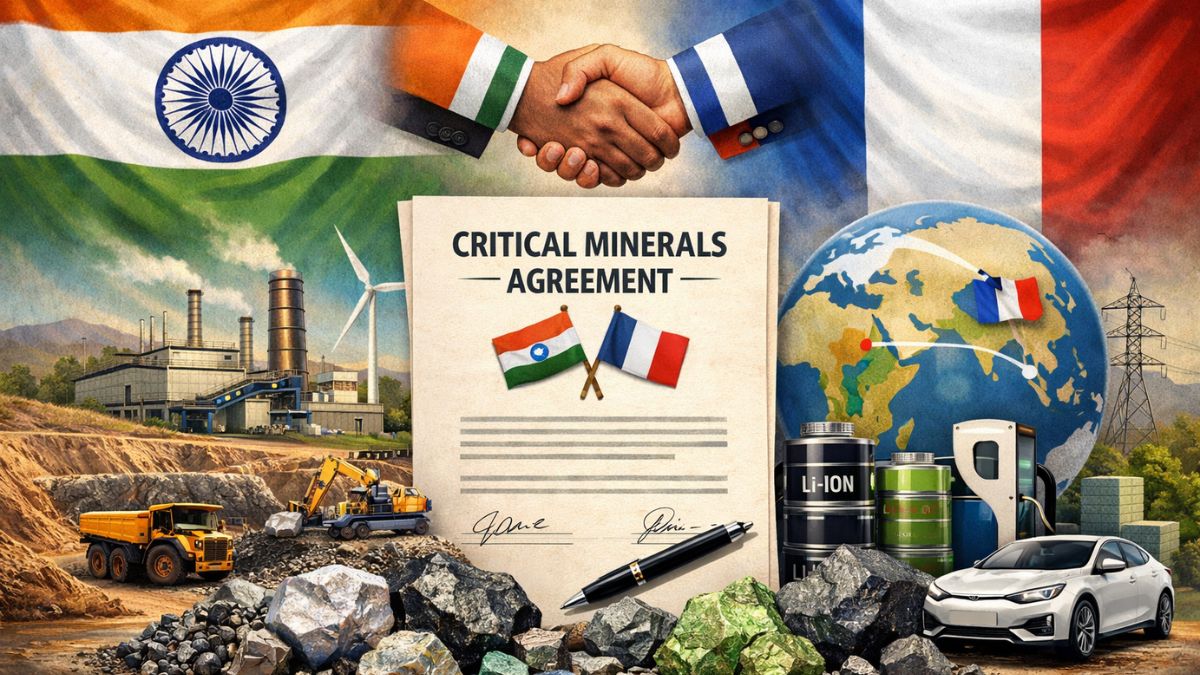
Several countries are taking steps to counter Chinese influence in rare earths and critical minerals, seeing their importance in modern day tech and AI data centres. India and France too have moved to deepen strategic cooperation in critical minerals and advanced technologies.
Prime Minister Narendra Modi and French President on Tuesday (February 17, 2026) announced a Joint Declaration of Intent that could significantly reshape supply chains for rare earths and high-tech materials. The announcement followed high-level bilateral talks between the two leaders in Mumbai, meetings that produced a series of major agreements spanning defence, innovation, clean energy, taxation, and Indo-Pacific cooperation.
At a time when global competition for lithium, cobalt, rare earths and other strategic resources is intensifying, the India-France push signals a coordinated effort to secure diversified and resilient supply chains.
Why India-France are collaborating for critical minerals?
According to the joint statement, PM Modi and President Macron agreed to deepen cooperation in the exploration, extraction, processing and recycling of critical minerals and rare earths. The leaders acknowledged that such minerals are indispensable for electric vehicles and battery storage; renewable energy infrastructure, semiconductor manufacturing, defence technologies, along with advanced electronics and AI systems.
Indian Ambassador to France Sanjeev Kumar Singla confirmed the signing of a Joint Declaration of Intent on cooperation in critical minerals, alongside plans to constitute a Joint Advanced Technology Development Group.
At a time when supply chains are vulnerable to geopolitical disruptions, both nations are seeking to build “diversified, sustainable, responsible and resilient” mineral ecosystems.
What other tech initiatives were announced?
Beyond minerals, the two countries agreed to establish a Joint Advanced Technology Development Group, a Centre on Advanced Materials, via a Letter of Intent between India’s Department of Science and Technology and France’s CNRS (National Centre for Scientific Research).
CNRS is one of the world’s largest scientific research institutions, particularly in basic and materials science research.
The collaboration aims to accelerate research in advanced materials, crucial for defence platforms, aerospace systems, quantum technologies and next-generation energy storage.
In addition, both sides signed an amendment to the Double Tax Avoidance Agreement, aimed at improving ease of doing business and boosting cross-border investments.
How does this fit into the Modi-Macron strategic reset?
The critical minerals pact builds on broader outcomes from the Modi-Macron meeting in Mumbai, where the two leaders inaugurated the India-France Year of Innovation 2026, expanded defence and industrial cooperation, discussed clean energy and space collaboration, and reaffirmed Indo-Pacific strategic alignment.
PM Modi described India-France ties as partnerships “for global stability and progress,” while Macron highlighted their growing strategic convergence.
Why do critical minerals matter more than ever?
Global demand for critical minerals has surged significantly due to a range of factors including the clean energy transition, expansion of electric mobility, digital infrastructure growth, strategic competition among major powers.
China currently dominates several stages of rare earth processing and battery supply chains. Western nations and emerging economies are racing to diversify sourcing and reduce vulnerabilities.
For India, securing access to critical minerals is essential to meet climate goals, boost domestic manufacturing, strengthen defence self-reliance, and support the semiconductor and electronics production, among other things.