


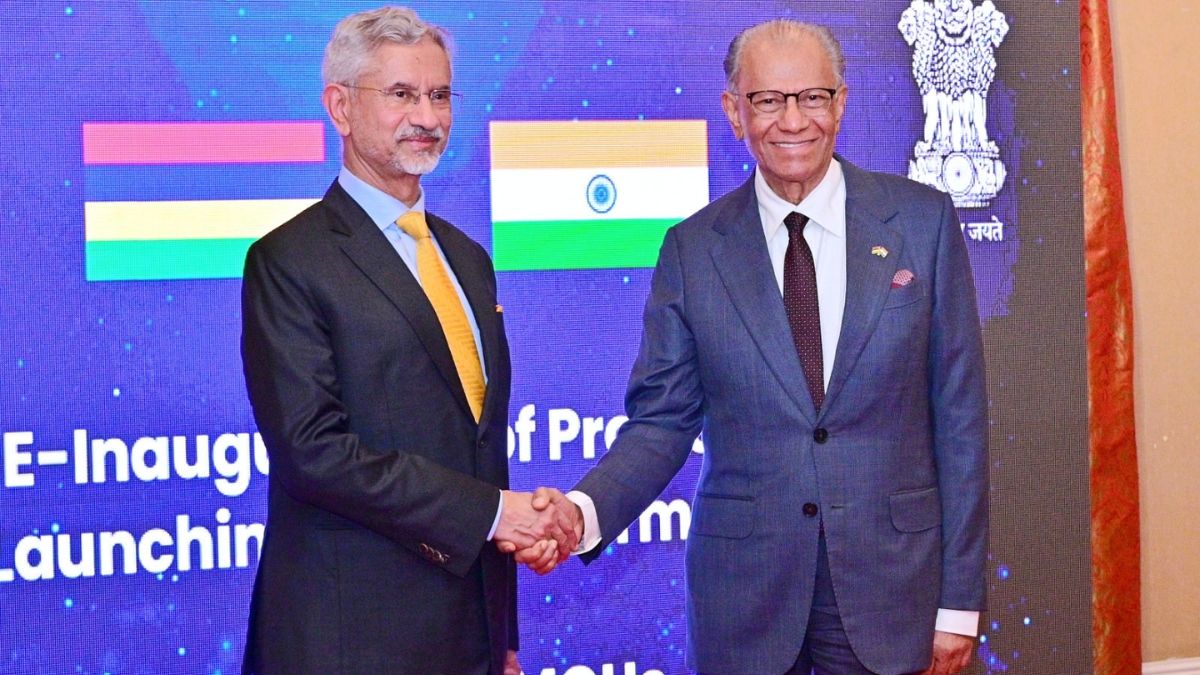
Against the backdrop of severe disruptions in global energy markets due to the conflict in West Asia, India has announced a major step to stabilise energy supplies in the Indian Ocean region. External Affairs Minister S Jaishankar, during his visit to Mauritius, revealed that New Delhi is in the final stages of concluding a government-to-government agreement for the supply of oil and gas to the island nation.
The move signals India’s expanding role as a regional energy stabiliser at a time when supply chains remain fragile despite a ceasefire in parts of the conflict zone. Foreign Secretary Vikram Misri, currently on his 3-day Washington visit, met with Energy Secretary Chris Wright, with the discussions focusing on advancing energy security, deepening bilateral energy trade.
Even though Iran allowed “friend” India-flagged vessels to transit through the Strait of Hormuz during the blockade, India is continuing to boost ties and agreements in this space so that there are enough oil and gas reserves in times of crisis.
Jaishankar Mauritius visit: Oil and gas cooperation
EAM Jaishankar, in his address to the media, underscored the urgency of energy collaboration, stating, “Our ‘Enhanced Strategic Partnership’ today truly extends across all sectors. The ongoing crisis in West Asia, as the Prime Minister reminded us, has underscored the importance of strategic partnerships, especially in the energy sector.”
“We are finalising a Government-to-Government agreement for the supply of oil and gas, which will play an important role in reinforcing energy security for Mauritius,” he further shared.
Mauritius Prime Minister Navinchandra Ramgoolam confirmed the development, saying, “We are in the process of finalising a government-to-government agreement on oil and gas.” This agreement comes as nations worldwide scramble to secure reliable fuel sources amid volatility triggered by the Iran-Israel-US conflict.
How is India positioning itself as a regional energy provider?
India’s outreach to Mauritius is part of a broader strategy to support neighbouring and partner countries during the energy crisis.
Around 38,000 metric tonnes of fuel were sent to Sri Lanka last month while 5,000 tonnes of diesel supplied to Bangladesh, with more planned. These moves highlight India’s growing role as a dependable energy partner in the subcontinent and the Indian Ocean region, cushioning allies from global supply shocks.
What defence-related announcement adds strategic weight to the visit?
In a parallel strategic development, Jaishankar announced that India will soon position a Defence Attache in Mauritius. “I am also happy to announce that we would be very soon positioning a Defence Attache in Mauritius. This will surely strengthen our growing engagements,” he stated.
This step is expected to deepen maritime security cooperation in a region critical for global trade and energy routes.
How does this tie into the broader India-Mauritius partnership?
The visit reinforced the “Enhanced Strategic Partnership” established during Prime Minister Narendra Modi’s Mauritius visit in March 2025. EAM Jaishankar highlighted cooperation across sectors like defence, energy, healthcare, education, and development. India’s engagement aligns with its Neighbourhood First policy and its outreach to the Global South.
Other than this, several initiatives were launched and expanded during the EAM’s Mauritius visit:
Community Development: 100 projects underway; 11 inaugurated; Phase II worth 500 million Mauritian Rupees announced
Healthcare: Renal Transplant Unit inaugurated; support for multiple facilities; upcoming AYUSH Centre of Excellence
Education: New agreement between UGC India and Mauritius’ Higher Education Commission
Renewable Energy: Solar projects and electric bus initiatives
Digital Governance: Mauritius to become the first country with the iGOT Karmayogi platform for civil servants
What did Mauritius say about India’s support during the crisis?
Prime Minister Ramgoolam expressed strong appreciation for India’s consistent backing, “India has always stood by us, especially in trying moments of our history. India’s support is indeed a glimmer of hope at such a difficult moment, when the world is going through an unprecedented turmoil and when all countries are reeling under the impact of the war in the Middle East.”
He added, “We both strongly believe that it is only through diplomatic channels that this crisis will come to an end.”
With energy security emerging as a central geopolitical concern, India’s move to secure and supply oil and gas to partners like Mauritius reflects a broader strategic shift, from being a major energy importer to becoming a regional energy anchor.