


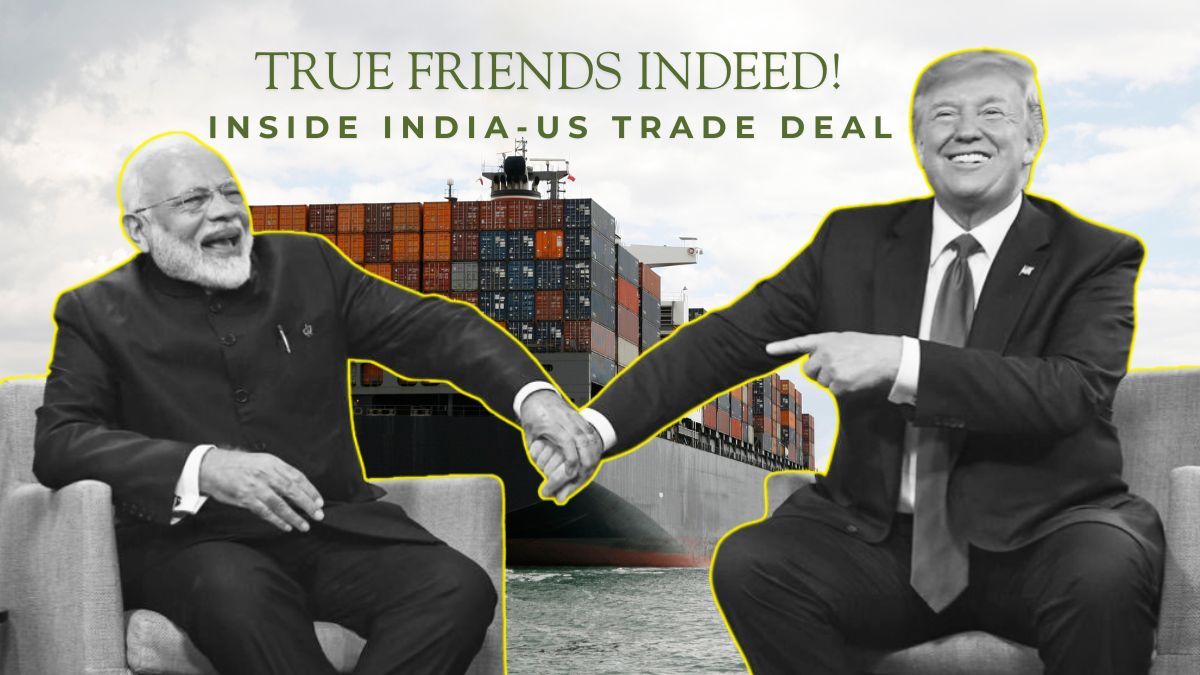
India’s tryst with the highly anticipated US trade deal finally happened, with Presidend Donlad Trump proving that he considers Prime Minister Narendra Modi a good friend indeed! In a move that surprised trade watchers and industry alike, India and the US announced a fresh trade deal on Monday night (February 2, 2026).
Long in the offing, the India-US trade deal comes just around a week after the India-EU Free Trade Agreement signed last week and sharply reduces US tariffs on Indian goods to 18% from 50%. The announcement came not through formal channels, but via US President Donald Trump’s social media post following a phone call with PM Modi.
The first hint was dropped by senior Trump aide and US Ambassador to India Sergio Gor. Emerging as the key architect behind the sudden breakthrough in India-US trade talks, Gor last night informed that PM Modi and US President Trump have engaged in a phone call, asking everyone to ‘stay tuned’.


While Trump has often called PM Modi his friend, it was Gor who once again stressed that “President Trump genuinely considers Prime Minister Modi a great friend!”, after the deal was announced by Trump. He told CNN-News18 that the deal is because of the personal rapport between Trump and PM Modi.
India-US trade deal: What has been agreed?
Neither government has yet released a detailed agreement, adding to the intrigue around a deal that could reshape India’s trade positioning at a time of intensifying global tariff wars. However, some talk points have been made public.
According to US President Trump, Washington has agreed to slash tariffs in exchange for India halting purchases of Russian oil, lowering trade and non-tariff barriers, and significantly ramping up imports from the United States. Trump said India would now source oil from the US and potentially Venezuela.
He added that New Delhi has also committing to “BUY AMERICAN at a much higher level”, including more than $500 billion worth of US energy, coal, technology, agricultural and other products.


PM Modi welcomed the announcement, saying, “Delighted that Made in India products will now have a reduced tariff of 18 per cent,” and described the deal as one that unlocks opportunities when “the world’s largest democracies work together.” “He again thanked Trump on behalf of the 1.4 billion people of India for this wonderful announcement.
How does India-US trade deal change our position against peers?
The revised tariff structure places India among the most favoured Asian trading partners of the US, giving it a clear advantage over regional competitors.
China: 34–37% tariffs
Vietnam & Bangladesh: 20%
Indonesia: 19%
Pakistan: 19%
At 18%, India now undercuts most competing export economies in Asia, improving its attractiveness for global supply chains looking to reduce dependence on China. However, India still faces slightly higher duties than some advanced economies such as the EU, Japan and South Korea, which enjoy tariff rates of around 15%, and the UK at 10%.
US tariff cut impact Indian exporters and manufacturing
For Indian exporters, particularly in sectors like engineering goods, textiles, pharmaceuticals, electronics and chemicals, the tariff cut could translate into improved price competitiveness in the US market. It strengthens India’s pitch as a China+1 manufacturing destination, especially as US maintains steep tariffs on Beijing.
The deal also signals growing strategic convergence, with trade, energy security and geopolitics increasingly intertwined in US–India relations.
While welcoming the trade deal announcement, External Affairs Minister S Jaishankar underlined that this will create more jobs, spur growth and promote innovation in both economies. It will strengthen ‘Make in India’ endeavors and encourage trusted technology ties.
“The opportunities in our economic engagement are truly vast and we are confident of realizing them. A robust economic relationship is the strongest foundation for our strategic partnership,” he noted.
What remains unclear about India-US deal?
Despite the headline-grabbing announcement, key details remain missing. There is no official notification yet from the White House, no Federal Register notice, and no clarity on when the lower tariffs will take effect, timelines for India ending Russian oil imports, which specific trade barriers will be reduced or whether India has committed to large-scale US investments.
India, the US, and Russia have also not issued formal statements clarifying the energy-related commitments.
Defence Minister Rajnath Singh called it a “landmark moment”, saying this would mark the opening a new chapter of deeper and greater economic cooperation. “With this agreement, India-US economic ties are set to reach new heights,” he posted on X.
India-US bilateral trade: An overview
Both the sides have been working hard on a bilateral trade agreement (BTA) since February 2025, eyeing $500 billion in trade by 2030. India currently has the US as its largest trading partner, with bilateral trade valued at $131.84 billion.
India’s top exports to the US include engineering goods, electronic goods, gems and jewellery, pharmaceutical products, light crude oil and petroleum, electrical, and others. India’s export to the US increased from US$ 77.51 billion in FY24 to US$ 86.51 billion in FY25.
On the other hand, imports from the United States rose to $ 45.69 billion in FY25 as India imported 5,695 commodities in the fiscal. India’s top imports from the US include mineral fuels, mineral oils and products of their distillation; natural or cultured pearls, precious or semiprecious stones, pre.metals, clad with pre.metal and articles, nuclear reactors, boilers, machinery and mechanical appliances, electrical machinery.
Trade deal with US a strategic win for India
Even with unanswered questions, the tariff reset marks a strategic gain for India at a time when protectionism is reshaping global trade. By securing lower duties than most Asian peers, India has positioned itself more favourably in US supply chains, potentially boosting exports, attracting investment, and reinforcing its role as a key economic partner.
If implemented as announced, the deal could become a defining moment in India–US trade relations, blending diplomacy, economics and geopolitics in a rapidly fragmenting global order.