


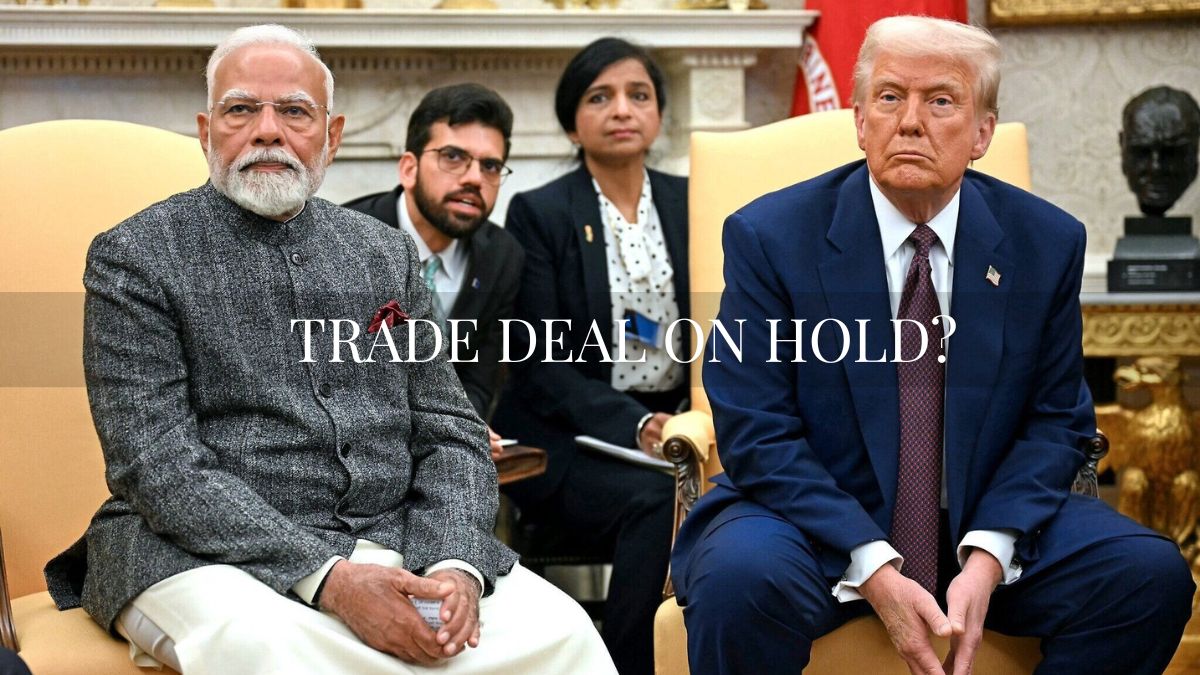
US President Donald Trump had in early February 2026 made a surprise announcement when he shared that they have reached a trade agreement with India that would reduce some of the punishing tariffs, which reduced the levy on India to 18% from 50%. The update, which came just a few days after the India-EU FTA announcement, sent a wave across the country.
However, the highly anticipated trade deal, which came after years of negotiations, is now in limbo again. In a significant development for India’s global trade ambitions, the much-anticipated India-US trade deal has been delayed, with officials confirming that the agreement will now be signed only after the United States finalises its new tariff framework.
Commerce Secretary Rajesh Agrawal said the timing of the pact hinges on clarity from Washington, following a US Supreme Court ruling that struck down key tariff measures introduced earlier. “The deal will be finalised once the tariff structure is in place,” Agrawal said during a trade briefing on Monday (March 16, 2026).
Agrawal underlined that trade agreements depend heavily on comparative tariff advantages. The announcement comes as a surprise, especially since both sides had finalised the framework for the first phase of the deal just last month, raising expectations of an imminent signing.
India-US trade deal timeline: What changed?
Delay in the much-awaited India-US trade deal is rooted in a major shift in US trade policy. A Supreme Court ruling against tariffs imposed under the International Emergency Economic Powers Act (IEEPA) effectively reset the tariff landscape, forcing Washington to redesign its approach.
In response, the Trump administration has introduced a temporary 10% tariff on all countries for 150 days (from February 24), shifted tariffs under Article 122, linked to balance of payments concerns. Following this, the US administration also begun recalibrating its broader tariff regime.
This uncertainty has made it difficult for India and the US to lock in final terms, as tariff levels determine the competitive edge Indian exports will enjoy in the American market.
Why tariffs are central to India-US trade deal
Officials emphasised that the agreement cannot be finalised without clarity on how India’s tariff rates compare with other countries. Under the earlier framework, the US had proposed reducing tariffs on Indian goods to around 18%. However, that figure is now fluid.
“If other countries end up with tariffs of 19–21%, India may remain at 18%. But if tariffs for others are lowered, India’s rate could also change,” an official explained.
This means the final deal will depend on where India stands relative to global competitors, not just bilateral negotiations. “Any deal that we sign has to be around a tariff structure or comparative advantage that India gets in the US market,” the official noted, adding that the US is working to recreate a tariff pathway.
Negotiations continue, legal finalisation paused
The two countries were expected to finalise the legal text and sign the agreement in March, but those plans have now been postponed. Agrawal confirmed that chief negotiators’ meeting has been deferred, talks are ongoing to resolve pending issues, India is using the delay to iron out finer details.
“We are using this time constructively so that these issues do not delay the agreement once the time is right,” he stated.
Key issues still under discussion
Beyond tariffs, several critical trade concerns remain unresolved, including non-tariff barriers impacting market access, provisions under Section 232 tariffs (linked to national security), regulatory and compliance frameworks. Adding another layer of complexity, the US has launched a Section 301 investigation into alleged unfair trade practices by India and 15 other economies.
This move could potentially lead to new tariffs, import restrictions, suspension of trade concessions, all of which could influence the final contours of the deal.
Meanwhile, even as talks with Washington continue, India is actively diversifying its trade partnerships. The government is currently negotiating six Free Trade Agreements (FTAs) with Australia, Sri Lanka, Peru, Chile, Eurasian Economic Union (EAEU), Israel.
Deal still on track, but with new variables
Despite the delay, officials on both sides indicate that the India-US trade deal remains on track, though its timeline is now tied to evolving global trade dynamics. The agreement is seen as a cornerstone of deepening economic ties between the two countries, especially amid shifting supply chains and geopolitical realignments.