


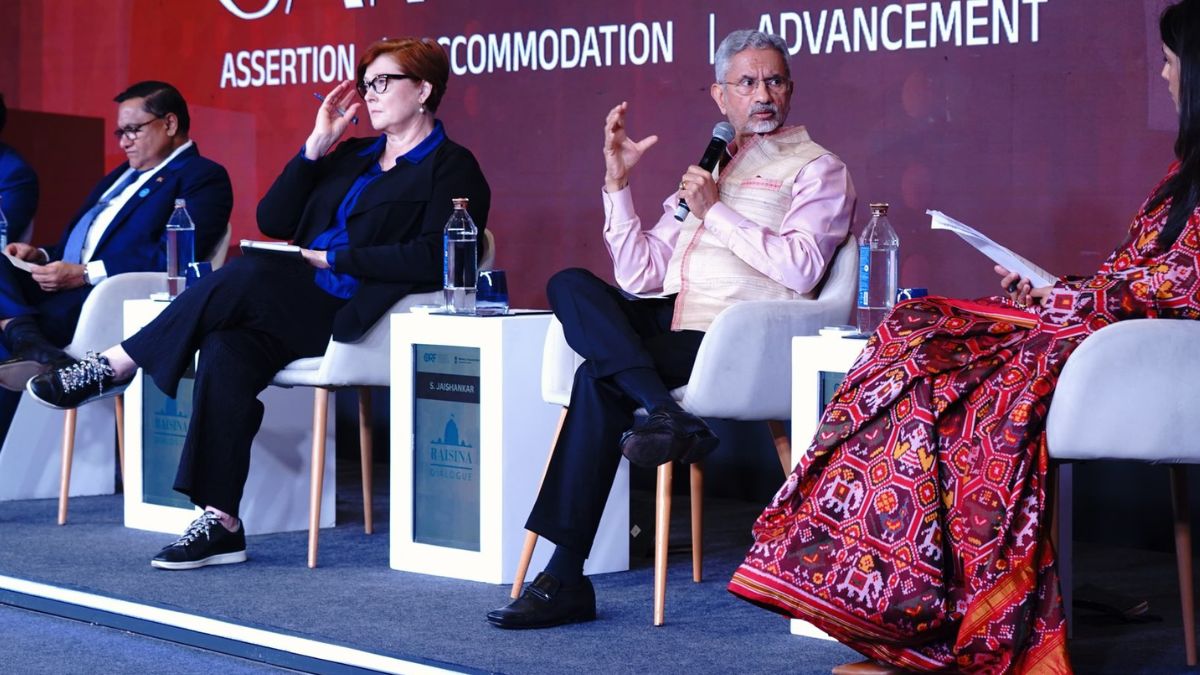
External Affairs Minister S Jaishankar has asserted that the emerging global order will be inherently multipolar, arguing that no single nation today possesses the dominance across economic, technological, and military domains required to maintain global hegemony. He made the remarks while speaking at the Raisina Dialogue 2026 in New Delhi.
Jaishankar said the balance of global power is now spread across multiple regions and actors, making a return to a unipolar system highly unlikely. “It will really be much more multipolar because no country today has hegemony over so many domains that it is an overall hegemony,” Jaishankar said.
His remarks underscore India’s growing strategic confidence as it positions itself as a major voice in shaping the future world order. Interestingly, similar views were echoed at the Dialogue by Finnish President Alexander Stubb when he highlighted that emerging powers, particularly India and the broader Global South, are set to shape the future world order.
Why is India central to the emerging multipolar world?
What Jaishankar highlighted about a multipolar world, particularly India’s role in it, was also pointed out by Finnish President Stubb, who was the chief guest at the Raisina Dialogue 2026. He argued that the future global order will not be decided solely by the West but increasingly by the Global South, led by countries like India.
Stubb said the geopolitical balance is shifting as emerging powers gain influence in areas ranging from technology and trade to security and diplomacy. “I believe the Global South will decide what the next world order will look like, and India will be a major force in determining the direction,” Stubb said during the discussion.
His remarks only reinforce the view that India’s economic growth, diplomatic reach, and strategic autonomy place it at the centre of global geopolitical recalibration.
How is the global power structure changing?
During the discussion on Stubb’s book ‘The Triangle of Power – Rebalancing the New World Order’, both leaders reflected on the dramatic transformation of global power dynamics. Stubb outlined three major phases of modern geopolitics:
Cold War bipolarity dominated by the United States and the Soviet Union
Post-Cold War unipolarity led by the United States
The current phase of multipolar competition, with several power centres emerging simultaneously
According to Stubb, the Global West still seeks to preserve the liberal world order created after World War II, while countries in the Global East, particularly China and Russia, advocate a different structure. However, he argued that the Global South will ultimately determine the direction of the next world order, with India playing a decisive role.
Why does India’s rise matter globally?
India’s growing influence stems from its unique position at the intersection of major geopolitical blocs. Unlike many major powers, India maintains strategic relationships with both Western nations and emerging economies while also championing the interests of the Global South.
Jaishankar pointed out that global influence today is no longer determined solely by economic power. “In different domains, different parts of the world will contribute more or will have more capabilities,” he said. This includes areas such as technology, supply chains, security partnerships, and diplomatic leadership.
Was the Western-led order always temporary?
Jaishankar also pushed back against the nostalgia in parts of the West for the post-World War II global order, which was largely shaped by Western powers. “This was the order by the West, for the West, from the West,” he said.
While many countries benefited from the system, he argued it was never realistic to expect the world to remain frozen in a 1945 or 1989 geopolitical framework. Instead, the shift toward multipolarity reflects the natural redistribution of power as new economies and regions rise.
The remarks were made at the 11th Raisina Dialogue, held in New Delhi from March 5–7, 2026, India’s flagship conference on geopolitics and geoeconomics. Organised by the Observer Research Foundation (ORF) in collaboration with the Ministry of External Affairs, the forum brings together global leaders, policymakers, strategists and diplomats to debate the most pressing international issues.