


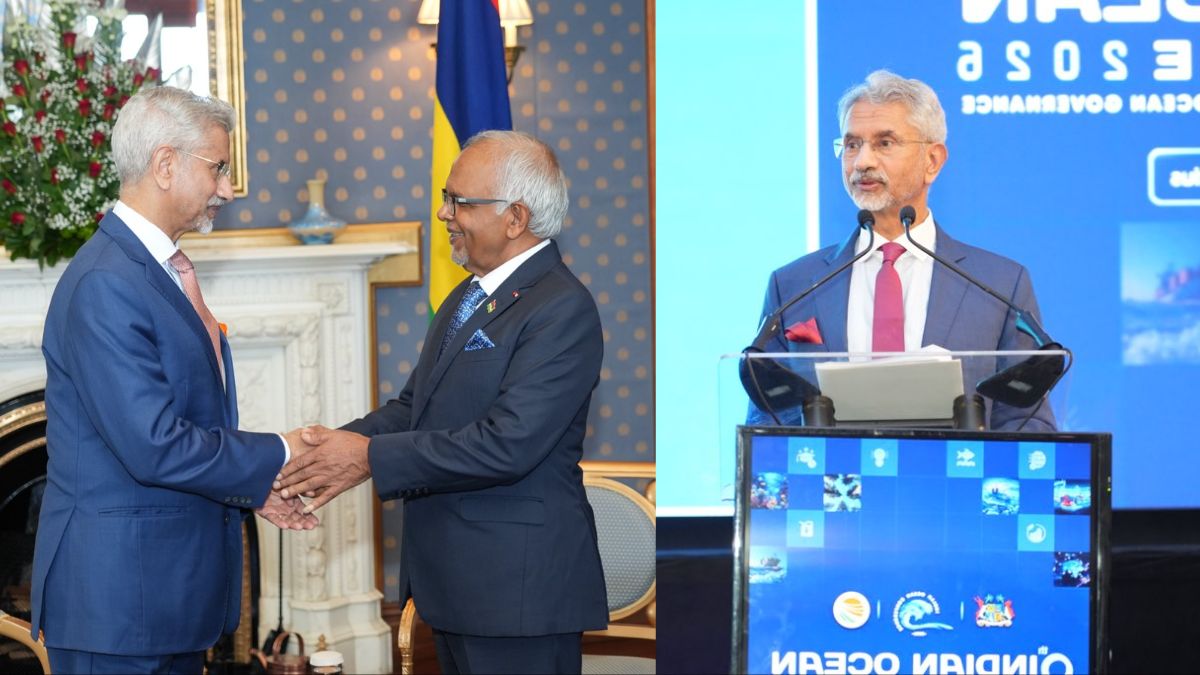
External Affairs Minister S Jaishankar on Friday (April 10, 2026) called on the President of Mauritius, Dharambeer Gokhool, during his two-day visit to the island nation, reaffirming the strong and enduring partnership between the two countries. Notably, he also announced that India will position a defence attache in the country.
On meeting the Mauritian President, Jaishankar said he conveyed warm greetings from President Droupadi Murmu and Prime Minister Narendra Modi, underlining the depth of bilateral ties. “Our conversation reflected the warmth of our friendship and the steadfast commitment to further advancing India-Mauritius partnership,” the EAM stated.
The meeting set the stage for a series of high-level engagements, signalling India’s continued prioritisation of Mauritius as a key partner in the Indian Ocean region.
Jaishankar Mauritius visit: What other key diplomatic engagements did Jaishankar hold?
Following his meeting with President Gokhool, Jaishankar held multiple high-level interactions on the sidelines of the 9th Indian Ocean Conference in Port Louis. He met Nepal’s newly appointed Foreign Minister Shishir Khanal, stating, “Glad to meet FM Shishir Khanal of Nepal this afternoon. Congratulated him on his appointment. Discussed realising the full potential of the India-Nepal partnership by deeper collaboration in different sectors.”
In talks with Bhutan’s Foreign Minister DN Dhungyel, Jaishankar highlighted the strength of ties, “A warm conversation today with Foreign Minister of Bhutan D.N. Dhungyel in Port Louis. Our unique and time-tested partnership continues to progress and prosper.”
He also met Seychelles Foreign Minister Barry Faure, reiterating India’s support, “Great meeting FM Barry Faure of Seychelles on the sidelines of 9th Indian Ocean Conference. India is committed to supporting Seychelles in meeting current economic challenges. Welcomed the steps in implementing the Special Economic Package.”
Additionally, EAM Jaishankar met former Mauritius Prime Minister Pravind Kumar Jugnauth, appreciating his role in strengthening bilateral ties.
Jaishankar’s address at the 9th Indian Ocean Conference
Addressing the 9th Indian Ocean Conference, themed ‘Collective Stewardship for Indian Ocean Governance’, Jaishankar laid out a broad vision for regional cooperation amid rising global uncertainty. He emphasised the centrality of the Indian Ocean stressing on 5 points, “The first is an obvious one. It is about the importance of the ocean.”
Jaishankar underlined that this is not just a framework in which we all exist, but an ecosystem. It is the resources on which we depend, the connectivity on which we thrive and indeed the culture that we have built up over the ages. It is so fundamental that when this is disrupted, numerous aspects of life are impacted.
Why did he stress overcoming historical and structural barriers?
Jaishankar called on nations to deepen cooperation and move beyond legacy constraints in his second point. “Two, in the last decades, our focus has been on overcoming the artificial barriers of the colonial era. This meant deeper regional cooperation, stronger economic linkages, rebuilding of connectivity and revival of traditions.”
“The world may be more fragmented; but we the nations of the Indian Ocean must seek to be more cohesive,” he stressed.
The EAM’s remarks underscored the need for long-term regional integration even as global fragmentation intensifies.
How did he describe the changing global order?
Highlighting the evolving geopolitical landscape, Jaishankar warned of increasing competition and fragmentation, “My third point, global trends are a reality that cannot be ignored. The world is more competitive, fractured, and inward-looking than in the past. The benefits of globalisation are today overshadowed by the temptation to leverage and the temptation to weaponise.”
As a result, we are all in a quest for greater resilience and are seeking more trusted partners.
With this, EAM Jaishankar pointed to growing concerns over both physical and non-physical choke points in his fourth point. “Choke points are now a great global anxiety. We naturally tend to think of it physically, as is the case in regions close by. But let’s not forget that it has also been conceptually developed in domains like finance, technology, resources, and even knowledge. Overcoming the controlled mindset is essential for the well-being of the international economy.”
Why is collective resilience the key message for Indian Ocean nations?
Calling the region a “Global South ocean,” Jaishankar stressed the importance of joint action. “There is a call for deeper cooperation among the nations of the Indian Ocean. In many ways, it is a global South Ocean. Whether it is food, fuel or fertiliser shortages; whether it is responding to natural disasters; or whether it is addressing the consequences of conflicts, the answer is increasingly in collective resilience.”
Notably, Jaishankar’s remarks come amid ongoing tensions in West Asia, where conflict has disrupted energy flows, trade routes, and economic stability. He flagged concerns over the humanitarian and economic impact, calling for protection of civilians and uninterrupted maritime navigation.
Jaishankar’s Mauritius visit (April 9-10, 2026) marks the first leg of his four-day diplomatic tour. He is set to travel to the United Arab Emirates next to review the Comprehensive Strategic Partnership with UAE leadership.