


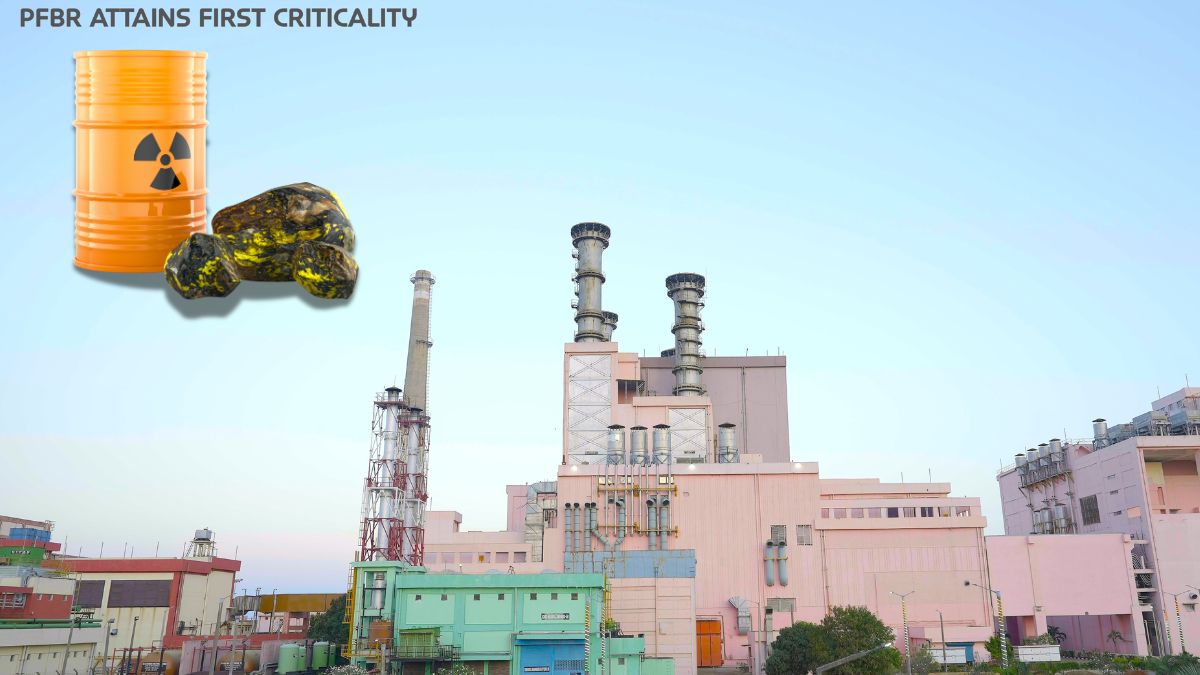
What is it that world’s biggest economies like the United States, Germany, France do not have, but India now has? A Prototype Fast Breeder Reactor (PFBR) at Kalpakkam in Tamil Nadu, which is set to give India a nuclear edge like no other, except Russia! India took a decisive step towards energy independence on April 6, 2026, when the indigenously designed PFBR attained first criticality.
Why this matters is because the development marks the start of a sustained and controlled nuclear chain reaction in the 500 MWe reactor, one of the most complex technologies pursued by the country for decades. Once fully operational, India will only be the second country, after Russia, to have a commercial operating Fast Breeder Reactor.
The achievement is not just technological, but signals India’s transition into a new phase of its nuclear journey, one that could fundamentally reshape its long-term energy security and reduce reliance on imported fuels.
What does ‘first criticality’ mean, and why does it matter?
First criticality signifies that the reactor has successfully initiated a self-sustaining nuclear chain reaction under controlled conditions. This is the most crucial milestone before full-scale power generation. For India, this is proof that it has mastered advanced reactor physics and engineering, placing it among a select group of nations capable of operating such sophisticated systems.
Prime Minister Narendra Modi marked the achievement by describing it as a defining step taken by India in its civil nuclear journey, advancing the second stage of its nuclear programme. “This advanced reactor, capable of producing more fuel than it consumes, reflects the depth of our scientific capability and the strength of our engineering enterprise,” he posted on X.
It is a decisive step towards harnessing our vast thorium reserves in the third stage of the programme, PM Modi added.
How does this push India closer to energy independence?
India is currently the third-largest emitter of greenhouse gases, and so has embarked on an ambitious journey to expand its nuclear power capacity from the current eight to 100 gigawatts by 2047. Nuclear power currently contributes just 3% of India’s electricity generation, with an installed capacity of 8.78 GW.
By the early 2030s, the government projects that this will rise to over 22 GW, before reaching the 100 GW mark by 2047.
What’s worth mentioning here is that this nuclear breakthrough for India comes during a period of geopolitical uncertainty. In light of the intense West Asia conflict, breeder reactors can offer a path toward energy sovereignty, reducing the impact of external shocks on the economy. The PFBR offers a long-term solution.
By producing more nuclear fuel than it consumes, it enables India to extract significantly higher energy from limited uranium reserves while building a pathway towards utilising its vast thorium deposits. This translates to fewer imports, greater stability, and a decisive move towards energy sovereignty.
What is the three-stage nuclear programme, and where does PFBR fit in?
The PFBR’s success formally marks India’s entry into the second stage of the three-stage nuclear power programme envisioned by Homi J Bhabha.
Stage 1: Pressurised Heavy Water Reactors (PHWRs) using natural uranium
Stage 2: Fast Breeder Reactors (like PFBR) producing more fuel (plutonium)
Stage 3: Thorium-based reactors for long-term sustainability
The Kalpakkam reactor acts as a crucial bridge between uranium-based and thorium-based energy systems, unlocking a virtually limitless energy future.
How is PFBR different from conventional nuclear reactors?
Unlike the Pressurised Heavy Water Reactors (PHWRs) India has traditionally operated, the PFBR is designed to multiply fuel rather than simply consume it. It uses mixed oxide fuel (MOX) containing plutonium recovered from spent PHWR fuel; is surrounded by a uranium-238 blanket, which converts into plutonium-239; uses fast neutrons instead of moderated (slowed) neutrons; and is cooled by liquid sodium, not water.
In essence, it is a “breeder” reactor, which is capable of generating more fissile material than it burns.
How efficient are fast breeder reactors compared to traditional ones?
The efficiency gains are dramatic. Dr Ravi B Grover, nuclear scientist and member of the Atomic Energy Commission of India, explains, “In nuclear engineering, we express fuel burn-up in MW days per tonne. The fission of one tonne of heavy metal in a day will produce 1,000,000 MW.”
He notes that a PHWR achieves about 8,000 MW days per tonne, using just 0.8% of energy potential and a fast reactor achieves 100,000 MW days per tonne, using 10% in one cycle. With fuel recycling up to five times, utilisation can reach 50%, transforming modest uranium inputs into centuries of electricity.
Why is this technology considered strategically critical?
India has limited uranium reserves but one of the world’s largest thorium reserves. Fast breeder reactors are the only viable pathway to convert this resource into usable fuel at scale. They also reduce nuclear waste, enhance fuel security, and insulate the economy from global supply shocks, making them a cornerstone of India’s strategic autonomy.
With this milestone, India is poised to become only the second country after Russia to operate a commercial-scale fast breeder reactor. The PFBR serves as a proof of concept for scaling up advanced nuclear systems that can deliver clean, reliable, and large-scale power.
Moreover, the breakthrough coincides with a one-year extension for India’s atomic chief, Dr Ajit Kumar Mohanty. The Appointments Committee of the Cabinet confirmed that he will continue to lead the atomic energy establishment beyond his scheduled departure, remaining in office until 2027.
Why is this a turning point for India’s energy future?
The Kalpakkam PFBR is more than just a reactor; it is a strategic asset that could redefine India’s energy trajectory. By enabling the country to generate more fuel than it consumes and preparing the ground for thorium utilisation, it opens the door to a near-limitless, indigenous energy source.
What makes this development even more big and fitting for India is its vast thorium reserves, as against the paucity of uranium. The Kalpakkam reactor blends these two realities strategically as it is powered by uranium in the first stage, and can be sustained by throium-blended fuel in the later stages.
Boasting of some of the world’s largest reserves, thorium in India is found on the sandy shores of Odisha, Kerala and Andhra Pradesh.
India’s nuclear vision
To further drive India’s nuclear mission forward, the Nuclear Energy Mission allocates Rs 20,000 crore towards the design, development, and deployment of Small Modular Reactors (SMRs), signalling a serious long-term investment in indigenous nuclear technology. At least 5 indigenously designed SMRs are to be operational by 2033.
Moreover, the Bhabha Atomic Research Centre (BARC) is leading the development of next-generation reactor designs, including the 200 MWe Bharat Small Modular Reactor (BSMR-200), the 55 MWe SMR-55, and a High-Temperature Gas-Cooled Reactor of up to 5 MWth (Megawatt thermal) designed for hydrogen generation.
Additionally, the Government has also enacted the ‘The Sustainable Harnessing and Advancement of Nuclear Energy for Transforming India (SHANTI) Act, 2025’, which consolidates and modernises India’s nuclear legal framework. It enables limited private participation in the nuclear sector under regulatory oversight, opening new avenues for collaboration and investment.
With India continues to widening its clean energy portfolio, fast breeder reactors are set to play a significant role in delivering reliable, low-carbon, base-load power with higher thermal efficiency.