


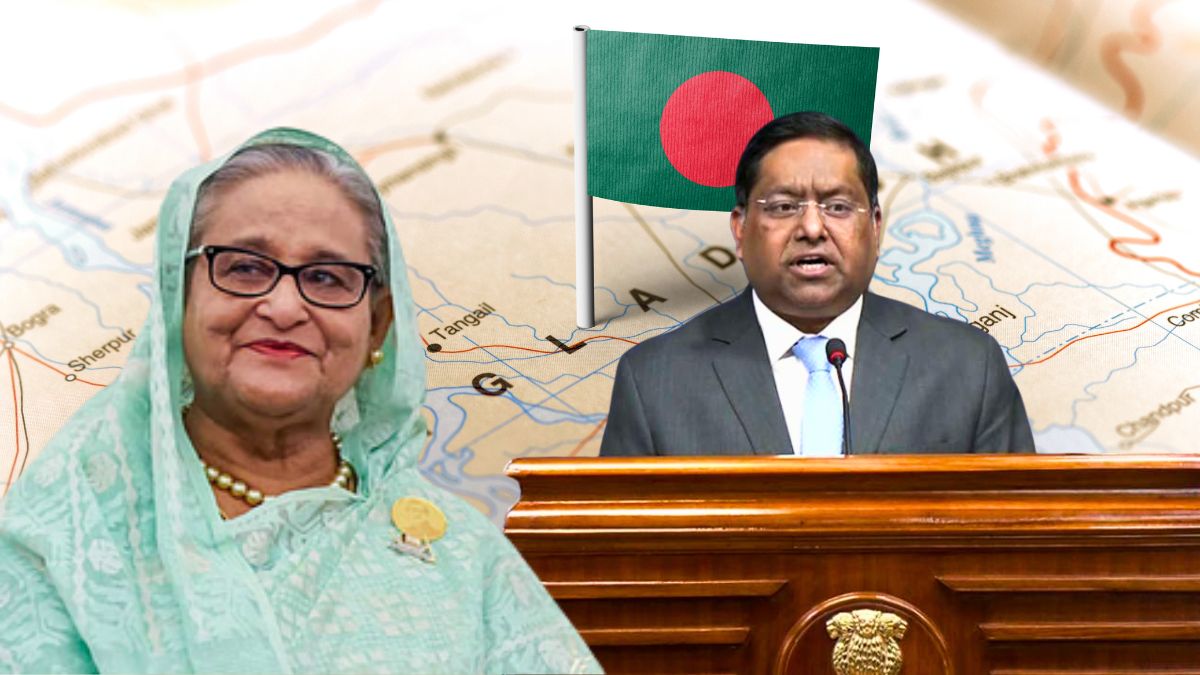
Ever since BNP leader Tarique Rahman won the February 2026 elections and took oath as the new Prime Minister of Bangladesh, India and Dhaka have been taking steps to rework their ties, which came under strain after former PM Sheikh Hasina’s ouster. In another major development, New Delhi has confirmed it is reviewing Dhaka’s request for Hasina’s extradition.
Ministry of External Affairs spokesperson Randhir Jaiswal made it clear that the matter is being handled strictly within legal frameworks. His remarks come at a sensitive moment in India-Bangladesh relations, even as both countries work to stabilise ties after major political changes in Bangladesh.
For the uninitiated, the development comes in the backdrop of the ‘July Revolution’ of 2024, which led to Hasina’s ouster and the formation of a new government in Dhaka. With Bangladesh’s leadership under domestic pressure to bring her back for trial, the issue has quickly emerged as a key diplomatic test between the two neighbours.
Sheikh Hasina extradition: What has India said?
“The request is being examined as part of ongoing judicial and internal legal processes. We will continue to engage constructively on the issue with all the stakeholders. We follow all developments very closely,” MEA spokesperson Jaiswal said on Friday (April 17, 2026) while responding to queries during the weekly media briefing.
India had first acknowledged receiving the request in 2025, and it is now undergoing a detailed legal and judicial review, guided by treaty obligations and domestic law.
Will the issue impact India-Bangladesh relations?
Despite the sensitivity of the matter, New Delhi has signalled a “business-as-usual” approach toward Dhaka, emphasising that bilateral ties will not be derailed. “I would also like to emphasise that the External Affairs Minister reiterated India’s desire to engage constructively with the new government and further strengthen bilateral ties,” Jaiswal stated.
Bangladesh former PM Hasina’s extradition issue has surfaced alongside ongoing high-level engagements, where Bangladesh is understood to have formally raised the matter.
At the same time, both sides are actively working to expand cooperation in key areas such as trade and economic ties, energy security, regional and strategic coordination.
“The two sides agreed to explore proposals for deepening the partnership through the relevant bilateral mechanisms,” Jaiswal noted.
Worth mentioning here is that in a significant diplomatic development, Bangladesh Foreign Minister Khalilur Rahman arrived in New Delhi earlier this month on April 7 for his first high-level bilateral visit to India in more than a year. This was Rahman’s first India visit after taking over as Bangladesh’s Foreign Minister.
How is India responding to internal political developments in Bangladesh?
On reports of political shifts within Bangladesh, including discussions around a ban on the Awami League, India has maintained a measured and cautious stance, avoiding direct comment. Instead, New Delhi has reiterated its broader priority of supporting stability and democratic processes in the neighbouring country.
The MEA underscored that India’s approach is guided by the “best interests of the people of Bangladesh”, reflecting a calibrated diplomatic posture.
What happens next in the extradition process?
India has made it clear that any decision on the extradition request will be determined by judicial scrutiny, domestic legal procedures, international treaty obligations. “The request is currently being examined as part of ongoing judicial and internal legal processes. We will continue to engage constructively on this issue with all stakeholders,” Jaiswal stated.
Meanwhile, diplomatic engagement continues in parallel. “Official meetings are expected to take place at an early date for both sides’ views on regional and global issues of mutual interest,” the MEA spokesperson underlined during the briefing.