


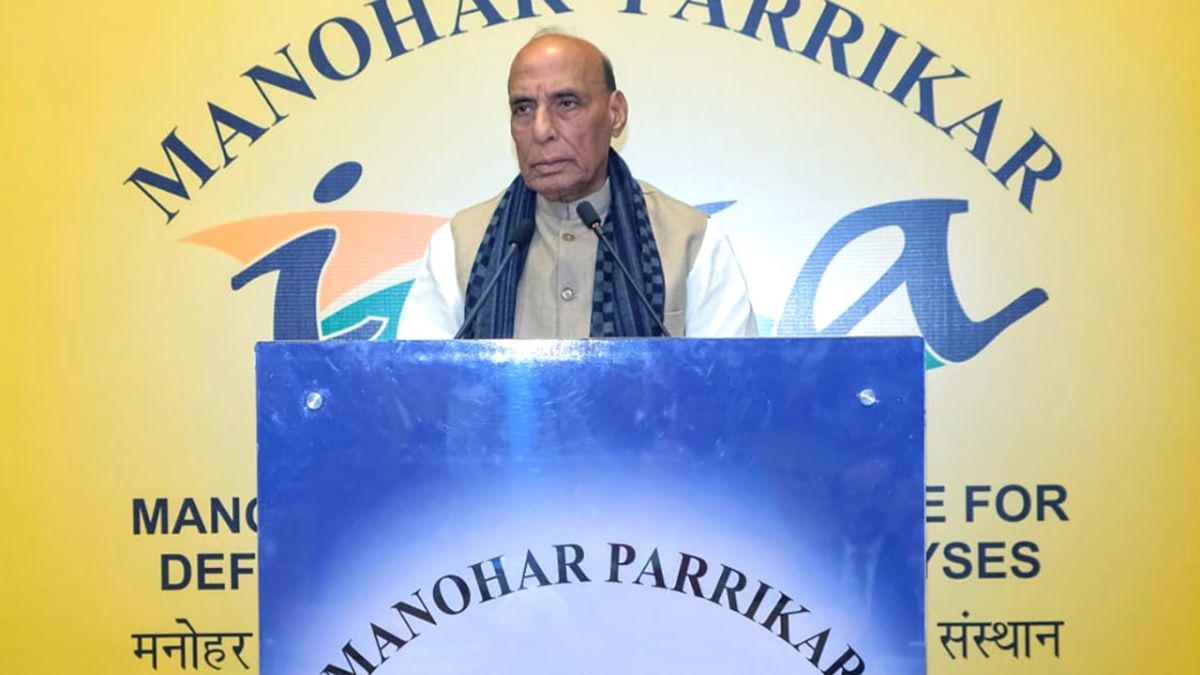
Defence Minister Rajnath Singh vowed action against the perpetrators of the tragic blast near Delhi’s Red Fort on 10 November 2025. He also said that a thorough probe is underway and accountability will follow.
“I extend my heartfelt condolences to all those who lost their lives in the tragic incident that occurred in Delhi yesterday. I pray to God to grant strength to the bereaved families in this hour of deep grief,” he said. He added that the country’s leading investigative agencies are carrying out “a swift and thorough inquiry” and that findings “will soon be made public,” stressing that those responsible “will be brought to justice and will not be spared under any circumstances.” He was speaking at the Delhi Defence Dialogue organised by the Manohar Parrikar Institute for Defence Studies and Analyses (MP-IDSA) in New Delhi on 11 November, 2025.
Pivoting to the Dialogue’s theme, Singh argued that India must move from consumer to creator by building systems and ecosystems that make the creation and adoption of new technology “seamless, swift and self-sustaining.” He called for “soldier-scientist-start-up-strategist synergy” to anchor capability development and insisted that strong foundations, agile institutions and open collaboration can make each technological wave an opportunity rather than a shock.
He urged that Aatmanirbharta extend to “digital sovereignty,” with India exercising control over the algorithms, data and chips that power platforms. “True strategic autonomy will come only when our code is as indigenous as our hardware,” he said, pointing to efforts to promote secure, indigenous software stacks, trusted semiconductor supply chains and home-grown AI models trained on Indian data.
The Defence Minister emphasised that technology is not only a force multiplier but also a resource optimiser. He said officials have been directed to factor life-cycle costs at the inception stage of every procurement proposal so that the system “sees the full picture” of what must be sustained tomorrow as well as purchased today.
Citing “invisible technologies” such as secure data architectures, encrypted networks, automated maintenance and interoperable databases as the backbone of readiness, Singh said technology leadership depends on process discipline as much as on devices. He highlighted government initiatives including Innovations for Defence Excellence (iDEX) and the Technology Development Fund (TDF), which he said are nurturing a generation of innovators across start-ups, MSMEs and larger companies.
Singh also encouraged the armed forces to import best global practices not only for equipment but for training, logistics, planning and management systems, and asked MP-IDSA to document and disseminate those practices for adaptation to Indian conditions.
The session was attended by Chief of Defence Staff General Anil Chauhan, MP-IDSA Director General Ambassador Sujan Chinoy, ambassadors from friendly nations and other civil and military officials.