


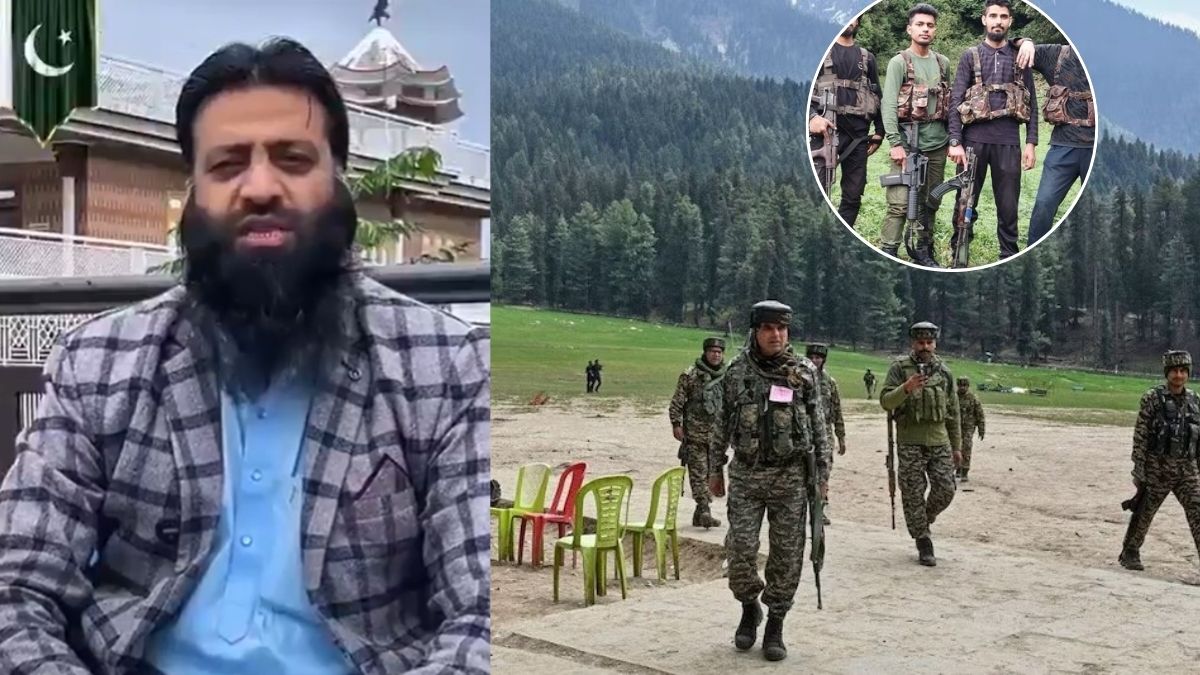
In a startling revelation that only bolsters the long-held view that India has voiced – Pakistan’s alleged links to terrorism – a senior Lashkar-e-Taiba commander has seemingly admitted that the 2025 Pahalgam terror attack served Pakistan’s strategic interests. He has revealed that the attack boosted the country’s image globally.
Top LeT commander Abu Musa Kashmiri, in a viral video, has claimed, “After Bunyan-un-Marsoos, Pakistan’s international image was boosted… I don’t know if the Pahalgam attacks were right or wrong… but the actions that followed in the form of Pakistan’s Bunyan-un-Marsoos, in response to India’s Operation Sindoor, which had failed miserably, have taken our country 50 years forward.”
The remarks are being seen as a significant contradiction to Islamabad’s consistent denials of involvement in the deadly attack that killed 26 people. Islamabad has repeatedly denied any direct links to the dastardly attacks in Pahalgam.
Pahalgam terror attack: Why is this revelation significant now?
Kashmiri’s latest revelation comes just days ahead of the first anniversary of the April 22 Pahalgam terror attack, amplifying its political and strategic implications. At the time, Pakistan had categorically rejected India’s accusations, calling them “replete with fabrications,” while its military insisted New Delhi had not provided any “shred of evidence.”
However, the latest statement by a top Lashkar commander, whose group has long been accused by India of operating from Pakistani soil, has raised fresh questions about the credibility of those denials.
How has India responded to such claims in the past?
India has consistently maintained that Pakistan provides safe haven, training, and operational support to terror groups targeting Indian interests.
The Pahalgam attack was claimed by The Resistance Front (TRF), widely believed to be linked to Lashkar-e-Taiba. In response, India had launched Operation Sindoor in May 2025, conducting precision strikes on nine terror camps across Pakistan and Pakistan-Occupied Kashmir.
The Indian Army had then declared, “Justice is served,” emphasising that the strikes targeted infrastructure linked to banned outfits like Jaish-e-Mohammed and Lashkar-e-Taiba.
What were the key targets of Operation Sindoor?
One of the most prominent targets was the Markaz Taiba complex in Muridke, near Lahore, often described by Indian agencies as a nerve centre of Lashkar-e-Taiba. Spread over 82 acres, the facility has long been under surveillance for its alleged role in training militants and planning attacks against India.
The complex, founded in 2000 with alleged financial backing from Al Qaeda leader Osama bin Laden, has also been linked to operatives involved in the 2008 Mumbai attacks, including Ajmal Kasab. By striking Muridke, India aimed not just at physical infrastructure but at what it considers the ideological and operational backbone of Lashkar’s global network.
Does the confession validate India’s long-standing claims?
While the video does not explicitly detail any operational links, the acknowledgment that the attack boosted Pakistan’s standing can be viewed as an indirect admission of strategic alignment. For years, India has accused Pakistan of using terror groups as instruments of state policy.
Moreover, the video has surfaced at a time when Pakistan is hosting high-stakes ceasefire talks between the United States and Iran, positioning itself as a diplomatic intermediary in the West Asia crisis. The Lashkar commander also suggested that the Pahalgam attack helped create conditions for Pakistan to emerge as a mediator.