


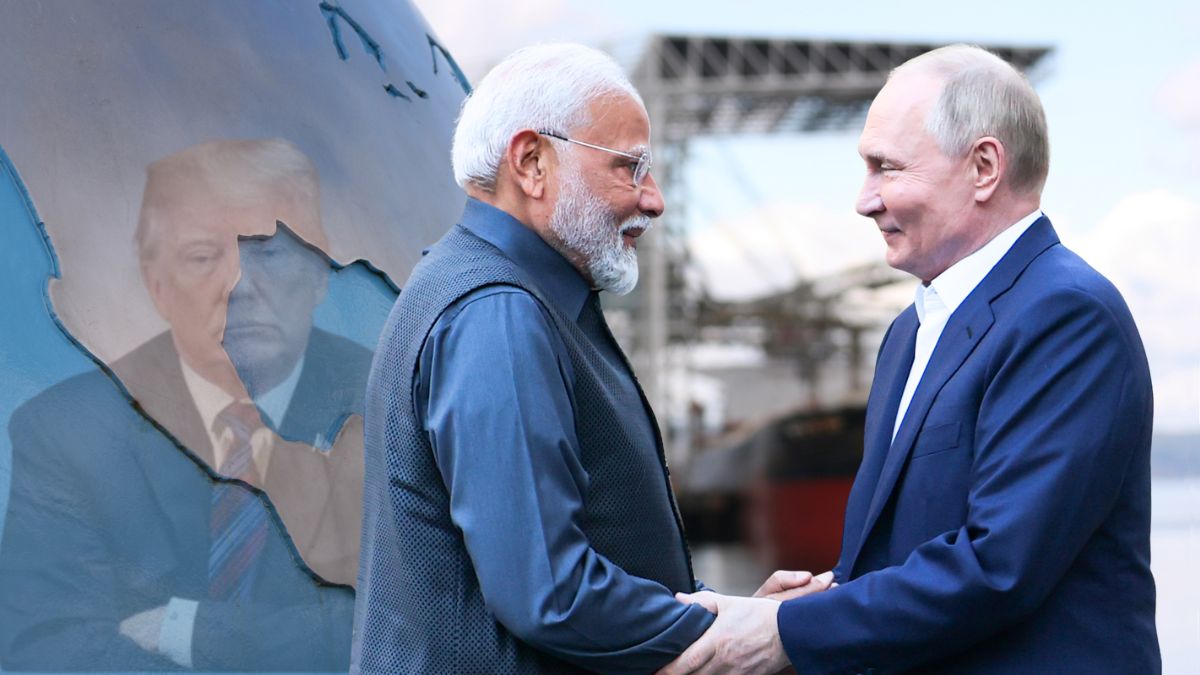
Russian President Vladimir Putin will arrive in New Delhi on December 4 and 5, 2025, for the 23rd India–Russia Annual Summit, a visit the Ministry of External Affairs (MEA) describes as a major opportunity to recalibrate one of India’s most crucial strategic partnerships.
The two-day state visit will include formal talks with Prime Minister Narendra Modi and a ceremonial reception by President Droupadi Murmu, who will also host a state banquet in his honour.
How will the Summit help in India-Russia strategic ties?
The MEA said on November 28, 2025, that the summit will allow both sides to assess progress across their “Special and Privileged Strategic Partnership”, while also reviewing regional and global developments.
Moscow has called the trip a significant moment, with the Kremlin stating that it will enable “a comprehensive discussion of the full spectrum of bilateral relations” across political, economic, defence, scientific, technological, cultural and humanitarian domains.
Would defence ties be the focus of Putin’s visit to India?
A major focus area during the summit will be defence cooperation, which has long been considered the backbone of India–Russia ties.
India is expected to raise concerns over delays in the delivery of the S-400 air defence systems, Defence Secretary Rajesh Kumar Singh said at ANI’s National Security Summit in New Delhi on November 28, 2025.
Three of the five contracted S-400 units have been delivered; the remaining two are expected only in 2026 and 2027.
What are India’s requests relating to arms deliveries?
Singh indicated that India is seeking clearer delivery timelines and intends to push for faster execution of pending projects, including Sukhoi fighter upgrades.
While the possibility of ordering additional S-400 units is not ruled out, he emphasised that no major announcements are expected during Putin’s visit. Moscow has reassured New Delhi that the remaining systems will be delivered as promised.
How S-400 was the linchpin of Operation Sindoor?
The S-400 has gained renewed significance after playing a decisive role during Operation Sindoor in May 2025, when it enabled the Indian Air Force to neutralise Pakistani fighter and surveillance aircraft at long range.
Within the services, the system has been formally designated the Sudarshan Chakra, a reference to the Hindu deity Lord Vishnu’s celestial weapon. India has already identified a domestic firm to establish a Maintenance, Repair, and Overhaul (MRO) facility for the platform.
On December 4, ahead of the Modi–Putin talks, Defence Minister Rajnath Singh will meet his Russian counterpart, Andrey Belousov, to review current cooperation and discuss potential future acquisitions, including the next-generation S-500 system.
Shipbuilding collaboration, joint weapons development, and industrial partnerships are also on the agenda, according to Indian government officials.
How are India-Russia defence ties diversifying?
The broader India–Russia defence relationship continues to evolve even as India diversifies its procurement sources and increases domestic manufacturing.
Rajesh Kumar Singh underlined that while Russia remains a “friend through fair and foul weather”, India’s policy of strategic autonomy guides its decisions.
India has purchased nearly $30 billion worth of US arms over the past two decades, but continues to value its long-standing military-technical partnership with Moscow.
When did Putin visit India last?
Putin’s last visit to India was in December 2021, shortly before Russia began military operations in Ukraine.
This year’s summit comes against the backdrop of shifting global alignments, US pressure on India to curb oil imports from Russia, and a noted drop in India’s December oil purchases due to concerns over Western sanctions.
Prime Minister Modi has tied the strengthening of India’s air defence network to his newly announced Sudarshan Chakra Mission, a decade-long plan to build an impenetrable national security architecture.
Addressing a gathering in Karnataka on November 28, 2025, he said the mission would create an “unbreakable protective wall” around critical national assets and warned that any aggression against India “will be destroyed by the Sudarshan Chakra”.
The upcoming summit is expected to produce several intergovernmental and commercial agreements, reaffirming the strategic depth of a partnership navigating complex geopolitical headwinds but rooted in decades of cooperation.