
Not Bow Before Anyone: Muhammad Yunus Vows To Follow Osman Hadi’s Ideals At His Funeral; Bangabandhu Hall Renamed
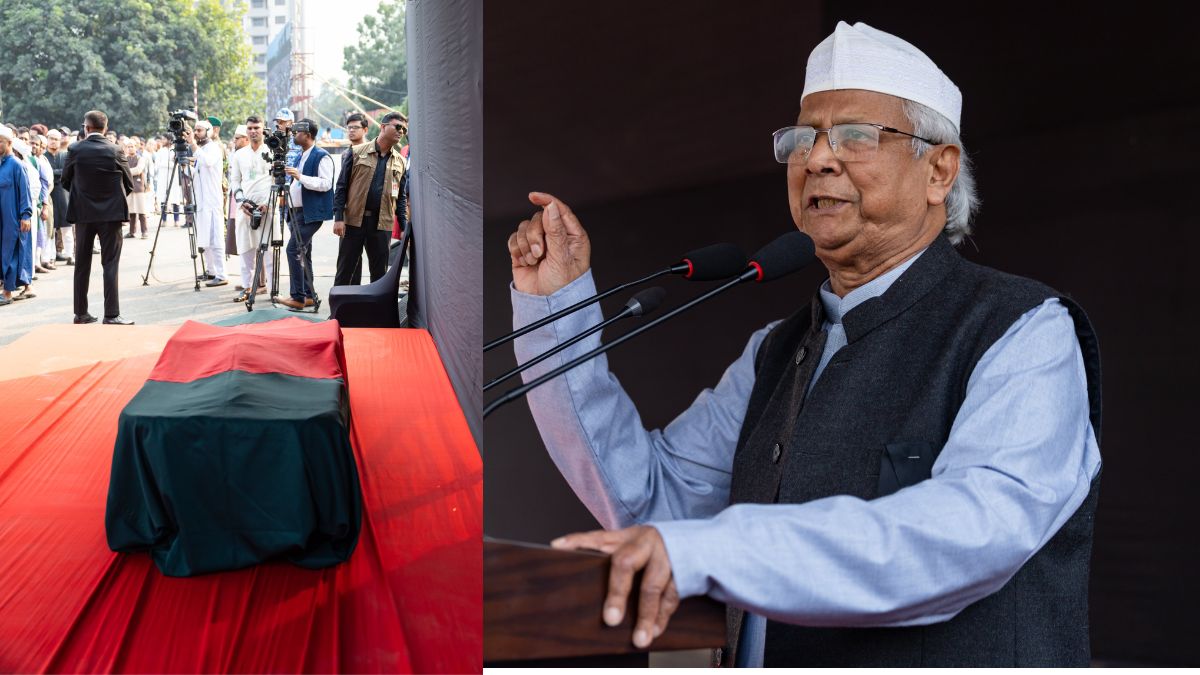
According to Muhammad Yunus, with the anti-India leader's 'mantra', he and all the Bangladeshi "will prove themselves in the work". Image courtesy: X.com/@ChiefAdviserGoB

Bangladesh’s fragile political calm was shaken further on Saturday (December 20, 2025) as its Interim Leader and Chief Adviser Muhammad Yunus publicly vowed to carry forward the ideals of slain radical leader Sharif Osman Hadi, elevating the 32-year-old firebrand into a powerful political symbol just days after his assassination.
Addressing thousands of mourners at Hadi’s funeral, Yunus said the gathering was not a farewell but a pledge. “As long as Bangladesh exists, you will remain in the hearts of all Bangladeshis,” he declared, promising that Hadi’s vision would be fulfilled “generation after generation.”
Hadi was the prominent face of the 2024 uprising that led to the fall of Sheikh Hasina’s government. He succumbed to gunshot wounds in a Singapore hospital on Thursday (December 18, 2025), six days after he was shot in the head by masked assailants on a motorbike in Dhaka while launching his election campaign.
Muhammad Yunus at Hadi’s funeral
Yunus, recalling Hadi’s political outlook, said Bangladesh would “walk before the world with our heads held high” and “not bow before anyone.”
With the anti-India leader’s ‘mantra’, he and all the Bangladeshi “will prove themselves in the work”, Yunus added, further noting, “We will walk before the world with our heads held high. We will not bow before anyone.” The Bangladesh’s interim leader also recalled Hadi’s desire to take part in elections.
“You wanted to participate in the election, and in doing so, you showed us the process of how an election campaign should be conducted. You taught us everything, and we have accepted this teaching. You will not be lost. No one will ever forget you. You will remain with us for ages, reminding us again and again of your mantra,” he stressed.
Who was Sharif Osman Hadi and why his death matters?
Hadi rose to prominence during Bangladesh’s 2024 student-led uprising, which ultimately led to the ouster of former PM Hasina. As convenor of the activist platform Inqilab Moncho, he emerged as a powerful youth voice and was preparing to contest the February 2026 national elections.
Last week, Hadi was shot in the head by masked assailants while launching his election campaign in Dhaka. He later died in a Singapore hospital. His killing triggered nationwide protests, some of which turned violent, with buildings torched and staff reportedly trapped inside.
Police have said suspects have been identified and alleged they may have fled to India, where Hasina is currently living in exile, setting off a fresh diplomatic flashpoint between Dhaka and New Delhi.
Diplomatic strains with India resurface
The fallout from Hadi’s killing has quickly spilled across borders. India summoned Bangladesh’s envoy Riaz Hamidullah following suggestions that suspects may have escaped across the frontier, after which Dhaka called in the Indian envoy in response.
New Delhi also expressed its serious concerns over the deteriorating security situation in Bangladesh and reiterated its call for holding free, fair and credible parliamentary elections. The polls are scheduled for February 12 next year.
Hall renamed after Osmal Hadi
Political tensions were further inflamed after Dhaka University renamed Bangabandhu Sheikh Mujibur Rahman Hall, named after Bangladesh’s founding father, to Shaheed Sharif Osman Hadi Hall, according to local media. Students and hall union leaders replaced the nameplate and removed Sheikh Mujibur Rahman’s name and graffiti from the building, BD News reported.
The move has sparked intense debate and protests on campus and online, reflecting deeper divisions over Bangladesh’s political identity and historical legacy. “Bangabandhu” is a revered title associated with Sheikh Mujibur Rahman’s role in Bangladesh’s independence, making the renaming a symbolically explosive act.
India tightens border security
As unrest intensified in Bangladesh, India’s Border Security Force (BSF) significantly ramped up security along the 4,096-km India–Bangladesh border, spanning West Bengal and four other states. Officials said additional troops have been deployed, patrols intensified, and surveillance enhanced, particularly in porous and riverine sectors.
All leaves for BSF personnel have been cancelled, and units are operating under an “all-alert” posture. Senior BSF officials confirmed coordination meetings with Border Guard Bangladesh (BGB) to exchange situation reports and reaffirm commitments under the Coordinated Border Management Plan (CBMP).
Security has also been stepped up in Kolkata, including around the Bangladesh deputy high commission and areas frequented by Bangladeshi nationals.