Asim Munir Revives Islamist Rhetoric Abroad, Positions Pakistan As Military Patron To Muslim Nations
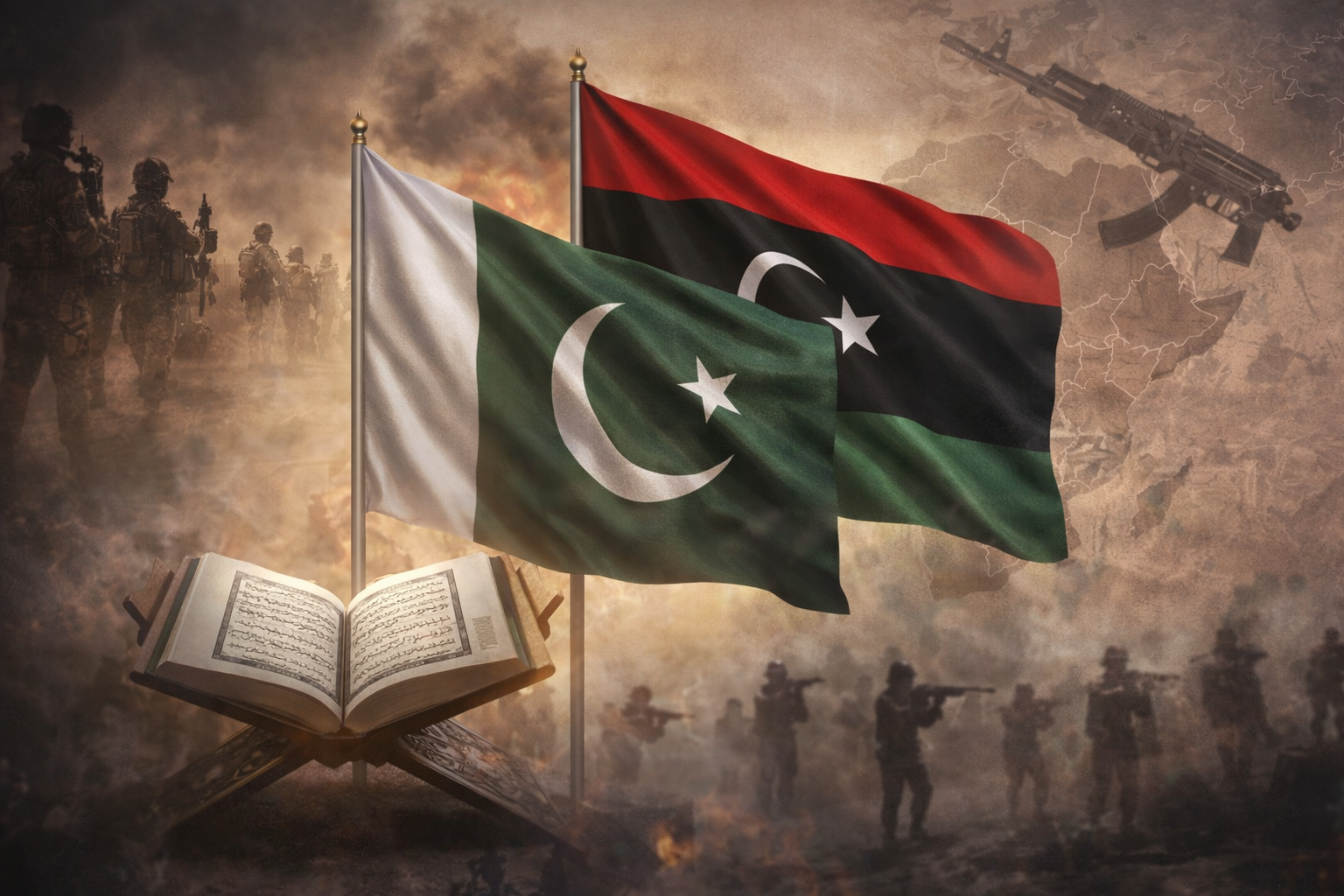
A conceptual illustration reflecting the intersection of military power, religious rhetoric, and geopolitical outreach as Pakistan seeks to project itself as a security partner to Muslim nations. AI-generated Image via DALL·E

Pakistan’s Army Chief, Asim Munir, has once again drawn attention for using religiously charged rhetoric in an overseas address, this time calling on Muslim countries to unite against what he described as the “enemies of Allah”, while projecting Pakistan as a leading security provider for the Islamic world.
The remarks, delivered during a visit to Libya last week, come amid heightened scrutiny of Munir’s public statements following India’s military response to the Pahalgam terror attack and the subsequent escalation that culminated in Operation Sindoor. Indian officials and analysts have previously linked Pakistan Army rhetoric and permissive signalling to the broader climate that enables terrorist violence in Jammu and Kashmir.
What did Asim Munir say during his Libya address?
Speaking in English and interspersing his remarks with Quranic references, Munir appealed to religious solidarity among Muslim nations, arguing that the Muslim world lacks power today because “other nations have taken from the Muslim countries the learnings of technology”.
He told his audience that Pakistan was willing to share its military capabilities and defence technologies with what he described as “our brothers”, stating that “every piece of equipment and technology” possessed by Pakistan was available to Muslim nations.
“Any assistance you need from Pakistan will be available at your doorstep,” he said, positioning the Pakistan Army as a provider of security and defence capacity beyond South Asia.
How did Munir frame the global situation of Muslim countries?
Munir claimed that several “magnificent Muslim countries” had been destroyed over the past two decades, attributing this to conspiracies, treachery, and the actions of external powers. He portrayed the contemporary international system as one where the rule of law has been replaced by what he called the “law of the jungle”, arguing that power today lies outside the Muslim world.
Referring to “Iqra”, the first word revealed in the Quran, Munir said Islam mandates the pursuit of knowledge and power, interpreting this as justification for building military strength. He argued that technological superiority had been taken away from Muslim societies and must be reclaimed.
What remarks have drawn the most concern?
In a section of his speech that has attracted particular attention, Munir cited Quranic verses to argue that Muslims were instructed to be prepared “to strike terror in the hearts of those who are the enemies of Allah”.
“We were asked to be ready with the utmost of our power to strike terror in the hearts of those who are the enemies of Allah,” he said, framing the use of force as a religious obligation. He followed this with the assertion that “who dares, wins”, again invoking divine sanction for assertive action.
Such language mirrors themes frequently used by Islamist terrorist groups, and Indian analysts have argued that repeated use of this rhetoric by Pakistan’s top military leadership contributes to regional instability by blurring the line between state policy and ideological mobilisation.
How does this relate to India–Pakistan tensions after Operation Sindoor?
Munir’s Libya speech comes against the backdrop of India’s military operation following the Pahalgam terror attack, which New Delhi attributed to Pakistan-based terrorist networks. Operation Sindoor and Pakistan’s subsequent military posture brought the two nuclear-armed neighbours to the brink of a wider confrontation before de-escalation set in.
During his address, Munir repeated Pakistan’s claim that its forces had shot down Indian aircraft during Operation Sindoor—an assertion India has rejected as false. The repetition of such claims abroad has been viewed in India as part of a broader effort to sustain a narrative of military parity and deterrence despite Pakistan’s internal economic and political fragility.
Is Pakistan seeking new defence markets?
Munir’s remarks also highlighted Pakistan’s push to expand defence exports. His Libya visit coincided with reports of a potential $4 billion defence deal between Pakistan and Libya, underscoring Islamabad’s efforts to market military hardware to African and Middle Eastern countries.
By publicly offering defence assistance and equipment, Munir assumed a role traditionally associated with civilian leadership, reinforcing perceptions that the Pakistan Army dominates foreign, defence, and economic decision-making. Analysts note that Pakistan’s military leadership has increasingly acted as the country’s principal diplomatic and commercial interlocutor in defence matters.
What broader pattern do these remarks fit into?
Munir’s Libya speech aligns with a pattern in which Pakistan’s military leadership uses religious and ideological framing to project influence abroad while asserting internal authority. Critics argue that this approach risks further isolating Pakistan diplomatically and deepening suspicions about its role in fostering militant narratives.
For India and other regional observers, the concern lies less in the speech itself and more in what such rhetoric signals: a continued reliance on ideological mobilisation and externalised conflict narratives at a time when South Asia remains highly sensitive to escalation.