



Kim Jong Un Inspects Nuclear Submarine Programme As Russia Signals ‘Invincible Friendship’
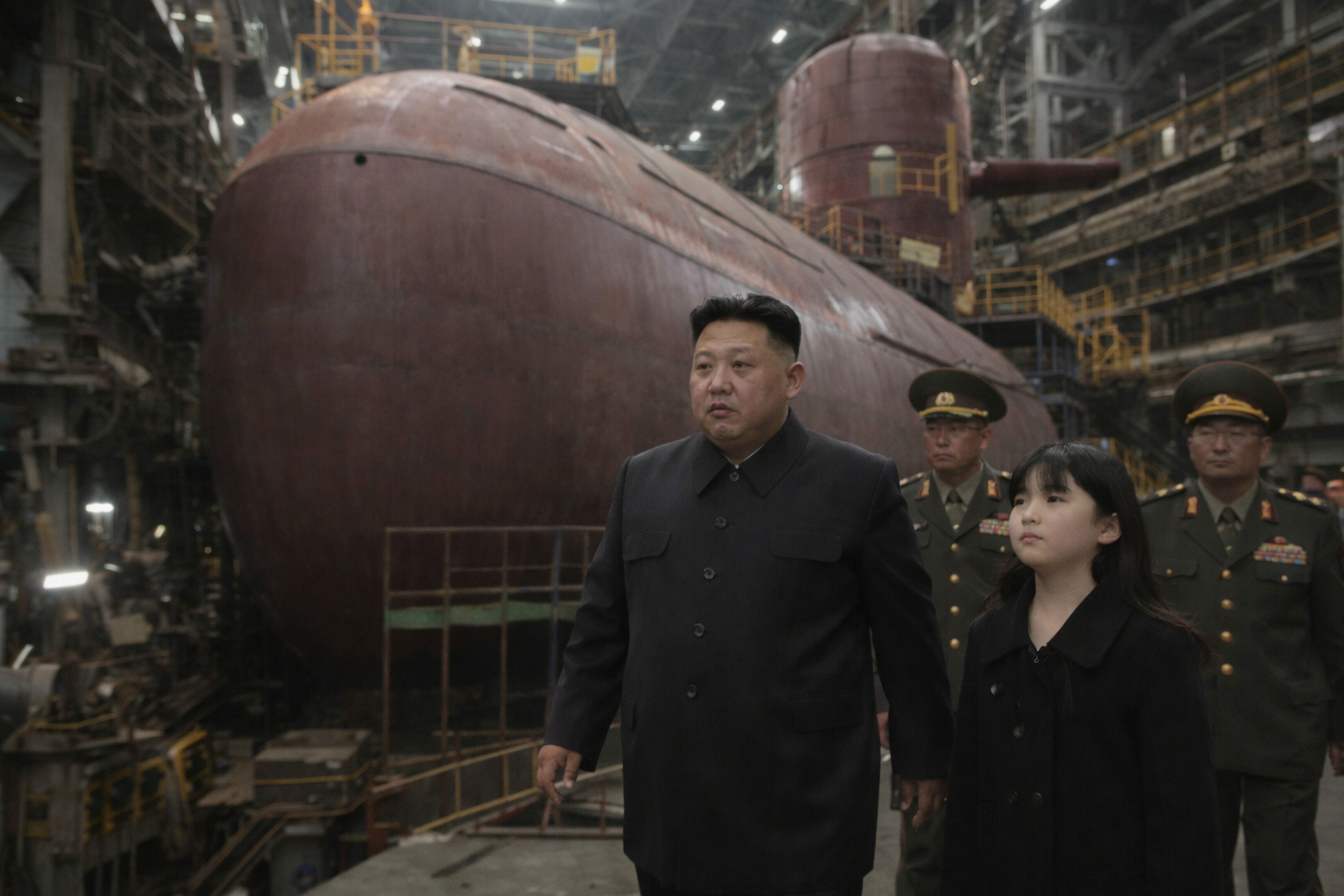
North Korean leader Kim Jong Un inspects what Pyongyang describes as a nuclear-powered submarine under construction at an indoor assembly facility, amid deepening military ties between North Korea and Russia. AI-generated Image via DALL·E

North Korean leader Kim Jong Un has inspected what Pyongyang describes as a nuclear-powered submarine under construction, as Russia’s President Vladimir Putin sent a message hailing the two countries’ “invincible friendship, underlining the deepening military alignment between Moscow and Pyongyang.
The developments come as North Korea and Russia draw closer following Russia’s full-scale invasion of Ukraine, with Western and South Korean intelligence agencies reporting extensive military cooperation between the two.
What did Kim Jong Un inspect during his visit?
According to the Korean Central News Agency (KCNA), Kim Jong Un visited a manufacturing facility for nuclear-powered submarines, where state media released photographs of him walking alongside what was described as an 8,700-tonne nuclear-propelled submarine inside an indoor assembly hall.
KCNA said the visit was undated, but images showed Kim accompanied by senior officials and his daughter, Kim Ju Ae. It was the most detailed public glimpse yet of North Korea’s nuclear submarine ambitions, with state media indicating that Kim reviewed plans related to naval modernisation and “new underwater secret weapons”.
What message did Russia send to North Korea?
KCNA reported that Vladimir Putin sent a message to Kim Jong Un praising the “heroic” role of North Korean troops supporting Russian forces, particularly in Russia’s Kursk region. Putin said their actions demonstrated the “invincible friendship” and “militant fraternity” between the two countries.
Putin added that the provisions of a “historic treaty” signed by the two leaders last year, which includes a mutual defence clause, had been fulfilled through joint efforts. The message was received in Pyongyang last week, according to KCNA.
How extensive is North Korea’s military involvement with Russia?
South Korean and Western intelligence agencies estimate that North Korea has sent thousands of troops to Russia, alongside artillery shells, missiles, and long-range rocket systems. South Korean officials have estimated that around 2,000 North Korean soldiers have been killed and several thousand wounded.
North Korea acknowledged earlier this month that some of its troops deployed to Kursk had been assigned mine-clearing duties and that casualties had occurred.
Why is the submarine programme drawing attention now?
North Korea has long listed a nuclear-powered submarine among its priority weapons systems. Kim Jong Un first outlined this ambition during a political conference in 2021, alongside plans for solid-fuel intercontinental ballistic missiles, hypersonic weapons, spy satellites, and multi-warhead missiles.
Experts note that the release of images showing what appears to be a largely completed hull suggests significant progress. Moon Keun-sik, a submarine expert at Seoul’s Hanyang University, said the submarine could potentially be ready for sea trials within months.
Questions remain over how Pyongyang, a heavily sanctioned state, has obtained the technology and resources required for nuclear propulsion. Analysts say North Korea’s alignment with Russia may have facilitated technical assistance, though there is no public confirmation of direct reactor transfers.
How has North Korea responded to South Korea’s submarine plans?
KCNA said Kim Jong Un criticised South Korea for pursuing nuclear-powered submarines, calling the move an “offensive act” that violates North Korea’s security and maritime sovereignty.
The remarks follow confirmation that Donald Trump has approved South Korea’s efforts to develop nuclear-powered attack submarines, though details of the programme remain unclear. North Korea said it would be “indispensable” to accelerate the nuclear weaponisation of its naval forces in response.
What additional weapons activity was reported?
KCNA also reported that Kim oversaw the test launch of “new-type high-altitude long-range anti-air missiles” over the East Sea, also known as the Sea of Japan. The missiles reportedly reached an altitude of 200 kilometres, which would place them in space.
South Korea’s Joint Chiefs of Staff said they had detected preparations for the launch in advance and were analysing the specifications alongside US intelligence authorities.
What are the broader regional implications?
The convergence of North Korea’s submarine programme, missile testing, and deepening military ties with Russia has heightened security concerns across Northeast Asia. A nuclear-powered submarine capable of launching missiles from underwater would significantly complicate detection and deterrence for neighbouring states.
As Pyongyang accelerates its naval nuclear ambitions and Moscow publicly endorses the partnership, prospects for reviving denuclearisation talks remain remote, further entrenching strategic instability on the Korean Peninsula.