


Why the Wuhan Story Still Matters in 2025
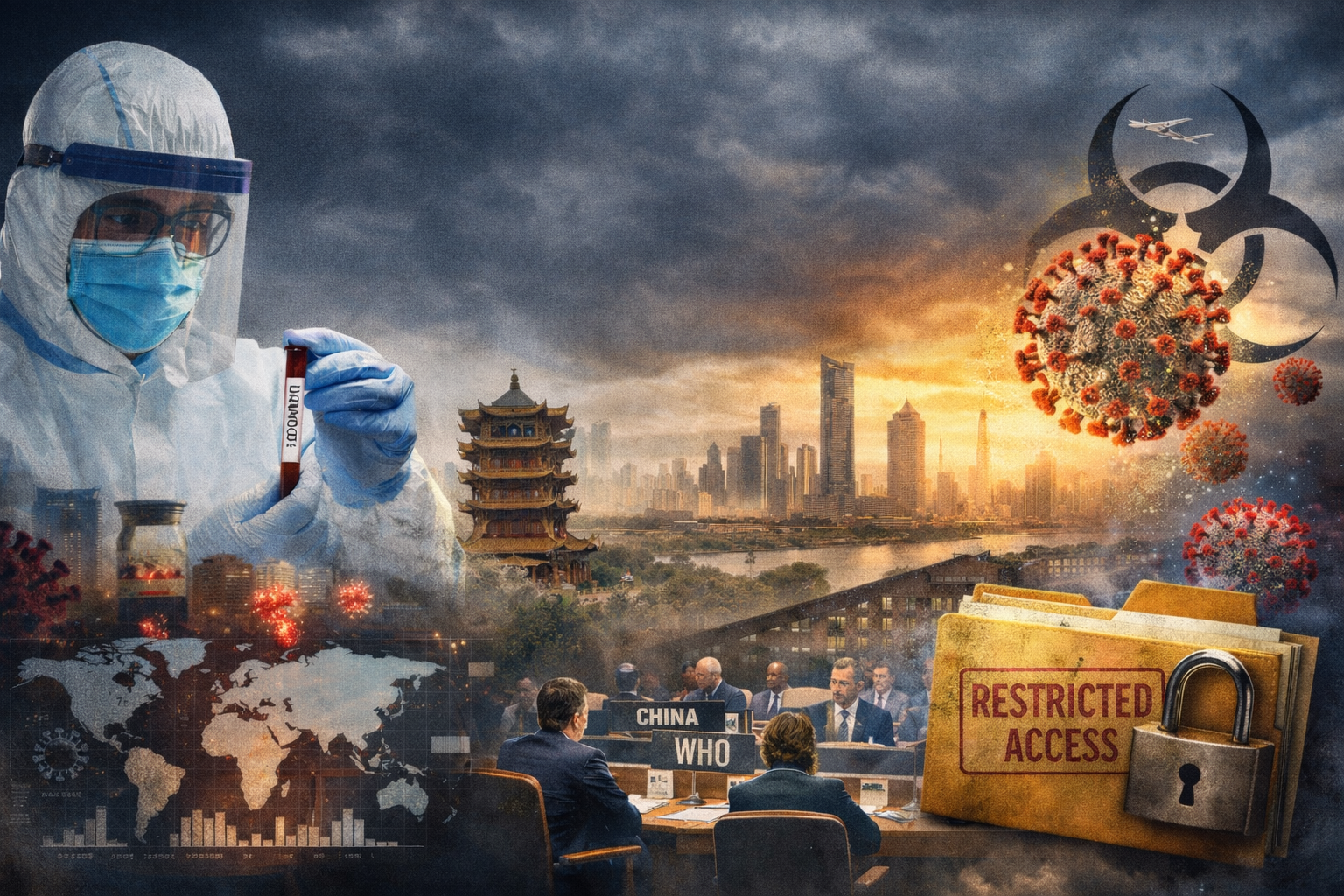
A composite illustration depicting Wuhan’s urban skyline, pandemic-era laboratory research, global air travel, and restricted data access, reflecting the enduring tensions between transparency, political control, and global public-health governance in the wake of COVID-19: AI-generated image via DALL-E

Six years after the first cluster of unexplained pneumonia cases surfaced in Wuhan, the city’s significance extends far beyond the question of COVID-19’s origins.
By 2025, Wuhan has become a standing case study in how delays, information control, and bureaucratic caution can transform a local health emergency into a global catastrophe. The debates it triggered — on transparency, early warning, and international trust — remain unresolved, even as governments and institutions insist the world is “better prepared” for the next pandemic.
The core lesson of Wuhan is not that outbreaks begin in one country or another. Pathogens emerge everywhere. The decisive variable is how information flows in the first critical weeks — whether early signals are shared rapidly and openly, or filtered through political and administrative incentives.
In December 2019, clinical anomalies were detected early by frontline doctors and hospitals. Surveillance mechanisms functioned. What failed was the timely transmission of those warnings through local and national reporting chains. Information moved slowly, unevenly, and defensively, shaped less by epidemiology than by concerns over stability, authority, and blame.
By the time the international community grasped the scale of the threat, critical weeks had been lost — weeks that no later lockdowns, border closures, or vaccines could fully recover. That initial delay, more than any subsequent policy decision, shaped the trajectory of the pandemic.
This is why the Wuhan story still matters in 2025. It exposed structural weaknesses in global public-health governance that remain only partially addressed.
WHO Reform and the Limits of the International Health Regulations
In the aftermath of COVID-19, reforming the World Health Organization and strengthening the International Health Regulations (IHR) became central to global health diplomacy. The IHR are intended to ensure rapid notification of outbreaks and to enable coordinated international responses to emerging threats.
The Wuhan experience demonstrated how fragile these mechanisms are when states retain full control over data, verification, and access. While the WHO can request information and issue alerts, it cannot compel disclosure, independently investigate outbreak sites, or override national delays in confirmation.
Negotiations on IHR amendments and the proposed pandemic agreement — still ongoing through 2024 and 2025 — seek to strengthen early-warning obligations, improve data-sharing standards, and reduce political interference. Yet these discussions continue to confront the same constraint: national sovereignty.
Most member states remain unwilling to grant the WHO automatic access to outbreak locations, raw epidemiological data, or binding inspection authority. The result is a system that depends heavily on trust rather than verification — precisely the vulnerability revealed in the opening months of 2020.
Global Public-Health Governance After COVID-19
Post-pandemic assessments increasingly converge on a clear conclusion: COVID-19 was not only a biological crisis, but a governance failure.
Technically, global health capacity has improved. Genomic surveillance is faster and more widespread. Data-sharing platforms are more advanced. Pandemic financing mechanisms and emergency stockpiles have expanded. These advances are real and measurable.
What remains unresolved is the translation of early scientific signals into timely, transparent public communication across borders. Detection without disclosure offers little protection. Faster sequencing does not compensate for slower reporting.
Wuhan demonstrated that even brief periods of opacity can negate decades of public-health investment. That reality remains unchanged in 2025. Without institutional safeguards for openness, preparedness gains remain conditional and uneven.
China, Data-Sharing, and International Access
China argues that its disease surveillance and reporting capacity has improved substantially since COVID-19. Domestically, investments in monitoring, testing, and public-health infrastructure are evident. Internationally, however, access to retrospective data and independent verification remains limited.
Foreign researchers and WHO teams continue to face constraints on access to raw datasets, early case records, and unfiltered epidemiological material. These restrictions are not unique to China, but their scale matters because of China’s central role in global travel networks, manufacturing supply chains, and disease emergence risk.
The issue extends beyond COVID-19 origins research. If major powers retain the right to manage information flow during health emergencies, global early-warning systems remain fragmented by design.
Wuhan illustrated how political caution at the local and national level can cascade into international delay — a dynamic that has yet to be decisively corrected.
What Think Tanks Learned From Wuhan
Some of the clearest assessments of the Wuhan failure have come from policy institutes rather than governments.
Analyses by institutions such as the International Crisis Group, Council on Foreign Relations, and Brookings Institution converge on three recurring lessons.
First, notification delays are often political rather than technical. Wuhan’s hospitals and laboratories did not lack diagnostic capability; they lacked permission to communicate openly. Fear of professional sanction, social instability, and political fallout routinely discourages early reporting in centralised systems.
Second, the WHO’s reliance on state cooperation is a structural limitation. Without independent verification authority, WHO assessments will almost always lag behind reality during politically sensitive outbreaks.
Third, debates over origins are ultimately governance debates. Much of the controversy surrounding COVID-19 stems from missing data, restricted access, and delayed transparency — not from the absence of scientific tools.
Wuhan became a symbol of how secrecy erodes trust, fuels speculation, and deepens geopolitical fracture.
Policy proposals inspired by these lessons — including trigger-based inspections, whistleblower protections, and neutral data-escrow mechanisms — remain largely aspirational. Few have been fully operationalised.
A Warning for the Next Pandemic
The Wuhan story still matters in 2025 because the conditions that amplified COVID-19 have not disappeared. Political incentives continue to reward control over candour. International systems still rely on voluntary compliance. Global trust remains fragile.
The next pandemic will not be judged by how quickly vaccines are developed or technologies deployed. It will be judged by whether early signals are shared without fear, filtration, or delay.
Six years on, Wuhan is not merely history. It is a warning embedded in institutional memory. Whether the world has truly learned from it will only become clear when the next outbreak begins — somewhere, inevitably — and the clock starts ticking again