

Bangladesh’s Election Date Hasn’t Ended the Crisis — It Has Exposed It
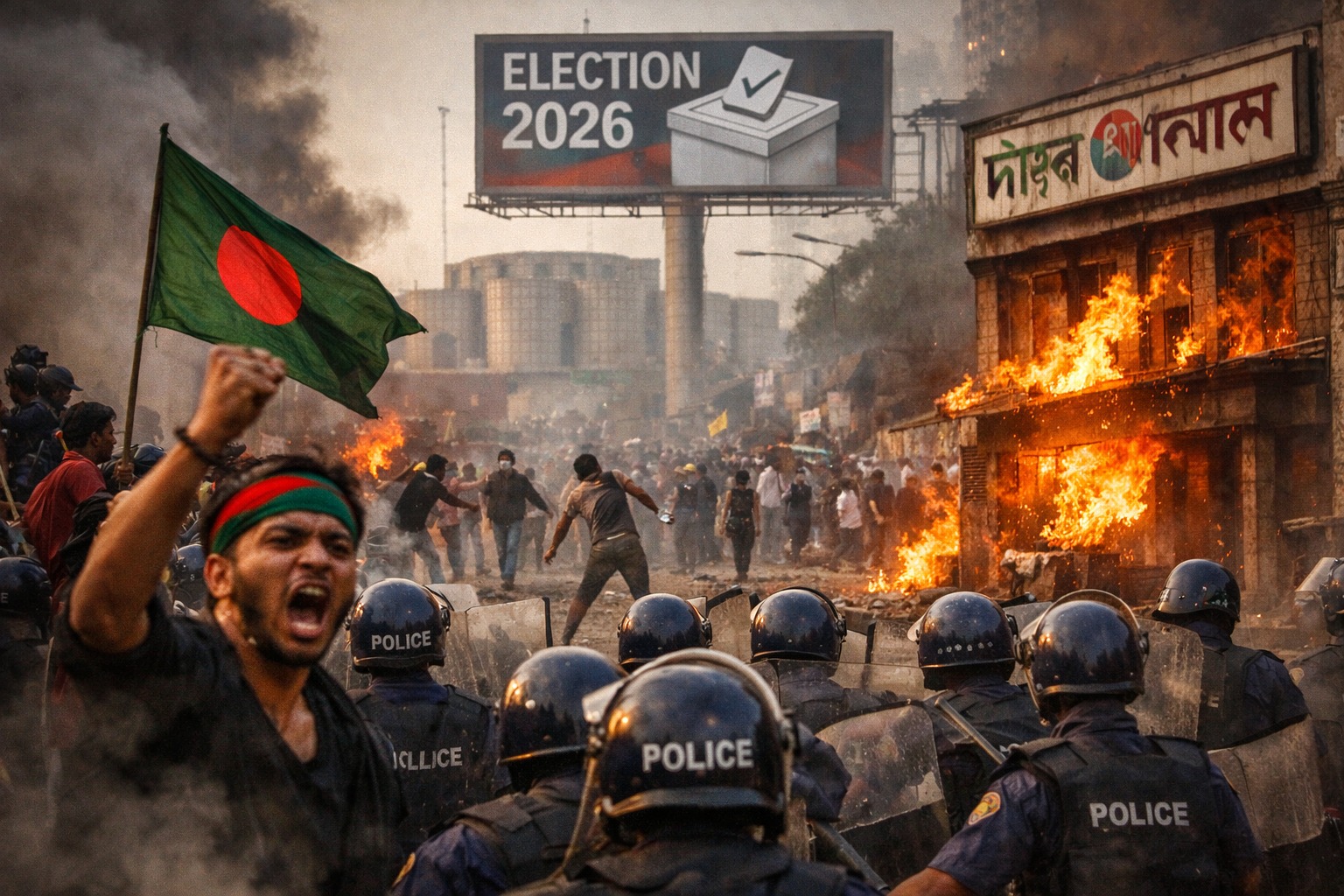
Protesters clash with security forces amid fires and smoke in Dhaka, underscoring how political unrest and street violence continue to shadow Bangladesh’s transition ahead of the February 2026 general election: AI-generated image via DALL-E
When Bangladesh announced February 12, 2026, as the date for its next general election, the expectation in some quarters was that political uncertainty would finally begin to recede. After months of an open-ended interim arrangement following the upheaval of 2024, a fixed date appeared to offer structure, closure, and a return to constitutional normalcy.
Instead, the announcement has revealed how deeply the crisis has entrenched itself beneath the surface of electoral timelines. The problem Bangladesh now faces is not procedural delay. It is a breakdown in trust, authority, and deterrence that an election date alone cannot repair.
Far from calming the country, the declaration has coincided with continued unrest, political violence, and a visible thinning of state control in moments of crisis. The election date has not resolved the transition. It has exposed how incomplete and contested that transition remains.
Elections announced into unrest
Bangladesh enters the 2026 election cycle amid sustained political volatility. Student movements that played a central role in the 2024 uprising remain active and mobilised. Protests continue to erupt across major cities, often triggered by political killings or perceived injustices tied to the interim period. Demonstrations have repeatedly escalated into clashes with security forces, requiring large-scale deployments to restore order.
These are not the conditions of a society settling into an electoral rhythm. They are the conditions of a society still negotiating where power lies and how it is exercised.
The persistence of unrest matters because elections function as pressure-release mechanisms only when participants believe the process offers genuine agency. In Bangladesh’s current climate, many do not. The announcement of a polling date has therefore been absorbed into an ongoing contest over legitimacy rather than standing above it as a neutral stabiliser.
A date shaped by pressure, not settlement
The manner in which the election date was set has further weakened its stabilising potential. The announcement followed sustained pressure from opposition forces, student groups, civil society actors, and international partners increasingly uneasy with prolonged interim rule. It did not emerge from a negotiated political settlement or a widely accepted transition roadmap.
More importantly, the vote remains conditional. It is tied to an expansive reform agenda, including a constitutional referendum to be held alongside the general election. Reform was earlier cited as the reason elections could not be held. Now it has been fused into the electoral exercise itself.
This sequencing is politically risky. Reforms are meant to establish clarity and confidence before voters are called to the polls. In Bangladesh, voters are being asked to decide on leadership and structural change simultaneously, without agreement on the rules of competition or trust in the institutions administering them. In unstable environments, such arrangements tend to amplify suspicion rather than legitimacy.
Political exclusion and the closing of formal channels
The most destabilising decision of the interim period has been the exclusion of the Awami League from contesting the election. Whatever judgments are made about its tenure in power, the party remains one of Bangladesh’s two dominant political forces, with deep organisational reach and a substantial voter base.
Removing such a player from electoral competition fundamentally alters the meaning of the exercise. Elections are not merely about administration; they are about representation. When a major segment of the electorate sees its political vehicle barred by decree rather than defeated at the ballot box, confidence in the process erodes rapidly.
The security implications are predictable. When formal channels of political participation narrow, mobilisation shifts elsewhere. Bangladesh’s history offers repeated examples of boycotts, hartals, and confrontational street politics when elections are perceived as foreclosed. The current wave of unrest fits that pattern.
Violence, deterrence, and institutional thinning
The consequences of prolonged political uncertainty are now visible beyond partisan rivalry. Over the past year, Bangladesh has witnessed a disturbing rise in mob violence and communal incidents. Lynchings linked to blasphemy accusations, attacks on minority neighbourhoods, and vandalism of religious and cultural sites have occurred with alarming frequency.
Equally telling have been attacks on the press. During recent protests, mobs torched newspaper offices, temporarily silencing some of the country’s most prominent independent media outlets. Such acts are not spontaneous outbursts alone; they reflect a weakening expectation that institutions will respond decisively or impartially.
This is what institutional thinning looks like in practice. Authority does not disappear overnight. It erodes gradually, as deterrence weakens and non-state actors test boundaries with increasing confidence. Elections held in such environments are not neutral events. They are stress tests — and often flashpoints.
Reform as control rather than confidence-building
The interim administration argues that reforms are essential to prevent a return to past governance failures. That argument is not without merit. Bangladesh’s political system has long struggled with executive dominance, politicised institutions, and weak checks and balances.
However, reform in contested transitions must be sequenced carefully. In Bangladesh, key aspects of the reform agenda remain vague or politically disputed. At the same time, enforcement actions during the interim period have been perceived as uneven, disproportionately affecting certain political actors and activists.
This perception matters more than intent. Reform that is trusted can restore confidence. Reform that appears selective reinforces the belief that rules are being rewritten to predetermine outcomes. In a society already experiencing unrest, that belief accelerates disengagement from institutional politics.
A generation that has not disengaged
The generation that mobilised in 2024 did not do so to exchange one form of unaccountable authority for another. Their demand was not simply elections, but agency and accountability. For many of them, the February 2026 date answers only part of that demand.
What they are watching now is whether the process leading to that date opens political space or constrains it further. An election perceived as managed or exclusionary risks deepening cynicism among precisely the cohort that has shown the greatest capacity for mobilisation.
That cynicism has consequences. When younger citizens disengage from formal politics while remaining active in protest spaces, instability becomes more persistent, not less.
An exposed, not resolved, transition
The deeper problem Bangladesh faces is that the transition has been treated as a timetable rather than a settlement. A date on the calendar creates the appearance of motion without necessarily producing legitimacy. In the absence of trusted institutions, inclusive participation, and credible referees, elections risk becoming procedural exercises detached from political reality.
If February 2026 delivers a vote shaped by exclusion, fear, and selective enforcement, the unrest visible today will not dissipate at the ballot box. It will harden. Political grievances displaced from institutions will remain active on the streets, where the costs of resolution are always higher.
Bangladesh still has time to adjust course. But that window is narrowing. Restoring credibility will require more than announcements. It will require visible restraint, institutional correction, and a willingness to accept uncertainty rather than manage outcomes.
The election date has not ended Bangladesh’s crisis. It has revealed how much remains unresolved. Whether the coming year leads to democratic repair or deeper instability will depend not on the calendar, but on whether political authority is rebuilt on consent rather than control.