

Army Deploys Gunshot Detection and Drone Response Systems from Indian Startup After Successful Trials
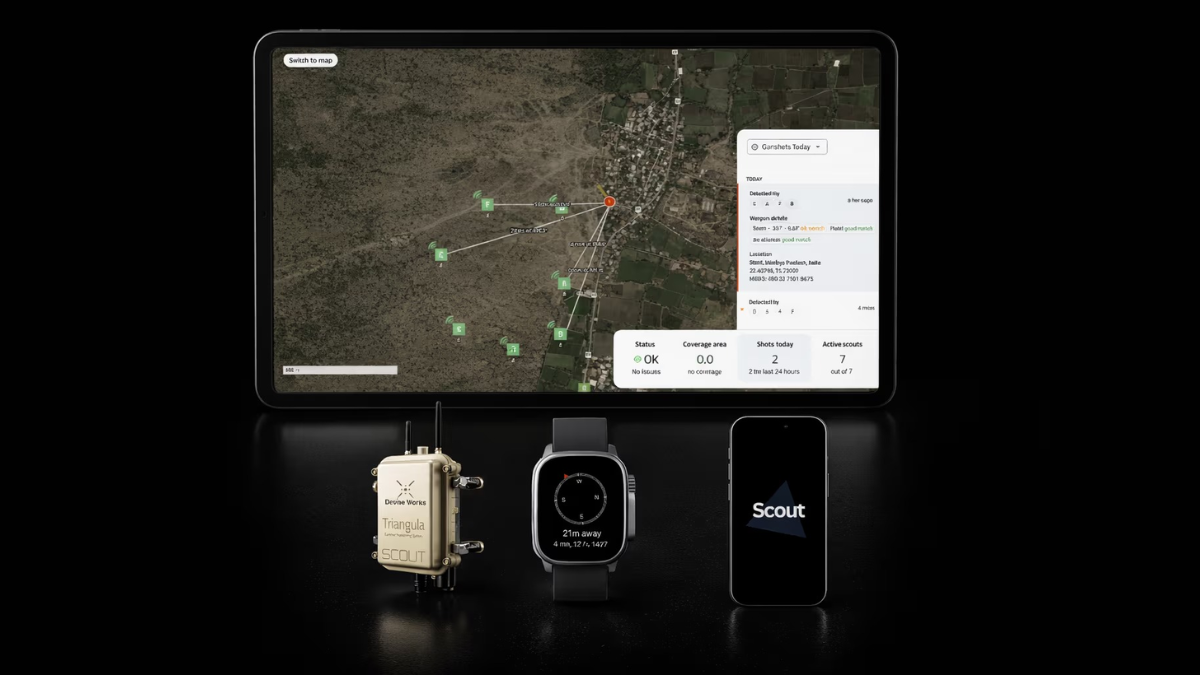
AI drones enhance Indian Army rapid response (Image courtesy: Drone Verse)

The Indian Army has deployed an indigenous AI Gunshot Detection and Autonomous Drone Response System, developed by an Indian defence technology company, to boost its response speed and accuracy in the border areas.
The two systems from the Gurugram-based DroneVerse Aviation Private Limited, was deployed for evaluation, to increase soldier safety in a high-threat environment, the company said on Thursday (January 29, 2026) in a statement.
Developed in partnership with a global AI-driven acoustic threat detection company named Triangula, the systems were made through a structured technology transfer agreement for the Indian market, the company said.
DroneVerse Aviation achieved over 90% indigenisation in the systems, both in sensor hardware and drone platforms, including acoustic sensors, electronics, airframes, avionics, autonomy software, and system integration.
The systems were designed and manufactured domestically in India, creating a supply chain ecosystem for long-term sustainment and technology security purposes, aligned with India’s Aatmanirbhar Bharat (Self-Reliant India) objectives, it said.
“In modern combat, situational awareness and reaction time are the difference between life and death. Our focus is operational speed, accuracy, and soldier safety, delivering intelligence when seconds matter most,” DroneVerse Aviation founder and chief executive officer Pawan Khatri said.
“By achieving over 90% indigenisation, we are ensuring that the Indian Armed Forces have a secure, self-reliant tactical advantage that performs reliably in the most complex terrain,” Khatri added.
The AI-enabled systems can detect and classify small arms fire, sniper shots, mortar and artillery fire, and can autonomously deploy drones to provide real-time aerial intelligence, the statement said.
The systems use distributed acoustic sensors along with a large AI-trained acoustic library to triangulate hostile fire within seconds and automatically generate precise grid coordinates.
Adopting secure communication protocols, the systems transmit the generated coordinates to the Unmanned Aerial Vehicle (UAV) that would be launched within four seconds to navigate directly to the source of the ammunition fire.
The drone also livestreams electro-optical and thermal imagery of the environment to the commanders on the ground, through an onboard AI, to identify human activity and to deliver actionable intelligence in real time, the company said.
“The drone is capable of dropping ammunition on the target once the enemy is confirmed, destroying the threat immediately, and offers up to 90 minutes of endurance,” it said.
“The drone is equipped with day/night cameras with infrared illumination, enabling reliable operations in adverse weather conditions, including rain and snow,” it added.
DroneVerse Aviation said the systems’ capabilities were tested and validated under Indian operational, terrain, and weather conditions, including through complex acoustic environments.
The successful evaluations and validations were done by the users from multiple Indian Army units across the Northern and Eastern Commands defending the Line of Control with Pakistan and Line of Actual Control with China, the National Security Guard, the Border Security Force, and paramilitary and police forces, under the Home Ministry.
Following the successful validations, the systems are to be deployed now in a phased manner across high-risk operational zones and critical installations in India’s borders and in the hinterland.