Indian Defence Top Brass Pan Out Across the Globe to Promote Ties with Germany, UK, US
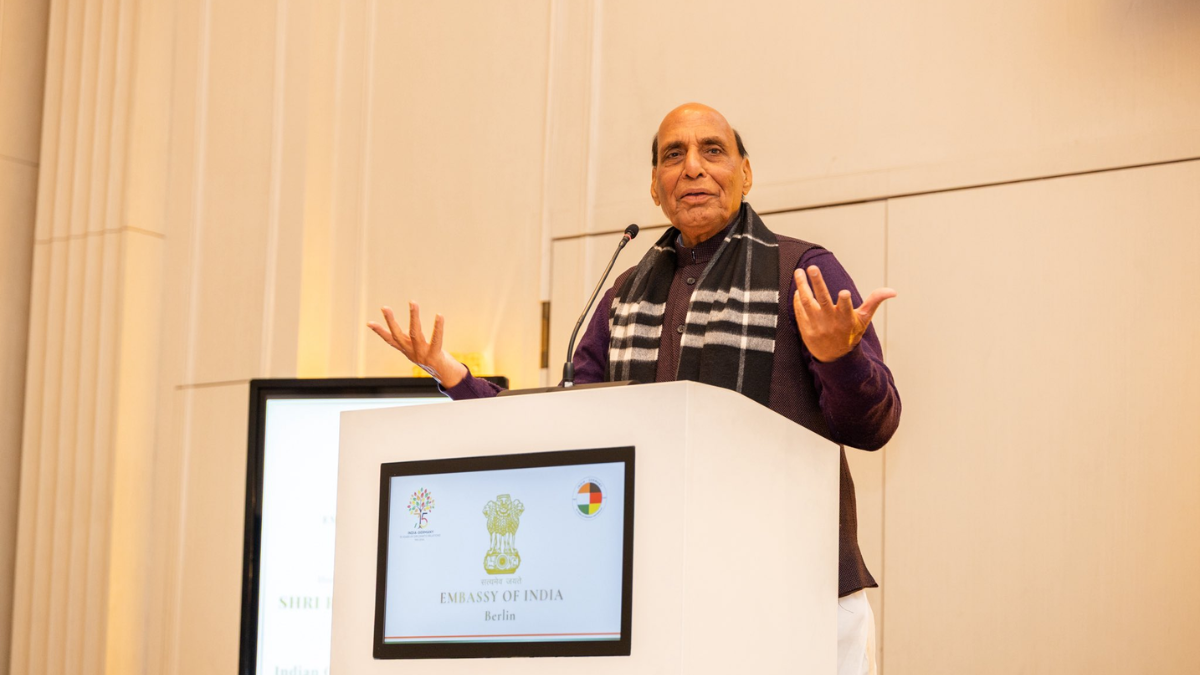
India Germany defence deal. Image courtesy: @rajnathsingh

India’s military top brass have panned out across the Americas and Europe to build better defence ties with key global powers such as Germany, the United Kingdom, and the United States.
India’s Defence Minister Rajnath Singh was in Germany on a three-day visit when he met with his counterpart, Boris Pistorius, in Berlin on April 22, 2026, when the two nations signed two key agreements.
The first agreement was the Defence Industrial Cooperation Roadmap that would prioritise co-development and co-production of military equipment, especially in niche technologies.
The second agreement was an Implementing Arrangement for Cooperation in UN Peacekeeping Training, under which India would take the lead to train the two nations’ soldiers to serve under the Blue Beret with its vast experience as the largest troop-contributing nation for the United Nations peace missions.
During their bilateral meeting, Rajnath Singh and Boris Pistorius discussed a range of bilateral security and defence issues and matters that could further bolster the strategic defence partnership with the European Union.
They also reaffirmed the commitment to enhance military-to-military cooperation as a key pillar of the strategic partnership, according to a statement from the Indian Ministry of Defence (MoD).
Rajnath Singh said that India is looking forward to the German Air Force’s participation in the next edition of Ex-TARANG SHAKTI, which will be held in India in September/October this year.
On the first day of his visit on Tuesday (April 21), Rajnath Singh noted that the Indian government’s ‘Aatmanibhar Bharat’ slogan was not “merely a procurement programme,” but it was “an invitation to co-create, co-develop, and co-innovate.”
Rajnath Singh was speaking to the German Parliamentarians in Berlin when he made a strong pitch for enhanced collaborations between the defence industrial ecosystems of India and Germany.
The Indian Defence Minister asserted that the world today is faced with new security threats, and the technological transformation has made the situation highly complex and intricately connected.
“A new approach with the willingness to adapt to the changing environment is the need of the hour,” he said.
He highlighted that India was witnessing an unprecedented transformation in the defence sector, and increased partnerships with the German industry could yield significant mutual gains.
“We recognise the established strengths of Germany’s leading industrial enterprises, while also admiring the vigour and dynamism of the renowned German Mittelstand (small and medium companies) in advanced and emerging technologies,” Rajnath Singh said.
“In India too, our start-ups and enterprising private companies are rapidly enhancing and complementing the capabilities of our larger and established defence enterprises. This is an area where India and Germany naturally complement each other, and our partnership can deepen further,” he added.
On the same day, Rajnath Singh interacted with the Indian community in Berlin, where he praised the 300,000-strong diaspora, describing them as the strongest bridge between the two countries, with contributions spanning across business, technology, healthcare, academia, and arts.
Meanwhile, India’s Chief of Defence Staff General Anil Chauhan was in the United Kingdom on Monday (April 20) when the two nations reinforced their defence ties with a focus on “evolving nature of conflict and deepening military-to-military cooperation.”
General Chauhan held a series of meetings during his official visit to the UK. The Indian Integrated Defence Staff Headquarters (IDS HQ) posted on X that the CDS met with UK Minister of State for Defence Readiness and Industry Luke Pollard and other senior officials.
In a parallel engagement, the CDS met with UK Minister of State for Indo-Pacific Seema Malhotra, aimed at advancing the broader India-UK strategic framework. Their discussions highlighted a shared priority on strengthening collaboration in critical domains such as cyber, intelligence, and space, reflecting the changing character of global security threats.
The engagements “reaffirmed” mutual commitment to building resilient and technologically advanced armed forces, while further solidifying the India-UK strategic partnership.
British High Commissioner to India Lindy Cameron said, “General Chauhan’s landmark visit shows the trust and ambition driving the UK-India defence partnership. We are stepping up cooperation to strengthen interoperability, spur innovation, and support a free, open, and secure Indo-Pacific.”
She said, “From joint training and defence industry cooperation to strategic dialogue, we are moving faster and closer, because India is a key defence partners for the UK. We will continue to build on this momentum in the months ahead.”
To contribute to the defence diplomacy efforts, Indian Army chief General Upendra Dwivedi was on a visit to the United States, where he was received with a guard of honour at Fort Shafter in Hawaii.
General Dwivedi’s visit underscored the growing strategic alignment between New Delhi and Washington as both nations look to bolster security architecture across the Indo-Pacific.
General Dwivedi engaged in extensive deliberations with General Ronald P Clark, Commanding General of USARPAC, alongside other senior military leadership.
Sharing the details in a post on X, the ADGPI said that COAS Dwivedi also held discussions on promoting peace and stability in the Indo-Pacific.
The COAS also undertook an aerial tour of Oahu Island. The survey provided the General with a firsthand look at the US military’s training ecosystem.
He observed the sophisticated infrastructure used for jungle and littoral warfare training and multi-domain readiness, gaining insights into how the US integrates land, air, sea, cyber, and space capabilities to maintain operational dominance.
Meanwhile, the Indian Embassy in Washington hosted General Dwivedi, who was in the US soon after the previous visits of India’s navy and air force chiefs. India’s Ambassador to the US, Vinay Mohan Kwatra, received the Indian Army chief at India House.
“It (Army chief’s visit) is expected to further cement the India-US defence ties, a cornerstone of our comprehensive global strategic partnership, towards ensuring a free, open and prosperous Indo-Pacific region,” the embassy said in a statement.