

India–China Defence Ministers’ Talks At SCO: LAC Stability, Regional Security Amid West Asia Conflict Discussed
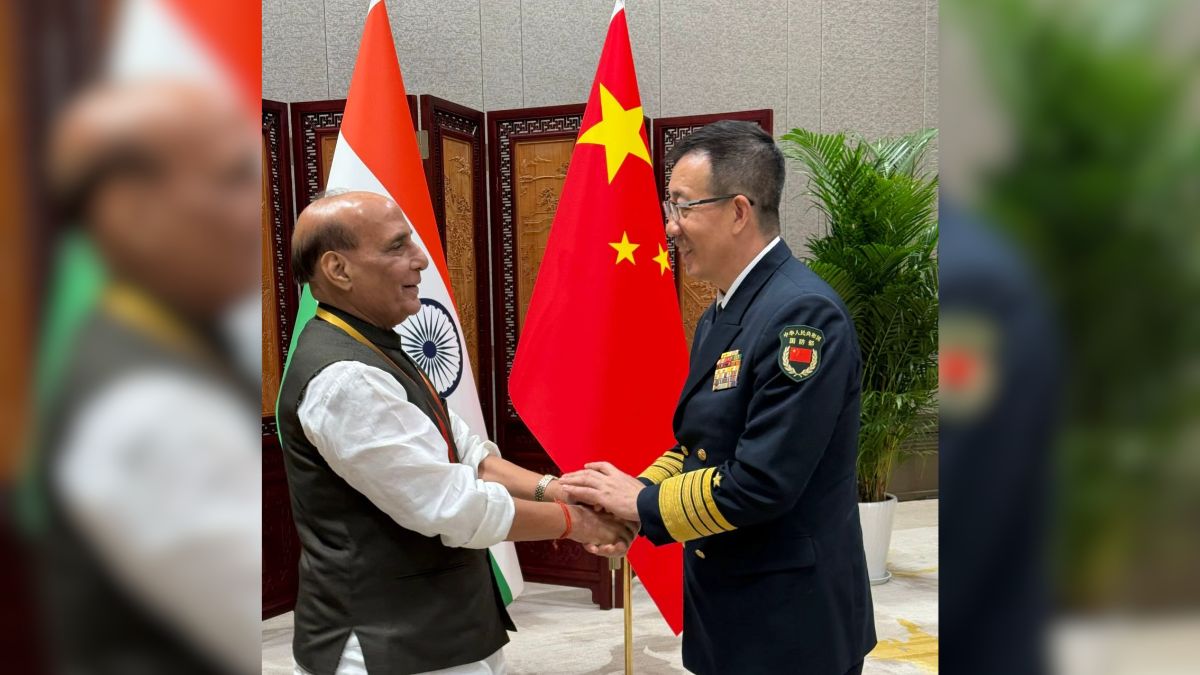
Rajnath Singh interacted with the Defence Minister of China Admiral Dong Jun during the SCO Defence Ministers’ Meeting in Bishkek. Image courtesy: X.com/@ChinaSpox_India

Defence Minister Rajnath Singh recently travelled to Bishkek in Kyrgyzstan to attend the SCO Defence Ministers’ Meeting. During his trip, Singh held bilateral meetings with key member countries on the sidelines of the meeting, including his Chinese counterpart Admiral Dong Jun. Both the leaders met on Tuesday (April 28, 2026).
Day after Singh’s meeting with Chinese Defence Minister Admiral Dong Jun, Beijing said the two sides discussed the issue of maintaining “peace and tranquillity” along the Line of Actual Control (LAC). On Wednesday (April 29, 2026), a spokesperson of the Chinese embassy in India, Yu Jing, shared the update on X.
“The two sides discussed maintaining peace and tranquillity along the LAC as well as broader regional security issues, including the West Asia situation,” the Chinese spokesperson wrote on social media.
Describing the interaction, Rajnath Singh said, “It was a pleasure to interact with the Defence Minister of China during the SCO meeting in Bishkek.”
Notably, the Indian statement did not mention that the LAC was discussed.
India-China relations: Why is the Line of Actual Control (LAC) central?
The LAC serves as the de facto boundary between India and China and has remained a sensitive issue in bilateral relations. Since the last meeting of the two defence ministers in June last year at Qingdao, China, developments have taken place on the pending border issue. Diplomatic engagement has continued through multiple channels, including talks between Special Representatives – India’s National Security Adviser Ajit Doval and China’s Foreign Minister Wang Yi.
These discussions have explicitly referenced the 2005 agreement titled ‘Political Parameters and Guiding Principles for the Settlement of the India-China Boundary Question’, which provides a framework for resolving the long-standing boundary dispute.
What makes this meeting significant now?
The Bishkek meeting was the first interaction between the two defence ministers since June last year, making it a key moment in ongoing military and diplomatic engagement. Moreover, it comes at a time when both countries have been working to stabilise the border situation while maintaining broader communication channels at political and military levels.
According to China’s statement, the talks also covered “broader regional security issues, including the West Asia situation.”
This reflects how ongoing geopolitical turmoil in West Asia is influencing multilateral discussions, with major regional powers assessing its impact on security, energy flows and economic stability.
What role does the SCO play in such engagements?
The Shanghai Cooperation Organisation (SCO), one of the largest political and economic groupings in the region, provides a platform for dialogue on security and cooperation among its members.
Established on June 15, 2001 in Shanghai, the SCO includes India, China, Russia, Kazakhstan, Kyrgyzstan, Pakistan, Tajikistan, Uzbekistan, Iran and Belarus. India became a full member in 2017.
This year’s Defence Ministers’ meeting took place against the backdrop of wider geopolitical uncertainty, with the grouping expected to deliberate on measures to reduce the impact of ongoing conflicts, including those in West Asia.


