


India Inducts Indigenous Hybrid Brake Parachute To Boost LCA Tejas Landing Safety
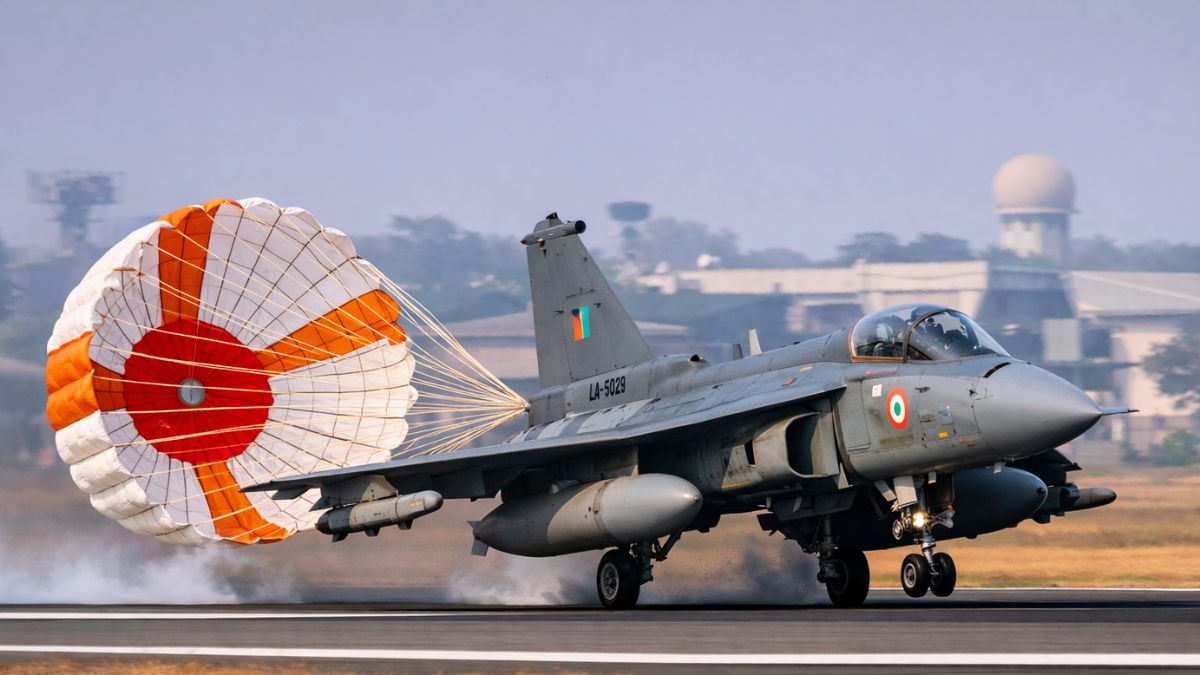
India has added a new layer of safety to its LCA Tejas fleet with the induction of an indigenous brake parachute system, strengthening landing performance and operational readiness at demanding airfields. Image courtesy: AI generated Picture via DALL-E

India has significantly enhanced the operational safety of its Light Combat Aircraft (LCA) Tejas with the induction of an indigenously developed Hybrid Brake Parachute, marking another milestone in the modernisation of the Indian Air Force’s frontline fighter fleet.
The system, produced by Gliders India Ltd (GIL), is designed to improve aircraft recovery during high-speed landings and emergency situations, particularly at short and advanced airfields.
How does the Brake Parachute system help Tejas jets?
According to defence officials, the lightweight parachute reduces the landing run of the Tejas while offering greater flexibility in demanding operational environments.
This capability is especially critical for fighter operations that require rapid recovery and redeployment under challenging conditions.
What is the Brake Parachute system?
The Hybrid Brake Parachute features a Uni-Cross main canopy with a diameter of 5.75 metres and a total surface area of 17 square metres.
This design ensures stable and efficient deceleration, which is vital during high-speed recoveries.
Weighing just 10 kilograms, the system combines low mass with robust performance, making it suitable for frequent operational use without adding a significant weight penalty to the aircraft.
How does the Brake Parachute system work?
In terms of performance, the parachute can be deployed at speeds of up to 285 kmph under normal conditions and up to 340 kmph during emergencies.
It incorporates a multi-stage deployment mechanism, including pilot and auxiliary chutes, to maximise reliability during critical moments of landing.
Officials note that the system “enhances mission readiness while adding an important safety layer for pilots during demanding operations.”
How does the Brake Parachute enable Tejas’ turnaround time?
Its compact design also simplifies installation and handling, contributing to faster aircraft turnaround times and reduced maintenance burden for ground crews.
Beyond operational benefits, the induction of the Hybrid Brake Parachute supports India’s push for self-reliance in defence manufacturing.
By replacing imported safety systems with a domestically produced solution, the upgrade strengthens indigenous capabilities and reinforces confidence in the homegrown Tejas programme, underscoring India’s commitment to modernising its air defence assets through local innovation.