
Sukhoi-30MKIs, Jaguars To Fly Over Arabian Sea As India, France, UAE Set For High-Voltage Trilateral Air Drills
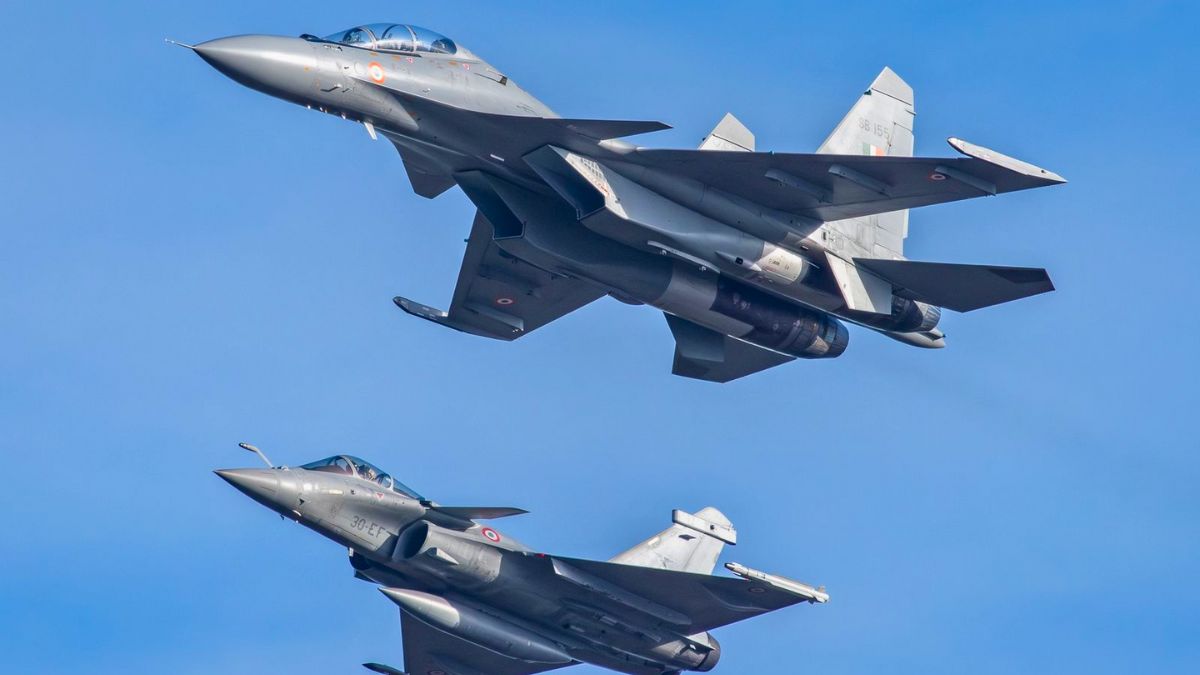
The exercise will be conducted over the Arabian Sea on India’s western front, with the designated exercise zone lying roughly 200 nautical miles from Karachi. Image courtesy: X.com/IAF_MCC

India is gearing up for a major airpower demonstration as New Delhi, Paris and Abu Dhabi come together on Wednesday (December 10, 2025) for a high-intensity trilateral air combat exercise over the Arabian Sea. Designed to deepen defence cooperation and sharpen joint warfighting skills, the drills mark one of the most significant air combat engagements in the region this year.
Reinforcing a fast-strengthening military partnership spanning the Indian Ocean and the wider Indo-Pacific, the joint exercise will see the Indian Air Force deploying several fighter jets like Sukhoi-30MKIs and Jaguars, backed by IL-78 mid-air refuellers and AEW&C (airborne early-warning and control) aircraft.
The trilateral drills comes just a few weeks after IAF’s Sukhoi-30 MKI frontline fighter aircraft took to the skies over France along with the French Air and Space Force’s Rafale jets as both forces took part in the 12-day long joint training exercise Garuda 2025 last month at Mont-de-Marsan Air Base in France.
How will India scale up air combat power for the drills?
The Indian Air Force is set to field a formidable mix of frontline aircraft, including Sukhoi-30MKI and Jaguar fighters, supported by IL-78 mid-air refuellers and AEW&C airborne early-warning platforms. These assets will operate from key airbases such as Jamnagar and Naliya in Gujarat and will undertake complex combat manoeuvres with French and Emirati forces.
France and the UAE will fly in Rafale and Mirage fighters along with additional supporting aircraft from the Al Dhafra airbase. India has already issued a Notam for the designated exercise area, located roughly 200 nautical miles from Pakistan’s Karachi, signalling a comprehensive operational setup for December 10–11.
India, France, UAE trilateral drills: What makes these exercises geopolitically important?
This is not the first time the three nations are training together. Their previous trilateral air combat exercise, Desert Knight, was held an year ago in December 2024. But the timing and scale of the latest edition reflect a deeper strategic push to enhance security coordination in the Indian Ocean Region and the broader Indo-Pacific.
India’s growing network of air and naval exercises with regional powers like France, the UAE, the US and Australia highlights its intent to develop seamless operational interoperability across multiple theatres. Officials emphasise that such engagements refine combat tactics and enhance readiness in realistic, high-pressure scenarios.
How does this fit into the broader trilateral defence roadmap?
The trilateral partnership launched by the foreign ministers of India, France and the UAE in 2022 goes well beyond military drills. The three countries are actively advancing cooperation in defence, energy, technology and climate action under an ambitious joint roadmap.
The air exercise follows the first-ever trilateral maritime partnership drill conducted by their navies in June 2023, which focused on countering both traditional and non-traditional threats at sea. Taken together, these steps highlight the emergence of a robust, multidimensional strategic alignment.
With the Arabian Sea now set to witness high-tempo joint combat manoeuvres, the trilateral remains a powerful signal of growing coordination among three key Indo-Pacific stakeholders, who are backed by shared interests, shared capabilities and shared commitment to regional security.