



The Strike Is Only Half the Battle: What the Swadeshi FF Bot’s Debut at Vayu Shakti 2026 Actually Signals
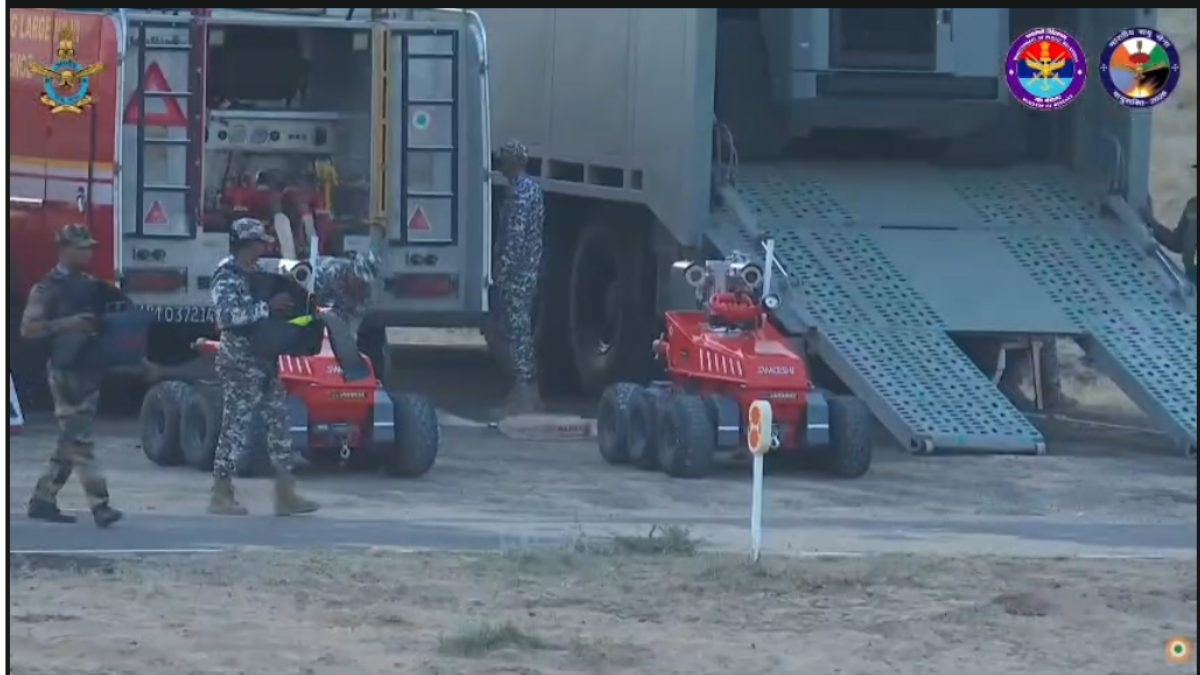
FF Bot firefighting robot. Image courtesy: IAF

Air force exercises serve a purpose beyond demonstration. They signal doctrine—what a force prioritises, what problems it has thought through, and how comprehensively it understands the nature of the wars it may be called upon to fight.
Measured against that standard, Exercise Vayu Shakti 2026 at Pokhran was notable for the combat aircraft and also for what it chose to place on the ground between phases.
What Happened at Pokhran
On February 27, 2026, the Indian Air Force conducted Exercise Vayu Shakti 2026 at the Pokhran Field Firing Range in Jaisalmer, Rajasthan. More than 130 aircraft participated in a scripted, day-and-night scenario covering the full spectrum of air operations—from offensive strikes and air defence to special operations and humanitarian missions. Frontline fighters, including the Rafale, Su-30 MKI, Mirage-2000, MiG-29, Jaguar, and Hawk, executed precision strikes on simulated ground targets using precision-guided munitions and long-range weapons.
Notably, for the first time, the exercise was conducted along a defined operational storyline designed to simulate a live combat theatre, rather than a series of standalone demonstrations–a format the IAF said was intended to reflect its doctrine of multi-domain integrated operations.
It was within this setting that a live demonstration of a firefighting robotic vehicle was conducted during a break in proceedings, before the exercise transitioned into its night phase. The platform—the FF Bot, developed by Ahmedabad-based startup Swadeshi Empresa Pvt Ltd–received a fraction of the coverage that the combat aircraft did. That gap in attention is worth closing.
The Problem the FF Bot Is Designed to Solve
Modern air warfare has a well-documented secondary effect that rarely features in coverage of strike operations: fire. When a missile hits a fuel depot, an ammunition store, or an aircraft hangar, the explosion is the first event.
What follows–fire spreading laterally into adjacent structures, heat triggering secondary detonations in munitions stores, and burning fuel compromising facilities that were never directly targeted–is often the more damaging sequence.
Iran, in 2026, has provided the starkest real-time illustration of this dynamic. Strikes on fuel depots near Tehran caused rivers of fire to pour through the streets, blanketing the capital in thick black smoke. US B-52 bombers targeting an ammunition depot and airbase in Isfahan triggered chain-reaction explosions, where heat from one strike bled into adjacent munitions stores and fuel lines, turning a single hit into a rolling catastrophe.
The window between ignition and irreversible cascade is narrow, hostile, and lethally unsurvivable for any human crew operating near live secondary detonation risk. This is not a new operational problem. What has been missing, historically, is a practical solution for it–a system that can enter that window and function effectively when human responders cannot.
What the FF Bot Brings to That Window
The FF Bot is a remotely operated, unmanned ground vehicle built specifically for high-risk fire environments. It is equipped with an aqua foam jet and fog water monitor for fire suppression, alongside optical and thermal pan-tilt-zoom cameras that provide real-time visual and infrared situational awareness, enabling precise targeting of fire sources, improved navigation in low-visibility conditions, and accurate assessment of heat signatures during active firefighting operations.
Its defining operational advantage is straightforward: it goes where personnel cannot. Its rugged frame, heat-resistant shielding, and remote-guided mobility allow it to move across debris, deliver fire suppressants, and stream real-time visuals from deep inside compromised structures, including fuel storage zones, explosive environments, and aircraft hangars, where human access becomes dangerous within seconds of a fire breaking out.
IAF engineering branches contributed to refinement trials, validating the system’s durability under high-temperature stress, uneven terrain, and low-visibility conditions. Officials noted that the robot not only met the performance benchmarks set for base-level firefighting equipment—it cleared them with room to spare.
Why Its Presence at Vayu Shakti Was Deliberate, Not Incidental
An air force’s combat effectiveness is a function of two things: its ability to strike, and its ability to keep the infrastructure that enables striking—airbases, fuel stores, hangars, ammunition depots—operational under adversarial conditions. These two requirements are inseparable. Destroying an enemy’s air assets is one mission objective. Preventing a single enemy strike from cascading into the destruction of an entire airbase’s operational capacity is another.
For a long time, the second half of that equation did not receive nearly enough attention. Vayu Shakti 2026—structured, for the first time, as an end-to-end simulated combat theatre was the appropriate setting to address that gap publicly and on record. The FF Bot’s demonstration was not a sideshow to the combat aircraft displays. Within the exercise’s own operational logic, it was a direct answer to the question that Iran’s burning infrastructure has been raising for weeks.
The Broader Institutional Picture
The FF Bot’s development and induction also reflect a maturation of India’s defence innovation ecosystem. The iDEX programme—Innovations for Defence Excellence, launched in 2018—gave deep-tech startups structured access to military problem statements, funding, and real trial environments. Over 300 contracts and Rs 1,500 crore later, the results are appearing at exercises like Vayu Shakti as field-ready hardware shaped by operational feedback rather than theoretical specifications.
The FF Bot’s cross-service adoption, developed originally for the Indian Navy and now procured by the Army, with the IAF incorporating it into Vayu Shakti, represents a meaningful step in inter-service technology transfer.
The combat aircraft at Vayu Shakti 2026 demonstrated what the IAF can do to an adversary, whereas the FF Bot demonstrated what the IAF can do to protect itself when the adversary strikes.