

Army Gets A Firepower Boost: First Batch Of 2000 Indigenous ‘Prahar’ LMGs Delivered By Adani Defence
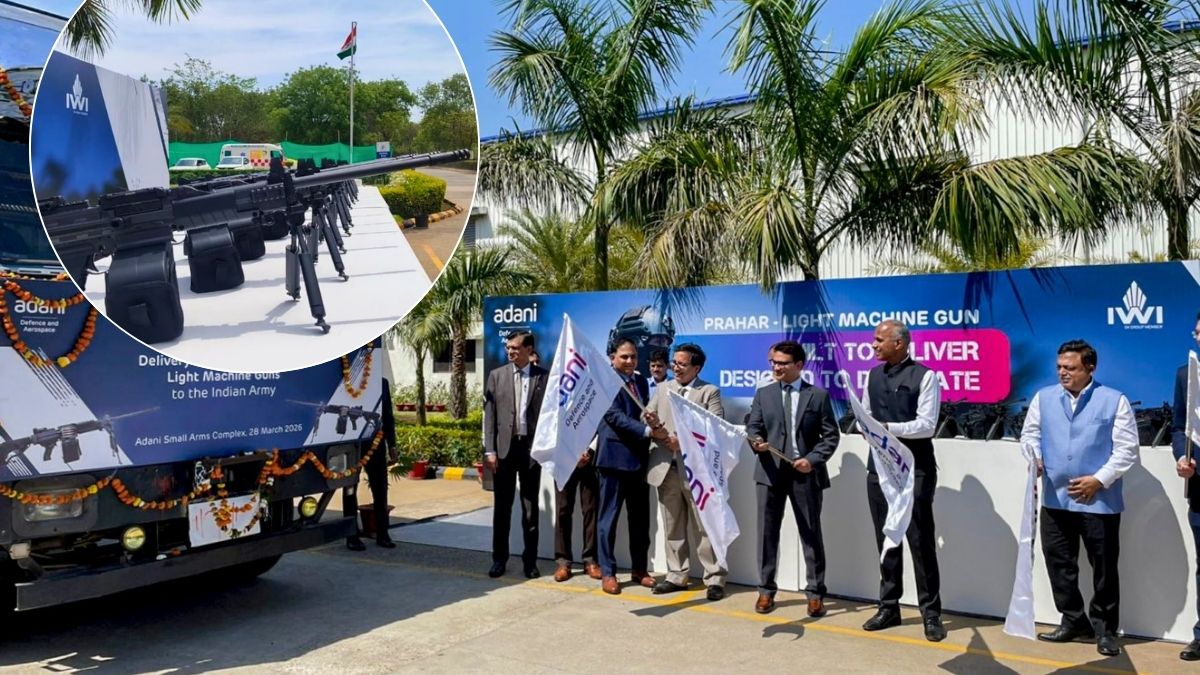
The Prahar LMG significantly reduces reliance on imported infantry weapons and strengthens self-reliance in the defence sector. Image courtesy: RNA

The first batch of 2,000 indigenously manufactured ‘Prahar’ light machine guns (LMGs) was delivered to the Indian Army by Adani Defence and Aerospace in partnership with Israel Weapon Industries on Saturday (March 28, 2026). The induction, which came ahead of the delivery schedule, marks a significant push to frontline combat capability and defence self-reliance.
Set to substantially enhance infantry firepower and battlefield effectiveness, the induction of Prahar LMGs represents a critical upgrade to the Army’s infantry backbone. The Prahar LMG, based on the proven Negev NG7 platform, directly addresses these operational requirements.
Delivered of the 2,000 indigenous LMGs by Adani Defence comes nearly a year ahead of schedule, marking a key milestone under the ‘Make in India’ initiative, with over 40,000 such weapons slated to be produced domestically in the coming years.
Why is the induction of Prahar LMGs a big deal?
Light machine guns form the primary suppressive fire element in combat, enabling troops to dominate engagements, pin down enemy positions, and provide cover during manoeuvres. With evolving battlefield dynamics, especially lessons from recent conflicts, the need for mobile, high-rate, and reliable firepower has become more pronounced.
The Prahar stands out for its lethality, mobility, and reliability, three attributes critical in modern warfare. Chambered in 7.62 mm calibre, it delivers higher stopping power compared to smaller calibre systems, making it effective in diverse combat scenarios, including counter-insurgency and conventional warfare.
Its relatively lighter weight of 7.6 kg gives Indian soldiers a distinct advantage, especially in high-altitude and rapid deployment situations where mobility can determine survival. The weapon’s compact design with a foldable stock further enhances its suitability for paratroopers and mechanised infantry.
Technically, the Prahar uses an open bolt system with a gas-operated rotating bolt, ensuring sustained firing capability with reduced overheating risks, a crucial factor during prolonged engagements.
How does this strengthen Army’s combat readiness?
The early delivery of the first batch signals not just faster procurement but also improved operational readiness. With thousands more LMGs set to be inducted, infantry units across theatres, from the northern borders to counter-insurgency grids, will see a uniform upgrade in firepower.
This also aligns with the Army’s broader push to modernise its small arms inventory, replacing legacy systems with more advanced, combat-proven platforms.
Beyond the battlefield, the Prahar programme underscores India’s growing strength in indigenous defence manufacturing. Produced by Adani Defence and Aerospace in partnership with Israel Weapon Industries, the project reflects a shift from mere assembly to full-spectrum manufacturing capability, including design, production, and quality assurance.
The Gwalior facility, capable of producing up to one lakh firearms annually, signals India’s ambition to not only meet domestic demand but also emerge as a global hub for small arms exports. Officials have described the accelerated delivery timeline as a sign of the industry’s ability to “race against time”.
Supply chains amid global tensions
Amid ongoing tensions in West Asia, concerns around supply disruptions remain. However, both Indian and Israeli partners have emphasised supply chain resilience, backed by manufacturing capabilities in both countries. Efforts are also underway to further localise production, ensuring that India’s defence preparedness remains insulated from geopolitical uncertainties.
The induction of Prahar LMGs is more than just a procurement milestone, as it marks a strategic upgrade in India’s infantry doctrine. As future batches roll out, the Prahar is expected to become a mainstay weapon in the Indian infantry’s arsenal.