


Maru Sangram In Desert: How Indian Army’s High-Intensity Drill In Jaisalmer Is Powering Next-Gen Warfare Readiness
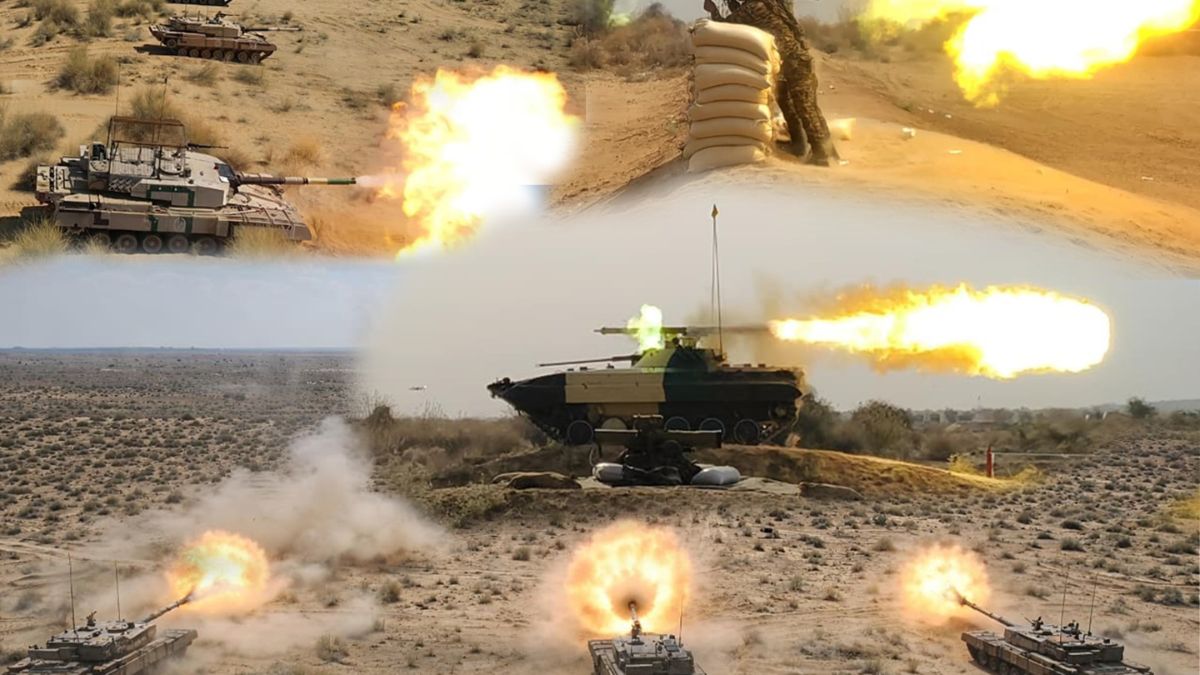
The Konark Warriors demonstrated their commitment to maintaining combat readiness by continuously honing their tactical and technical skills. Image courtesy: X.com/@KonarkCorps

In the vast and unforgiving expanse of the Thar Desert, the Indian Army has once again showcased its combat edge through Exercise Maru Sangram, an intensive war drill that underlines its readiness for modern, multi-domain warfare. At a time when evolving threats demand speed along with precision, such exercises are critical in ensuring that India’s frontline forces remain battle-ready at all times.
The review of the exercise was done by Lt Gen AVS Rathee, General Officer Commanding of the Konark Corps, signalling the strategic importance attached to operational preparedness, especially in forward areas.
Conducted in the forward sector of Jaisalmer, the exercise brought together a formidable combination of combat arms under near-real battlefield conditions. The elite Battle Axe Division, led by Major General Ashish Khurana, spearheaded operations alongside armoured units, mechanised infantry and artillery formations.
Exercise Maru Sangram 2026: What did the troops practice?
The drill was designed to validate integrated battle strategies, ensuring seamless coordination across units. The harsh desert terrain added another layer of complexity, testing both equipment and personnel under extreme environmental conditions.
In a post on X, Indian Army’s Konark Corps said, “Konark Warriors continue to hone skills to be battle-ready – Armoured, Mechanised Infantry, Artillery, Drones & Counter-Drone Systems and Attack Helicopters – all for one and one for all ‘Atmanirbharta, Innovation & Precision’ of Indian Army for Future Battle Fields.”
How is the Army integrating modern warfare tools?
One of the defining features of Maru Sangram was the integration of advanced technologies into conventional combat frameworks. Drone and counter-drone systems played a key role, enhancing surveillance, target acquisition and threat neutralisation capabilities.
Attack helicopters were deployed to provide aerial support and real-time intelligence, reflecting a shift towards multi-domain operations where land, air and technology converge. This integration is crucial as modern battlefields increasingly rely on speed of information and precision engagement, according to a Times of India report.
How does the Army stay combat-ready through such drills?
For the Indian Army, exercises like Maru Sangram are not just demonstrations, they are essential mechanisms for continuous learning and adaptation. By simulating real combat scenarios, the Army is able to test doctrines, refine tactics and identify operational gaps without the risks of actual conflict.
Regular exposure to diverse terrains, from deserts to high-altitude zones, ensures that troops remain versatile and prepared for any contingency. These drills also foster coordination between different arms of the military, enabling faster and more effective responses during real operations.
Lt Gen Rathee, during his on-ground interaction with troops, highlighted the importance of agility, precision and seamless coordination in modern warfare. He commended the soldiers for their high morale and professionalism, particularly in operating under extreme desert conditions.