

Pakistan-Facing Indian Army Command Exercises Mechanised Forces, Attack Choppers Integration
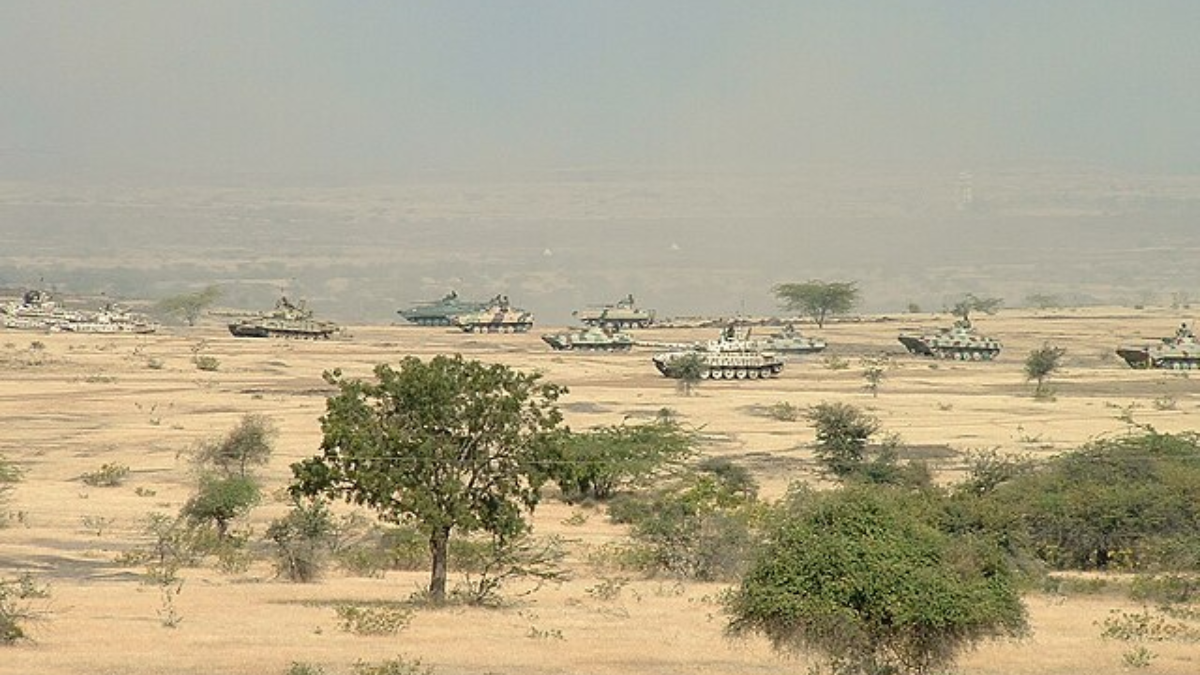
Image courtesy: Wikimedia

Indian Army’s Pakistan-facing Southern Command showcased its capabilities to integrate the mechanised forces with attack helicopters to inflict serious damage to enemy forces in a two-week military exercise that ended on March 18.
The exercise, to validate the army’s force structures’ leap towards tech-driven warfare, created a formidable “protective umbrella” over the battlefield using the attack helicopters in aid of the mechanised forces’ thrust into enemy territory, while facing enemy battle tanks.
The exercise, codenamed ‘Amogh Jwala’, was carried out at the Babina firing range and validated the landmark capability between March 6 and 18, according to army officers with knowledge of the matter.
Focusing on multi-domain operations in an increasingly complex combat environment, the “highlight” of the exercise was the “seamless” coordination between the armoured columns and attack helicopters operating in tandem, one of the army officers said.
“Tanks and infantry combat vehicles advanced under the cover of aerial repower, while helicopters conducted precision strikes, reconnaissance, and real-time target designation,” another army officer said. “This level of synchronisation marks a major evolution in how mechanised warfare will be conducted in future conflicts,” he said.
Southern Army Commander Lt. Gen. Dhiraj Seth, an armoured corps officer himself, witnessed the culmination phase of the ‘Amogh Jwala’ exercise. General Seth commended the troops for their operational excellence and professionalism displayed throughout the exercise.
The Indian Army, which relied on the Indian Air Force (IAF) for close air support during such mechanised forces operations on the battlefield, has over the last couple of decades consciously inducted attack helicopters under its Army Aviation Corps so that command and control of the air support remained with the ground commanders.
The integrated operations between the mechanised forces and the attack helicopters are a strategic game-changer for the Indian Army, as this means the air support for the forward-moving armoured columns would be organic, allowing the army commanders on the battlefield to direct fire at enemy armoured columns and artillery to take them out even beyond visual ranges.
“This enables faster decision-making and precise engagement, drastically reducing response times. The integration also enhances survivability by neutralising threats ahead of advancing columns and providing overwatch. It ensures that mechanised forces maintain momentum even in dynamic battle scenarios,” another army officer said.
“As global battlefields become more technology-driven, the successful integration of attack helicopters with mechanised forces represents a decisive step forward,” a senior armoured corps officer said. “For the Indian Army, it signals a future where speed, precision, and cross-domain coordination will define battlefield dominance,” he added.
Beyond ground-aerial operations coordination, Exercise Amogh Jwala also showcased a broader shift in the warfare strategy of the Indian Army, focusing on multi-domain operations. Mechanised forces operated in conjunction with fighter aircraft, drones, counter-drone platforms, and electronic warfare systems.
The exercise also tested night-fighting capabilities and electronic warfare integration, demonstrating the Indian Army’s growing technological edge.