


Indian Army Unleashes ‘Shaktibaan’: 20 New Drone Regiments To Strike Targets Up To 500 Km, Redefining Modern Warfare
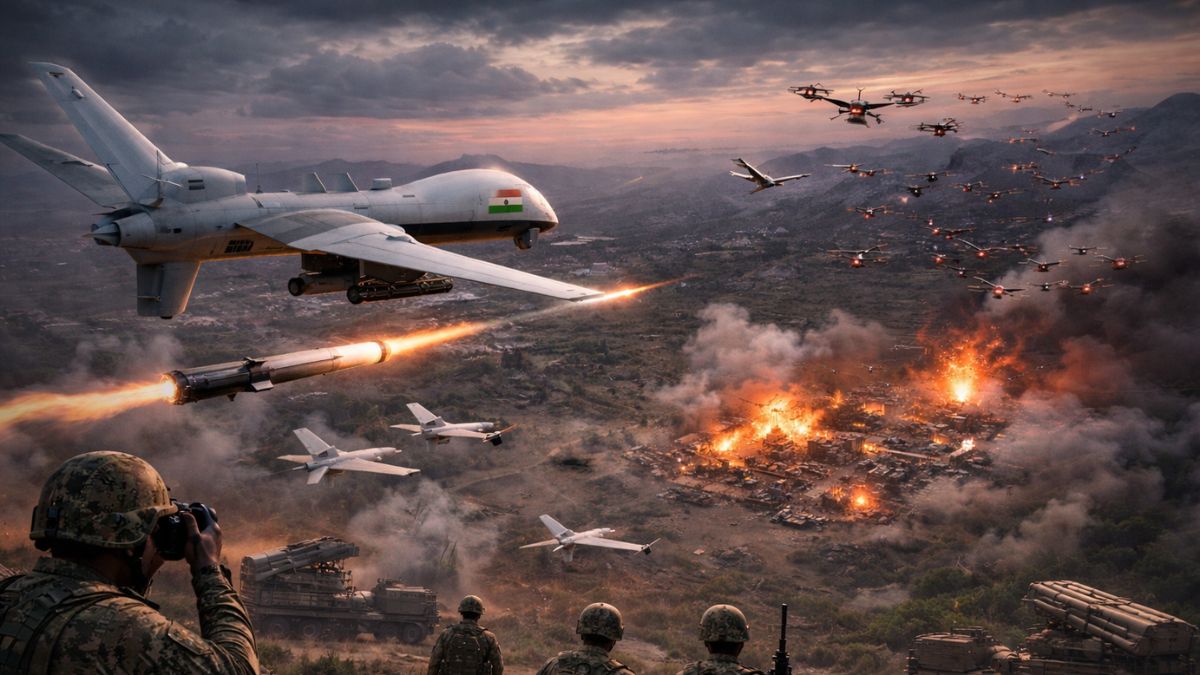
The Indian Army is reshaping its combat architecture by raising new Shaktibaan drone regiments, signalling a decisive shift toward long range, precision and unmanned warfare. Image courtesy: AI generated picture via DALL-E

In a sweeping transformation aimed at preparing for future wars, the Indian Army is raising 15–20 new Shaktibaan regiments equipped with swarm drones, loitering munitions, and long-range unmanned aerial vehicles (UAVs) capable of striking targets from 5 km to as far as 500 km, defence officials have confirmed. The move marks one of the most ambitious restructurings of the Army’s combat architecture in decades.
What are the Shaktibaan regiments?
The Shaktibaan regiments, part of the Regiment of Artillery, are designed to plug a critical capability gap in precision strike operations between 50 km and 500 km. Initial units have already been operationalised, signalling that the shift from concept to battlefield reality is well underway. Conceived under the leadership of Army Chief General Upendra Dwivedi, the initiative reflects the Indian Army’s rapid adaptation to the demands of drone-centric and networked warfare.
How will the Army equip the Shaktibaan regiments?
To equip the first Shaktibaan regiments, the Army is set to issue a fast-track tender for around 850 loitering munitions, along with dedicated launchers. Valued at approximately Rs 2,000 crore, the project will rely entirely on the Indian industry, with firms such as Solar Defence and Aerospace, AdDefence, and RapheM expected to be key contenders. Deliveries are anticipated within the next two years, underscoring the urgency attached to the programme.
How will the new regiments complement existing firepower?
The new regiments will complement existing long-range firepower. For strikes beyond 400–500 km, the Artillery already fields the BrahMos supersonic cruise missile, while its rocket forces are being strengthened with 120-km-range Pinaka multi-barrel rocket systems. Together, these assets are intended to provide a seamless, layered strike capability across the tactical and operational spectrum.
What more is the Indian Army doing for drone induction?
Drone modernisation is not limited to Shaktibaan units alone. The Artillery is also raising 35–40 Divyastra batteries, each equipped with lethal drones of various types. The Infantry, meanwhile, is forming Ashmi platoons in every battalion, while a new Special Forces formation, Bharav, has been created at the Corps Headquarters level, with every operative trained to launch attack drones.
Why is the Indian Army restructuring its fighting units?
The push builds on recent combat experience. During Operation Sindoor, Indian forces employed loitering munitions such as Nagastra, Sky Striker, Harpy, and Harop to strike enemy and Pakistan Army bases following the escalation of hostilities. With over one lakh trained drone operators already in place, the Indian Army’s Shaktibaan initiative signals a decisive shift toward drone-led, precision warfare.