

Bangladesh Unrest Deepens After Student Leader’s Killing As ISI Exploits Volatility; Protests Spill Into India With 1971 Warning
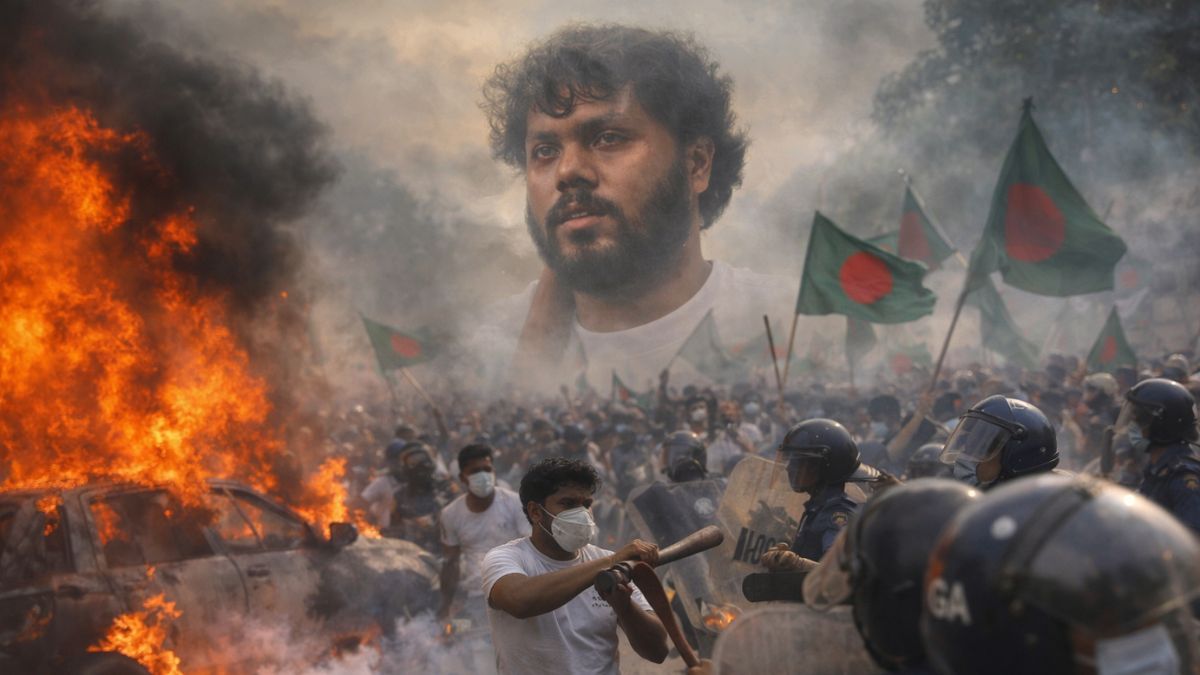
Street unrest in Bangladesh has intensified following a political killing with protests and instability underscoring a fragile pre-election environment and growing regional concern. Image courtesy: AI generated picture via DALL-E

Bangladesh has plunged into a fresh phase of political violence and uncertainty following the killing of student leader Sharif Osman Hadi, with intelligence assessments indicating that Pakistan’s Inter-Services Intelligence (ISI) is exploiting the unrest to destabilise the country ahead of its February 2026 general elections, even as protests linked to the turmoil spill over into India’s Northeast with sharp reminders of the 1971 Liberation War.
The immediate trigger for the latest wave of violence was the death of Hadi, a 32-year-old activist and prominent face of the 2024 uprising that led to the fall of Sheikh Hasina’s government.
Hadi succumbed to gunshot wounds in a Singapore hospital on Thursday (December 18, 2025), six days after he was shot in the head by masked assailants on a motorbike in Dhaka while launching his election campaign. His killing has ignited widespread protests across Dhaka and other cities, pushing an already fragile political environment closer to the edge.
How did the violence spread in Bangladesh?
Within hours of the announcement of his death, violent demonstrations erupted in Dhaka, with mobs torching and vandalising the offices of leading newspapers Prothom Alo and the Daily Star, accusing them of serving “Indian interests”.
Journalists and staff were trapped inside the burning buildings before firefighters and army units intervened. The Awami League’s regional office in Rajshahi was demolished using a bulldozer, while protests were also reported in Chattogram and Khulna. Hundreds surrounded the residence of India’s deputy high commissioner in Dhaka, forcing police to use tear gas to disperse the crowd.
Interim leader Muhammad Yunus described Hadi’s death as an “irreparable loss” to Bangladesh’s democratic transition, declared a national day of mourning, and promised a transparent investigation. Authorities have announced a reward of five million taka for information leading to the arrest of the suspects, who police say may have fled across borders.
How is the Bangladesh violence a Pakistan ISI work?
Beyond the street violence, security agencies see a more calculated hand at work. Intelligence inputs suggest the ISI is not overtly leading the unrest but fuelling it through narrative amplification, digital propaganda, and Islamist networks linked to Jamaat-e-Islami and its student and madrasa affiliates.
These groups have reportedly been instructed to remain in the background, allowing local actors to front the agitation and preserve an appearance of organic mobilisation. Financial flows and social media accounts traced to Pakistan have amplified anti-India sentiment, portraying New Delhi as the protector of Sheikh Hasina, who remains in self-imposed exile in India.
This model of plausible deniability mirrors the ISI’s long-standing playbook: low-cost destabilisation using local grievances, ideological messaging, and online radicalisation. For Pakistan, Bangladesh’s instability has strategic value by exerting pressure on India’s eastern flank at a sensitive political moment.
Has this triggered protests in India to remind about 1971 war?
The regional reverberations were visible on Friday (December 19) in Agartala, Tripura, where hundreds of indigenous youth and students protested outside the Bangladesh Deputy High Commission.
Organised by the Youth TIPRA Federation (YTF), the demonstration condemned remarks by Hasnat Abdullah, a Bangladeshi leader of the newly formed National Citizens Party, who had warned that Dhaka could retaliate against India by supporting efforts to isolate the northeastern “seven sister” states.
Addressing the protest, YTF president Suraj Debbarma invoked the 1971 Liberation War, reminding Dhaka that Bangladesh’s independence was achieved with India’s military support and sacrifice.
“Today, India is being portrayed as an enemy. That is deeply unfortunate,” he said, warning against rhetoric targeting the Siliguri Corridor and Northeast India’s vulnerability. The protest also reflected growing unease among indigenous groups over border security and regional stability.
As Bangladesh navigates a critical pre-election period, the convergence of political killings, mass unrest, external manipulation, and regional tensions underscores how fragile the transition remains, and how quickly domestic turmoil can spill across borders.