
Japan Deploys Combat Troops To Philippines for First Time Since WWII: What Exercise Salaknib 2026 Signals
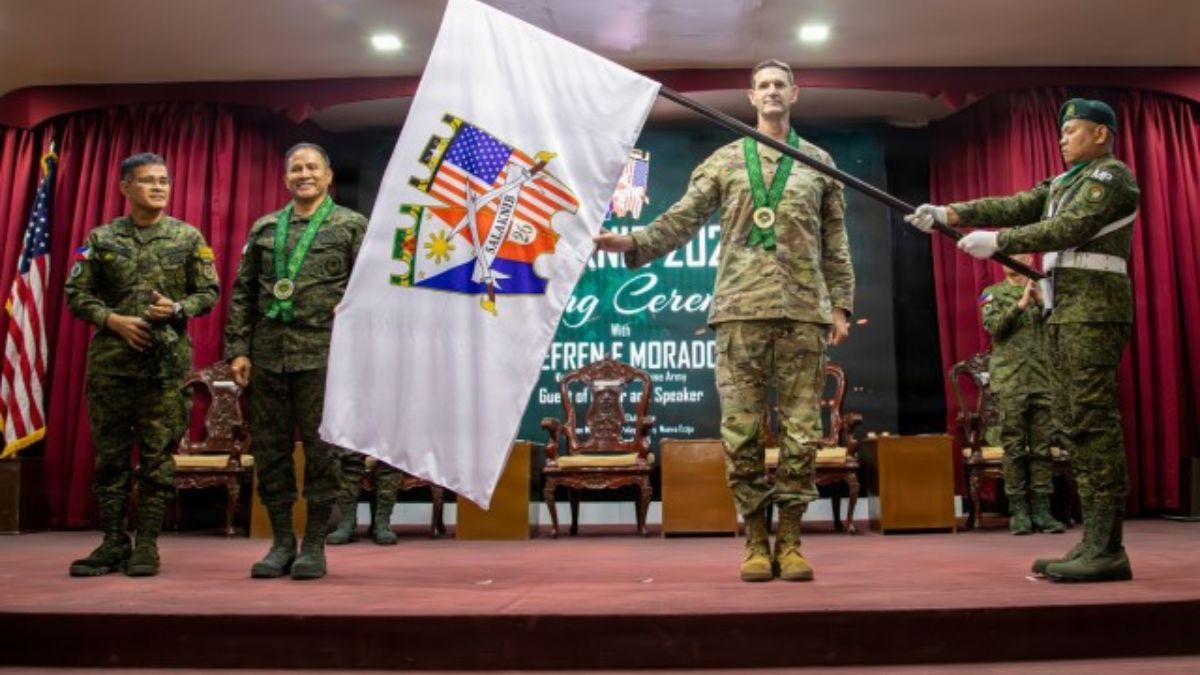
More than 7,000 soldiers from the United States and Philippine armies are taking part in this year’s Salaknib drill. Image courtesy: US Army

In a significant geopolitical development, Japan has deployed combat-ready troops to the Philippines for the first time since its World War II occupation of the country, marking a major shift in regional security dynamics. Around 420 personnel from Japan’s Ground Self-Defence Force have joined the ongoing US-Philippine Salaknib military exercises in northern Luzon, alongside more than 7,000 American and Filipino troops.
The move is being closely watched by regional powers, particularly China, as it reflects Tokyo’s evolving military posture and willingness to take on a more assertive security role in the Indo-Pacific.
What are the Salaknib and Balikatan exercises aiming to achieve?
The annual Salaknib drills, which began last Monday (April 6, 2026) and will run through April 17, are designed to “enhance combat readiness and interoperability between the two armies, focusing on a wide spectrum of military operations”, according to the US Army. Thousands of US and Philippine soldiers are training shoulder-to-shoulder in a series of complex, multi-domain training events.
It will soon be followed by Balikatan exercises, involving all branches of the US and Philippine militaries. Japan is also expected to play a major role, with at least 1,000 personnel anticipated to participate alongside forces from Canada, Australia, France, New Zealand, making it one of the largest editions in the exercise’s history, according to South China Morning Post.
Why is Japan expanding its military role now?
Tokyo’s growing participation comes amid deepening security ties with Manila, especially after the Japan-Philippines Reciprocal Access Agreement, which took effect last September. The pact allows both nations to deploy troops on each other’s soil for joint training, disaster response, and maritime security.
Analysts say the move reflects a broader strategic shift. With the United States increasingly stretched by global commitments, including tensions in the Middle East, regional allies like Japan are being encouraged to take on greater responsibility, the SCMP report added.
Is this about China and Taiwan?
Security experts believe China is central to the calculus. Collin Koh of Singapore’s S. Rajaratnam School of International Studies noted that Beijing could interpret Japan’s involvement as a “rehearsal” for a potential Taiwan contingency alongside the US.
The drills also align with Washington’s updated national security strategy, which emphasises strengthening the “first island chain”, a strategic arc stretching from Japan through the Philippines aimed at limiting China’s military access to the Pacific.
How are Japan-Philippines ties evolving?
Japan’s participation underscores what analysts describe as a shift towards quasi-alliance status between Tokyo and Manila. Gregory Poling of the Centre for Strategic and International Studies called the development a “big deal”, highlighting the “normalisation” of Japan’s military role in regional security.
Both nations share concerns over maritime security and critical trade routes in the South China Sea, as well as the potential fallout from any conflict over Taiwan.
While the exercises may not immediately alter the balance of power, experts say they are crucial for building long-term interoperability and coordination among allied forces. Kei Koga of Nanyang Technological University noted that such cooperation could prove vital in the event of a regional crisis.
Japan’s deployment marks a symbolic and strategic turning point. From a country constrained by its post-war pacifist constitution, Tokyo is steadily transitioning into a more proactive security actor. The fact that this deployment comes in the Philippines, once occupied by Japan during WWII, adds historical weight to the move.