
Naval Blockade, Oil Tanker Seizures And Now Dock Strike! Trump Claims First Land Strike In Venezuela
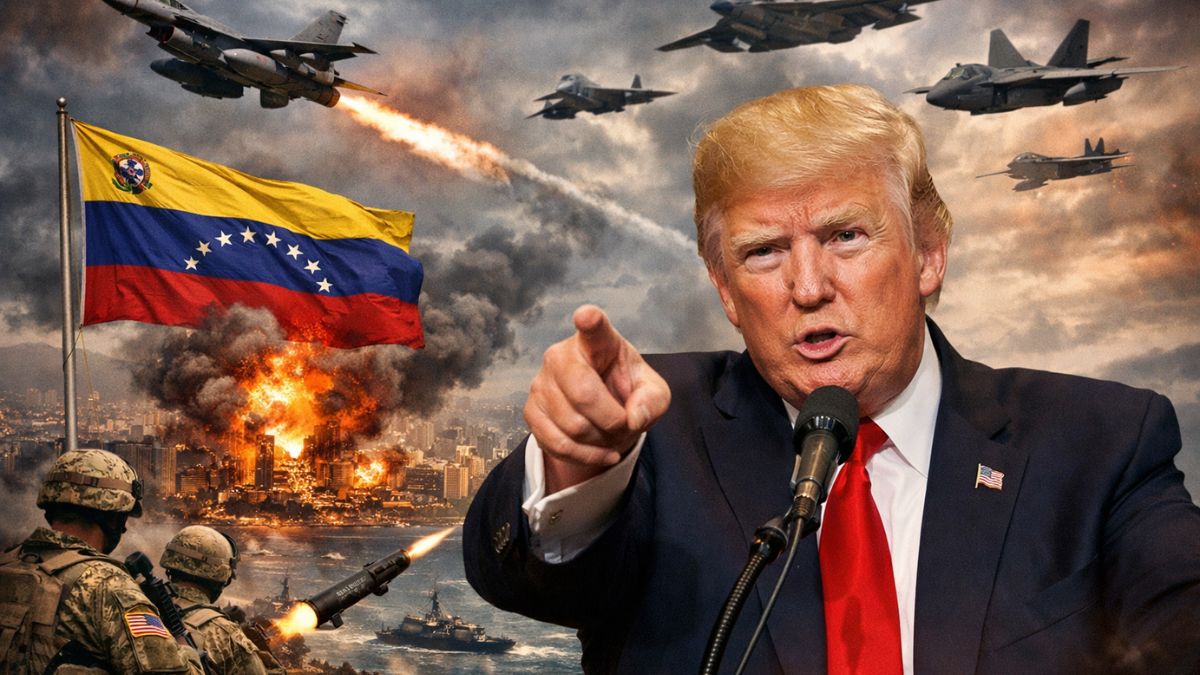
In a radio interview, Trump described a US operation against a "big facility", but provided limited details. Image courtesy: AI-generated picture via Sora

Tensions between the United States and Venezuela have entered a sharper and more confrontational phase. After a naval blockade, and US’ seizure of oil tankers, President Donald Trump has now hinted at the first land strike inside Venezuela, as he aims tackling the country’s illegal drug trade that have killed Americans.
US President Donald Trump recently claimed that American forces carried out a strike on a Venezuelan “dock area” allegedly used to load drug-smuggling boats, signalling a potential expansion of Washington’s pressure campaign against President Nicolás Maduro. He shared there had been a “major explosion” where “they load the boats up with drugs”.
Trump, however, refrained from sharing any more details or the dock’s location. His remarks notably come amid a widening clash that now includes a US naval blockade, seizures of oil tankers, and a growing number of lethal strikes on suspected drug vessels in the Caribbean and Pacific.
US strikes Venezuela: What did Trump say about the alleged strike?
Trump said the US carried out a strike on a dock linked to Venezuelan drug trafficking operations, describing a “major explosion” at a site “where they load the boats up with drugs.” Venezuela’s government has yet to officially respond.
“There was a major explosion in the dock area where they load the boats up with drugs,” Trump said as he met in Florida with Israeli Prime Minister Benjamin Netanyahu. “They load the boats up with drugs, so we hit all the boats and now we hit the area. It’s the implementation area. There’s where they implement. And that is no longer around.”
Asked whether the CIA was responsible, Trump declined to confirm. “I know exactly who it was, but I don’t want to say who it was,” he told reporters on Monday (December 29, 2025).
Was the strike a covert CIA operation?
According to CNN and The New York Times, the explosion was caused by a drone strike carried out by the CIA, citing sources familiar with the matter. US authorities have neither confirmed nor denied the reports, and no images or videos, typically released by the Pentagon after such actions, have been made public so far.
Trump had previously hinted at such an operation in a radio interview last week, referring to a US strike on a “big facility,” again without offering specifics. On December 26, 2025, Trump described hitting “a big plant or a big facility” associated with drug trafficking operations during a radio interview on WABC’s Cats & Cosby Show.
How does latest strike fit into Trump’s broader pressure campaign on Maduro?
A US strike on land would constitute a marked escalation in Trump’s strategy against Maduro, whom Washington has accused of leading a “narco-terrorist” organisation, a charge Venezuela strongly denies. Trump has repeatedly threatened military action, authorised covert operations, and intensified economic pressure.
He has always framed the campaign as part of a wider “war on drugs” and national security effort.
What is the US doing at sea?
Alongside the alleged dock strike, the US has dramatically increased maritime operations targeting what it claims are Venezuelan-linked drug-smuggling boats. Since September, US forces have carried out around 30 strikes on suspected “narco-terrorist” vessels in the Caribbean and eastern Pacific, killing more than 100 people, according to US officials.
On December 20 , the US Coast Guard with the support of the Department of War apprehended an oil tanker that was last docked in Venezuela in a pre-dawn action. “The United States will continue to pursue the illicit movement of sanctioned oil,” DHS Secretary Kristi Noem, whose department oversees the Coast Guard, said.
The most recent incident occurred on Monday, when US Southern Command said two people were killed in a “lethal kinetic strike” on a vessel in the eastern Pacific. However, Washington has not publicly released evidence proving the boats were carrying drugs, and the identities of most of those killed remain unknown.
US naval blockade against Venezuela
The Trump administration has also ordered a naval blockade targeting sanctioned oil tankers entering and leaving Venezuela, arguing that oil revenues are being used to finance drug trafficking and criminal networks.
In recent weeks, US forces seized two oil tankers and pursued a third. Caracas condemned the actions as “piracy,” accusing Washington of attempting to strangle Venezuela’s economy and seize control of its vast oil reserves, the largest proven reserves in the world.
Is regime change the real objective?
Maduro has long accused the US of using the “war on drugs” as a pretext to remove him from power. Trump has not ruled that out. When asked whether the tanker seizures were meant to force Maduro out, Trump replied: “Well, I think it probably would… That’s up to him what he wants to do.”
The comment reinforced suspicions in Caracas that Washington’s ultimate goal goes beyond counter-narcotics enforcement.
With alleged covert strikes, lethal maritime operations, and a naval blockade now in play, the US–Venezuela conflict appears to be entering its most volatile phase in years. The absence of confirmation from Caracas and the lack of publicly released evidence from Washington have only added to uncertainty.