


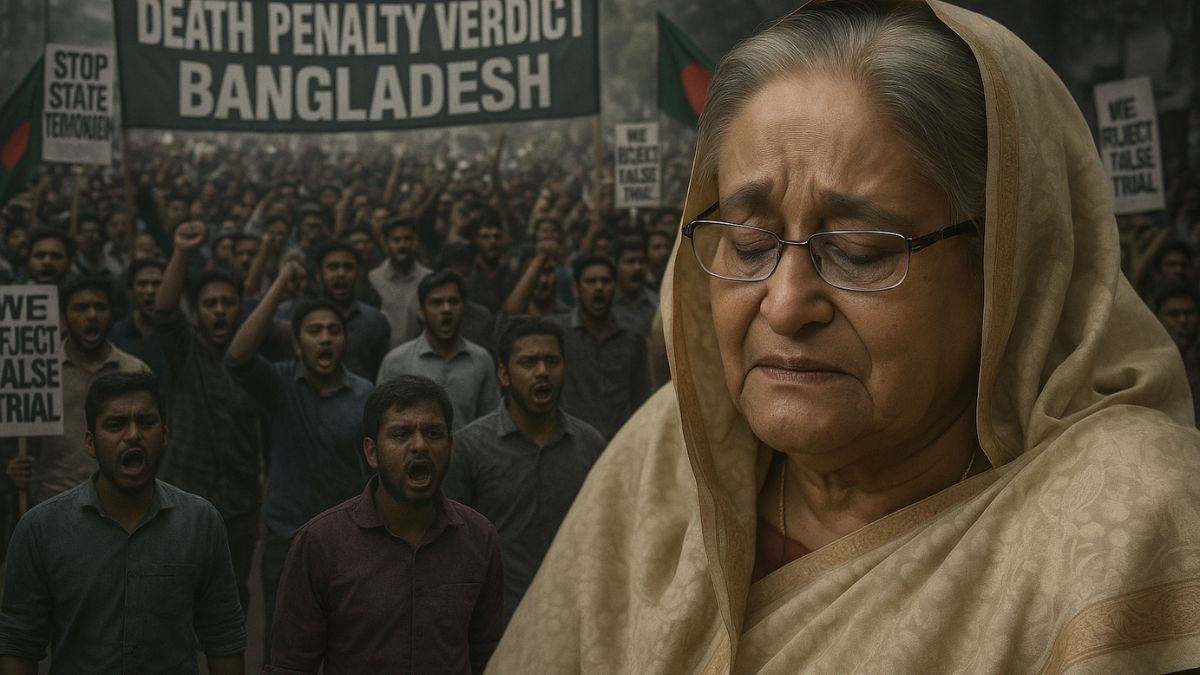
Monday (November 17, 2025) sent shockwaves across the geopolitical community as Bangladesh International Crimes Tribunal-1 (ICR-1) sentenced former Prime Minister Sheikh Hasina to death after finding her guilty on multiple counts. As the tribunal sentenced Hasine to death in absentia, Bangladesh descended into one of its most volatile nights in recent memory.
Bangladesh ICT’s verdict that set off widespread protests, arson, and violent clashes. The ICT, a special domestic court created to prosecute genocide and war crimes from the 1971 Liberation War, found former PM Hasina guilty of crimes against humanity connected to the July 2024 students’ demonstrations.
Along with Hasina, former Home Minister Asaduzzaman Khan Kamal and former Inspector General of Police Chowdhury Abdullah Al-Mamun were also convicted, though Mamun received partial clemency.
Sheikh Hasina death penalty: How the verdict cause widespread unrest
Death penalty verdict for Hasina ignited immediate unrest across Dhaka and multiple districts, with more than 50 vehicles torched and at least 50 people injured in clashes in the politically sensitive Dhanmondi 32 area, home to the residence of Sheikh Mujibur Rahman.
Protesters blocked highways, hurled crude bombs, and attacked symbols of the state, while police responded with tear gas, sound grenades and baton charges. Over the past week alone, Bangladesh has witnessed more than 50 arson and explosive incidents, resulting in at least three fatalities.
The unrest spread further when former President Abdul Hamid’s residence in Kishoreganj was vandalised by unidentified men shortly after a rally celebrating Hasina’s conviction passed through the area. The country remains in a state of high alert, with authorities deploying additional forces amid fears that the political crisis may deepen.
Hasina death penalty verdict’s ripples felt in India
As Bangladesh struggles with internal volatility, India has moved swiftly to reinforce its border security, especially along North and South 24-Parganas in West Bengal. The moment the ICT judgement was announced, Indian security agencies activated elevated protocols to deter any potential cross-border spillover.
Intelligence inputs warn that if the Awami League is formally banned in Bangladesh, its leaders, cadres and sympathisers may attempt to seek refuge in India. In response, the Centre has instructed West Bengal Police and the Border Security Force (BSF) to maintain maximum vigilance.
Security checks have been reinforced at key border entry points such as the Ichamati Bridge in Basirhat, Tentulia Bridge in Swarupnagar, Bonbibi Setu in Hasnabad, Nabadurga Mor in Hemnagar and Shayestanagar in Baduria. Transport entering from border-adjacent zones is being thoroughly inspected, with 24×7 monitoring systems now in place.
This heightened security posture comes at a particularly sensitive time for India, which is already tackling a series of explosions in Delhi and Kashmir. A senior administrative official noted that “the twin developments — unrest in Bangladesh and recent terror incidents in India — have pushed security agencies into a heightened state of caution.”
Meanwhile, Hasina, who fled to India after resigning during the student-led uprising in July 2024, is now at the centre of a political maelstrom. She faces five major charges linked to last year’s crackdown that left more than a thousand people dead. Within Bangladesh, Awami League leaders argue that the verdict marks a “dark chapter” in the country’s history.