



Expand List Of Chinese Military Companies, Add Xiaomi, DeepSeek: Why US Lawmakers Want 17 Firms In 1260H List
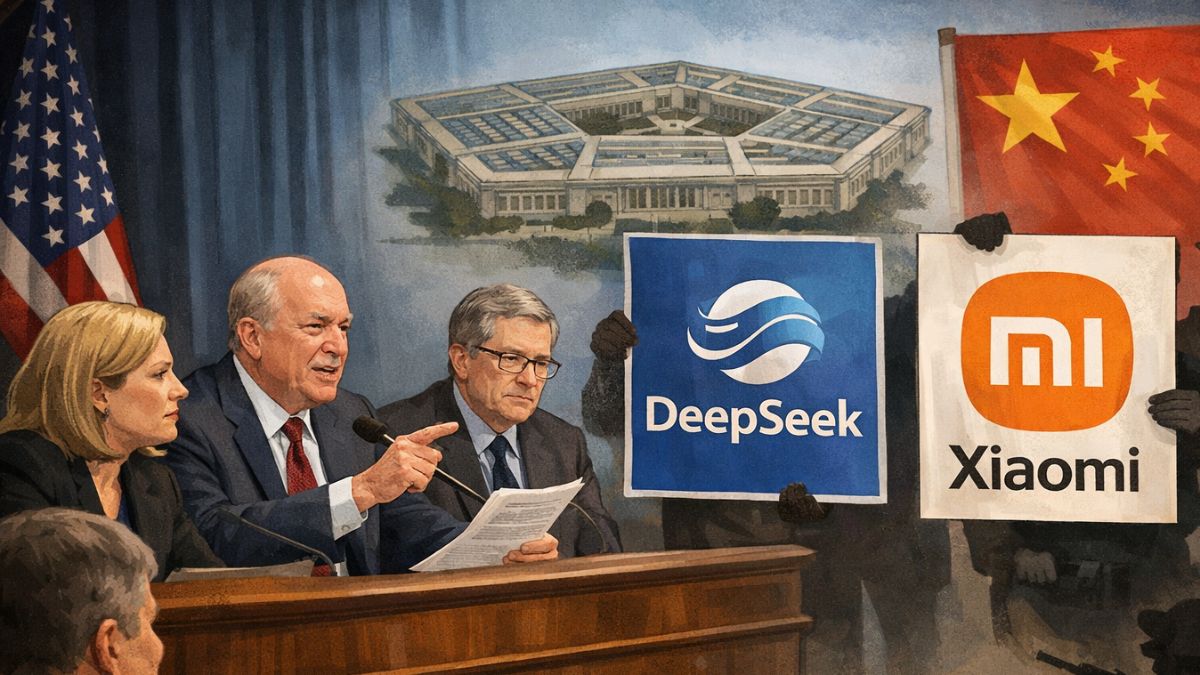
While the 1260H list does not formally sanction Chinese firms, it sends a message to suppliers about the US military's opinion of the firms. Image courtesy: AI-generated picture via Sora

A group of nine Republican US lawmakers has urged the Pentagon to expand its list of Chinese companies accused of supporting China’s military, a move that could significantly deepen the tech and economic decoupling between Washington and Beijing. They have made the demand in a letter sent to US Secretary of Defense Pete Hegseth.
The lawmakers have called for 17 several high-profile Chinese firms, including popular AI company DeepSeek, smartphone giant Xiaomi, and display manufacturer BOE Technology Group, to be added to the Pentagon’s Section 1260H list. The appeal came just days after President Donald Trump signed a $1 trillion military spending bill.
What is the Section 1260H list?
The Section 1260H list identifies companies the US believes are “Chinese military companies” operating directly or indirectly in support of the People’s Liberation Army (PLA). This list keeps a track of Chinese companies, links with their military that are directly or indirectly operating in US. It eventually helps US to counter ‘Military-Civil Fusion’ (MCF) policy by Beijing.
While inclusion on the list does not amount to formal sanctions, it carries powerful consequences. This signals the US government agencies and defence contractors that the companies pose national security risks; discourages US suppliers from working with listed firms; can trigger secondary restrictions and reputational damage.
Major Chinese firms already on the list include Tencent Holdings and electric vehicle battery giant CATL. Some companies previously added have sued the US government, arguing the designation damages their business without due process.
Why are US lawmakers pushing for these firms to be added to 1260H list?
The lawmakers argue that the companies named in their letter play a role in dual-use technologies – civilian products that can also be repurposed for military applications. According to a Reuters report, DeepSeek is accused of assisting China’s military and bypassing US export controls.
BOE Technology Group, a key supplier to Apple, is viewed as part of China’s strategic electronics ecosystem. Xiaomi, already scrutinised in the past, is seen as embedded in China’s broader tech-industrial policy.
The push reflects mounting concern in Washington that Chinese firms operate in close alignment with state and military objectives, blurring the line between commercial innovation and defence capability.
Which other companies are being targeted?
Beyond the headline names, lawmakers recommended adding a wide range of Chinese firms spanning biotech, robotics, semiconductors, and autonomous systems, including WuXi AppTec and GenScript Group (biotechnology); RoboSense, Livox, Unitree Robotics, and CloudMinds (robotics and AI); Hua Hong Semiconductor, Shennan Circuit, and Kingsemi (chipmaking and electronics).
The breadth of the list highlights how US concerns now extend well beyond weapons-related industries to entire technology ecosystems.
What would this mean for these Chinese firms?
If added to the 1260H list, the affected firms could face reduced access to US defence and government contracts, pressure on global customers to find alternative suppliers, heightened scrutiny from investors and regulators, potential knock-on effects from future US sanctions or export controls.
For companies like BOE, which supply global giants such as Apple, the risk lies less in immediate bans and more in long-term supply chain uncertainty.