




Chinese GPS-Tagged Seagull Sparks Security Scare Near INS Kadamba, Found To Be Part Of Migratory Research
Security agencies initiated checks near INS Kadamba after a tracking device linked to a foreign research institute was found in the area before it was confirmed to be part of a migratory study. Image courtesy: AI generated picture via DALL-E

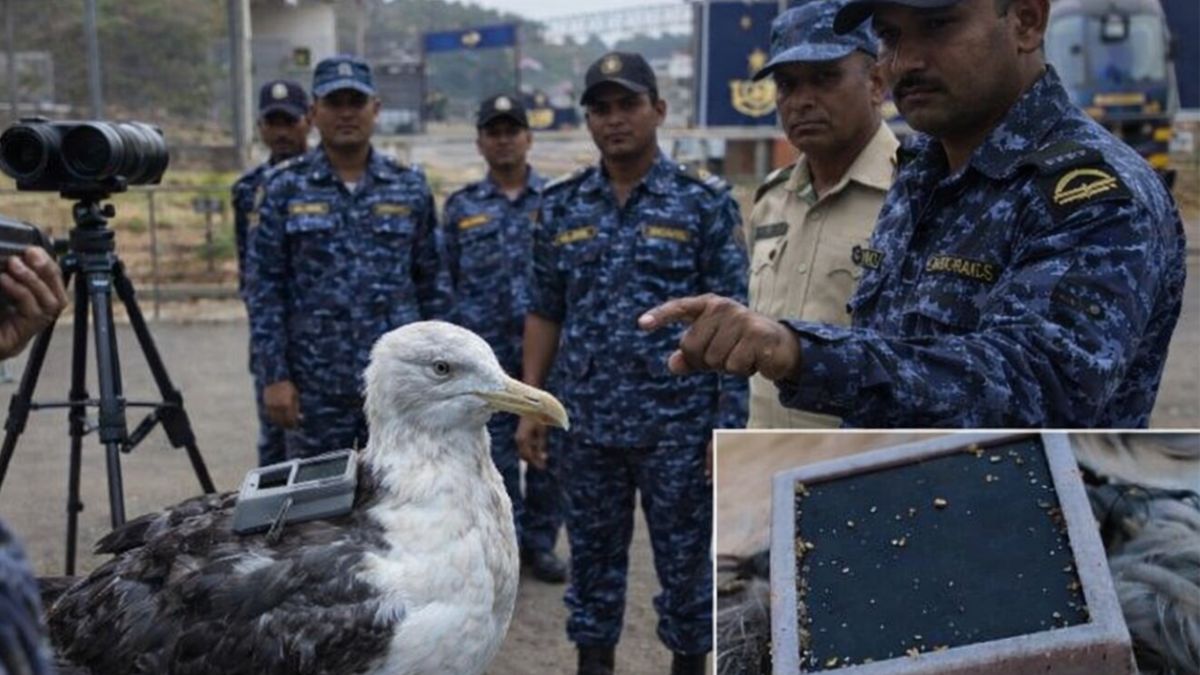
A GPS-tagged migratory seagull found near the high-security INS Kadamba naval base in Karwar, Karnataka, briefly triggered security concerns after the device was identified as bearing an inscription linked to the Chinese Academy of Sciences.
Authorities later confirmed that the tracker was part of an international scientific study on bird migration and posed no surveillance threat.
When and where was the bird spotted?
The bird was spotted by a passerby near the Kadamba Naval Base in Uttara Kannada district, close to one of India’s most sensitive naval installations that houses the aircraft carrier INS Vikramaditya.
Alarmed by the presence of a tracking device, the individual alerted the police, prompting an examination by local authorities, forest officials, and naval police.
What did officials find on the bird?
Officials found that the lightweight GPS tracker carried the inscription “Eco-Environment Science, Chinese Academy of Sciences” and was designed solely to monitor the seagull’s movement, feeding habits, and long-distance migration routes.
Forest department sources said the device had no camera, audio, or spying capability and was consistent with trackers commonly used in wildlife research.
The seagull was subsequently handed over to the Marine Forest Division office, while forest officials initiated communication with the Chinese Academy and partner wildlife organisations to formally verify the study.
Why did the Chinese GPS tracker raise an alarm?
Given the location within a high-security zone, Karwar City Police and naval security agencies are continuing procedural checks before formally closing the case.
“This is a highly sensitive area that remains on constant alert. While preliminary findings suggest a migratory research purpose, verification with the institution mentioned on the tracker is necessary,” a senior official said.
How have previous incidents too cause concern?
Such incidents are not unprecedented. Earlier this year, a falcon released in Maharashtra as part of a study by the Forest Department and BNHS landed within the Karwar naval base, briefly drawing public and security attention.
Seagulls typically migrate along the Karnataka coast after the monsoon and have been sighted in large numbers across Karwar and Ankola in recent weeks.
Officials noted the bird was likely exhausted after travelling thousands of kilometres, underscoring how scientific research can sometimes collide with heightened geopolitical sensitivities.