

INS Tir, Shardul, Sujata and ICGS Sarathi Sail East: Navy’s First Training Squadron Heads To Southeast Asia
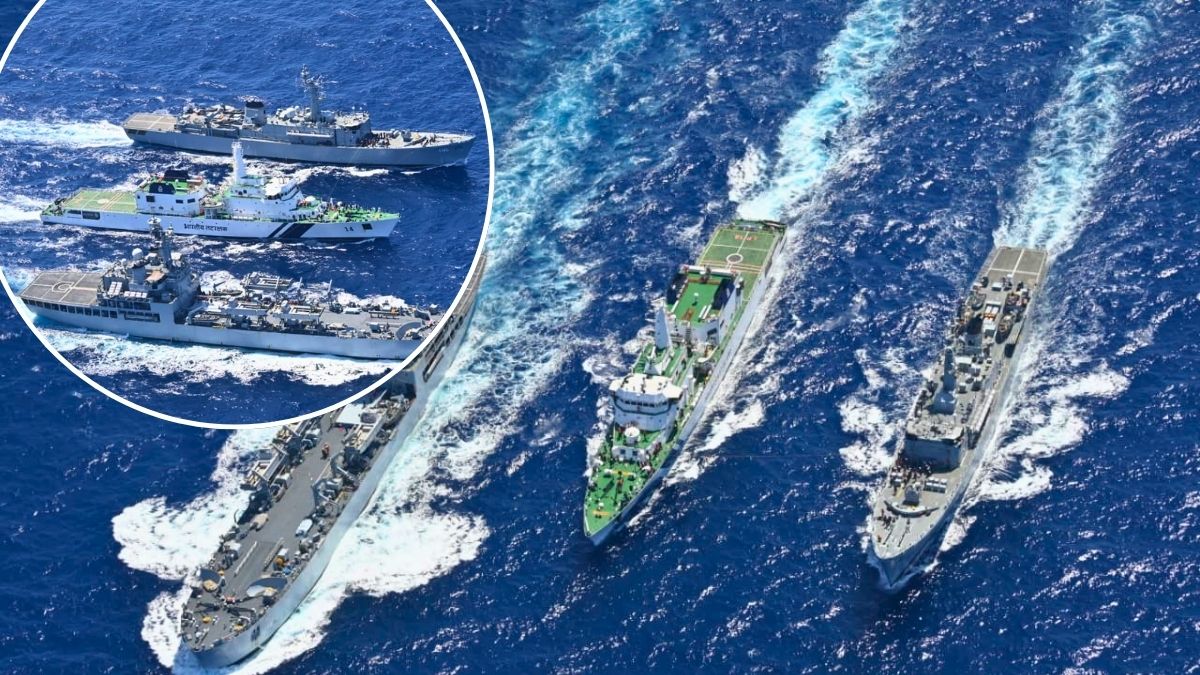
As part of the deployment, the squadron is scheduled to undertake port calls at Singapore, Indonesia and Thailand. Image courtesy: X.com/@indiannavy

Indian Navy ships regularly engage in port calls and visits to other friendly naval partners. Continuing its outreach and further deepening its operational footprint and strategic engagement in Southeast Asia, ships of Indian Navy’s First Training Squadron (1TS) will be undertaking a Long Range Training Deployment to South East Asia.
Set to embark on a Long Range Training Deployment (LRTD) to the region, the Navy’s First Training Squadron’s outreach underlines New Delhi’s commitment to capacity building, maritime cooperation and the Act East Policy.
The deployment involves frontline and training platforms INS Tir, INS Shardul, INS Sujata, along with Indian Coast Guard Ship Sarathi, and forms a key component of the 110th Integrated Officers’ Training Course (IOTC).

What is the mission of Navy’s training squadron?
The LRTD is designed to provide hands-on operational exposure to officer trainees, blending seamanship, navigation, leadership and joint operations with real-world maritime environments. The deployment allows trainees to operate across diverse sea conditions while interacting with regional navies and maritime agencies.
Beyond training, the mission reinforces India’s role as a net security provider in the Indian Ocean Region (IOR) and Southeast Asian waters.
“This is aimed at providing comprehensive operational and cross-cultural exposure to officer trainees, while reinforcing sustained maritime engagement in consonance with India’s Act East Policy and vision for a free, open and inclusive IOR,” the Indian Navy said in a statement.
Which countries will Indian Navy ships visit?
As part of the deployment, the squadron will undertake port calls at Singapore, Indonesia and Thailand — key maritime partners in Southeast Asia. These visits will feature professional exchanges with host navies, cross-deck training and ship visits, interactions with maritime and naval experts, joint maritime partnership exercises.
Such engagements are aimed at enhancing interoperability, trust and operational coordination among regional maritime forces.
How does this align with India’s Act East policy?
The deployment directly supports India’s Act East Policy, which emphasises deeper strategic, economic and security ties with Southeast Asia. By maintaining sustained naval presence and cooperation, India signals its commitment to a free, open and inclusive Indo-Pacific.
Maritime diplomacy through training deployments has become a cornerstone of India’s regional outreach, complementing bilateral defence ties and multilateral maritime frameworks. Indian Navy conducts/participates in bilateral/multilateral maritime exercises and coordinated patrols (CORPATS) with friendly foreign countries on a regular basis.
Why is the deployment strategically significant?
The LRTD reflects a multi-layered strategic objective – training future naval leaders through real-world deployments; strengthening defence partnerships with ASEAN nations; promoting rules-based maritime order; enhancing jointness, with personnel from the Indian Army and Indian Air Force embarked on board.
The presence of six international officer trainees in the 110th IOTC further highlights India’s growing role in defence capacity building for friendly foreign nations.
Moreover, the deployment of the first training squadrone also underscores the Indian Navy’s emphasis on training excellence, joint and integrated operations, maritime cooperation and goodwill, along with a proactive engagement across the Indo-Pacific.