The Power of Presence: Steel, Compassion, and the New Maritime Diplomacy

The horizon of the Indian Ocean Region (IOR) is shifting, not through the thunder of conflict, but through the steady, rhythmic presence of a fleet that has learned to listen as much as it leads. For a long time, the Indian Navy was defined by its geography—a force meant to guard a specific coastline and secure a particular set of trade routes. But a quiet transformation has taken place over the last few years. From the biting winds of the North Arabian Sea to the humid, contested reaches of the South China Sea, the Indian Navy has turned out to be a bridge-builder and the region’s preferred security partner.
This isn’t just semantic window dressing. It is a fundamental shift in how India interacts with its neighbors. As a result of the partnership of equals, this is evident in the gifting of the INS Kirpan to Vietnam and the transfer of Fast Interceptor Crafts to Mozambique. These aren’t just hand-me-downs; they are investments in the sovereignty of others. When India helps Sri Lanka commission a Maritime Rescue Coordination Centre, it isn’t seeking to control Sri Lankan waters; it is ensuring that Sri Lanka has the eyes and ears to manage its own destiny.
The year 2025 has been a whirlwind of proof for this doctrine. Look at the numbers, but more importantly, look at the missions. When a massive earthquake shattered lives in Myanmar and Thailand in March, the response was measured in hours, not days. Under Operation Brahma and Operation Sagar Bandhu, ships like the INS Satpura and INS Gharial were underway within half a day, carrying tonnes of relief. That is the “First Responder” spirit in action. It is the same grit that saw the INS Trikand’s medical team perform a grueling three-hour surgery on a Pakistani sailor who had suffered a horrific hand injury off the coast of Oman. On the open ocean, the flag on the uniform matters less than the life in the balance. Whether it was providing fuel to a Malaysian-flagged vessel with a Chinese crew or rescuing a seafarer with third-degree burns 550 miles off the coast of Somalia, the Indian Navy is proving that its reach is defined by its compassion as much as its cannons.
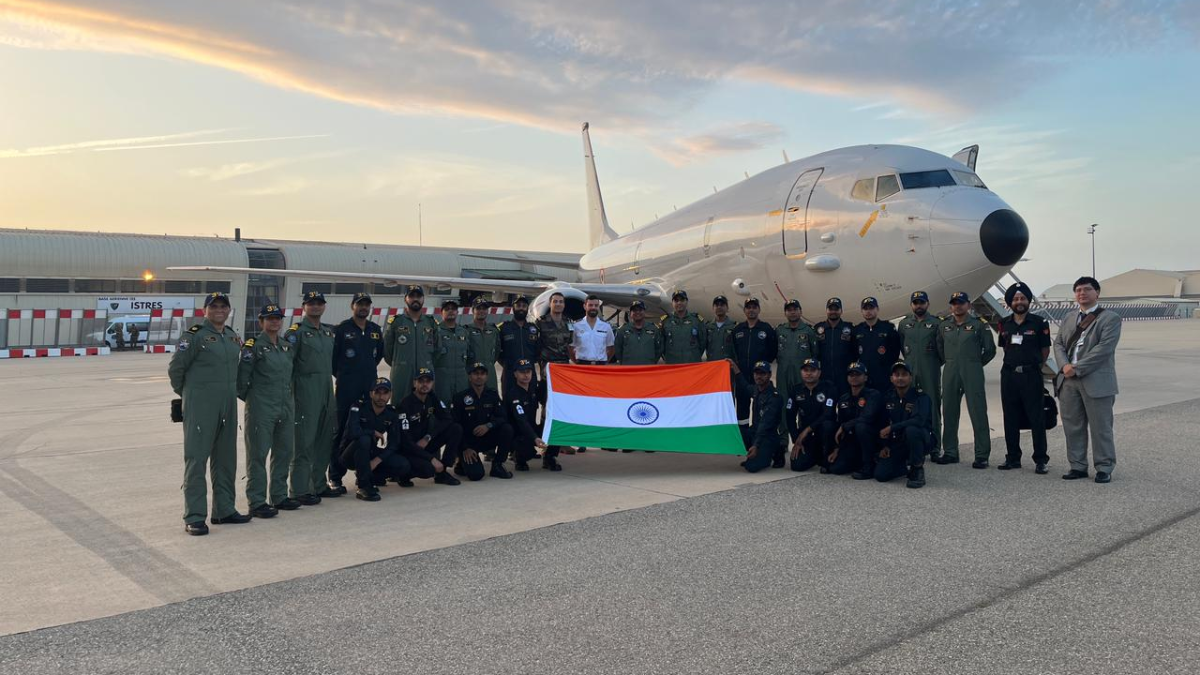
Diplomacy also happens in the grand theatre of international exercises. The scale of engagement is relentless. In early 2025, the French Carrier Strike Group, led by the Charles de Gaulle, joined Indian forces off the coast of Goa for Exercise Varuna. These are high-stakes, high-complexity maneuvers—anti-submarine warfare and air defence drills—that require a level of technical trust few nations share. Yet, almost simultaneously, India was engaging with the Russian Federation in Exercise INDRA and sending the INS Imphal to Port Louis to march in the Mauritius National Day parade. This ability to navigate multiple, often conflicting, geopolitical spheres is a testament to a navy that knows how to speak many languages at once.
Even the journey of the INS Tamal—from its commissioning in Kaliningrad to its arrival in Karwar—was a floating diplomatic mission. It didn’t just sail home; it stopped in Russia, Morocco, Italy, Greece, Saudi Arabia and Oman, conducting passage exercises at every turn. Each port call is a handshake. Each joint exercise is a promise of stability. By the time the Indian Navy hosted MILAN 2024 in Visakhapatnam, drawing in navies from 50 different countries, the message was clear: India is the anchor of the Indo-Pacific.
Ultimately, this is about more than just managing the growing competition with China or protecting trade routes. It is about a vision called SAGAR—Security and Growth for All in the Region. It is a recognition that in a world of rising tides and shifting alliances, no nation can survive as an island. By training smaller neighbours, conducting hydrographic surveys for them, and being the first to arrive when the clouds turn dark, the Indian Navy is rewriting the rules of naval diplomacy. It is showing that the true measure of a great power isn’t how much it can take but rather how much it can give when the world is at its most vulnerable.