
From One Plot to a Pattern: What the Case of Muhammad Shahzeb Khan Reveals About a Deeper Global Network
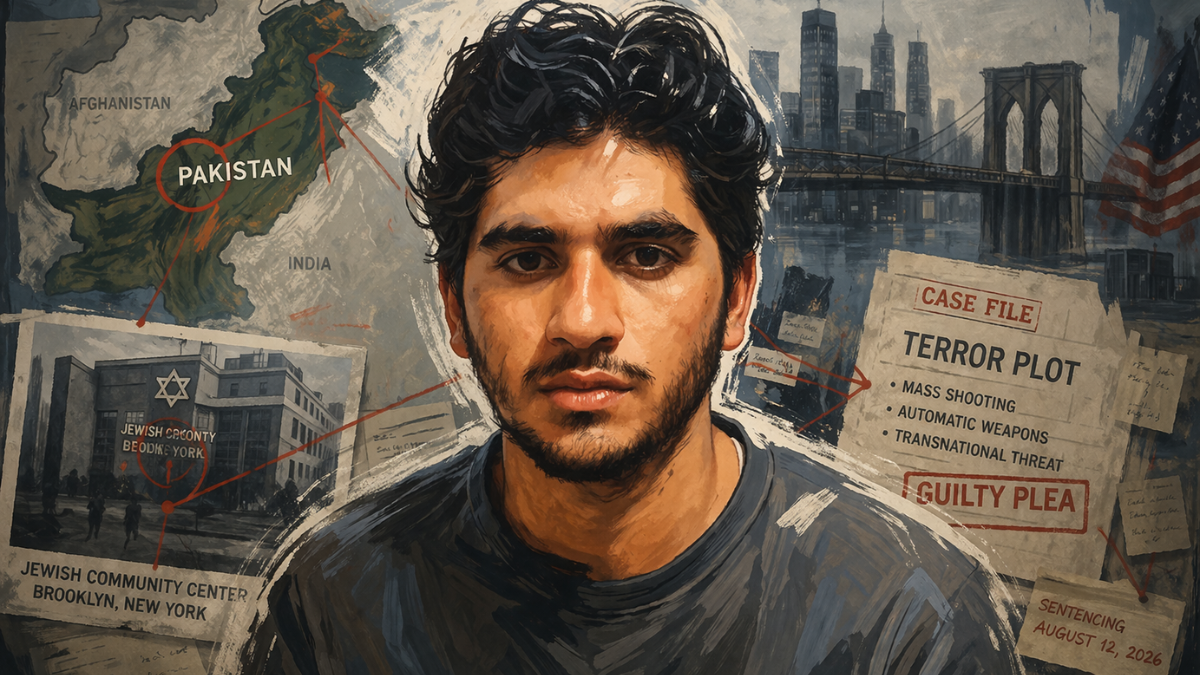
Muhammad Shahzeb Khan terrorism. Image courtesy: AI

Muhammad Shahzeb Khan, also known as ‘Shahzeb Jadoon’, pleaded guilty this week to attempting to commit acts of terrorism transcending national boundaries. According to the US Justice Department, Khan had planned to enter the United States and carry out a mass shooting with automatic weapons at a prominent Jewish center in Brooklyn, New York. He entered his plea before U.S. District Judge Paul G. Gardephe and is scheduled to be sentenced on August 12, 2026.
On its surface, it is a familiar story. A young man, radicalised across borders, was intercepted before violence could unfold. Authorities will describe it as a success—an attack prevented, a life diverted, a system working as intended. But to leave it at that would be to miss the more unsettling reality beneath it.
Khan’s trajectory was not unusual. A Pakistani national who had moved abroad, he gradually immersed himself in extremist narratives, communicated across encrypted platforms, and began to map out an attack far from where his story began. His plans ultimately collapsed under the weight of surveillance and intelligence coordination. Yet the question that lingers is not how he was stopped, but how such pathways continue to exist at all.
For decades, Pakistan has occupied a complicated position in the global security landscape. It has been both a frontline state in counterterrorism efforts and, simultaneously, a recurring point of origin or convergence for militant networks with international reach. This contradiction is not incidental; it is rooted in history.
In the years following its independence in 1947, Pakistan struggled to establish stable political institutions. Power frequently shifted between civilian governments and military rule, with the latter exerting enduring influence over national strategy. Within that framework, the use of non-state actors gradually became embedded as a tool of regional policy, particularly in relation to Afghanistan and the contested territories of Kashmir. What may have begun as a calculated approach to strategic depth would, over time, create an infrastructure far more resilient and far less controllable than anticipated.
The Soviet-Afghan war marked a turning point. Pakistan became a central node in the mobilisation of fighters, the dissemination of ideology and the logistics of conflict. The networks that emerged during that period were not dismantled when the war ended. Instead, they evolved. Training pipelines, funding channels and ideological ecosystems persisted, repurposing themselves for new conflicts and new theatres.
By the early 2000s, the consequences of that evolution were unmistakable. Groups operating from or linked to Pakistan were implicated in some of the most consequential acts of terrorism in the region. The attacks in Mumbai in 2008, carried out with precision and coordination, demonstrated how these networks could project violence beyond borders with devastating effect. Earlier, the assault on the Indian Parliament had already signalled the willingness of such groups to target not just civilians, but the very institutions of state power.
At the same time, Pakistan’s territory remained entangled in the broader architecture of global militancy. The discovery of Osama bin Laden in Abbottabad in 2011 was a moment that reverberated far beyond South Asia. It raised difficult questions about oversight, about complicity and about the extent to which militant actors could operate within the country’s borders without detection. Pakistan rejected allegations of deliberate sheltering, but the episode reinforced an international perception that has proven difficult to dispel.
Yet the most profound consequences of this long entanglement have been felt within Pakistan itself. Militant groups, once oriented outward, began to turn inward. The rise of the Tehrik-i-Taliban Pakistan transformed the country from a staging ground into a battleground. Attacks multiplied, targeting civilians, security forces, and public institutions. The massacre at a school in Peshawar, where more than a hundred children were killed, became a defining moment—one that underscored how completely the logic of militancy had escaped its original confines.
In recent years, the scale of the crisis has only intensified. Pakistan now ranks among the countries most affected by terrorism globally, with a sharp rise in attacks, fatalities and hostage incidents. The violence is concentrated in regions where state control is weakest, particularly along the Afghan border, but its implications are national and, increasingly, international.
It is against this backdrop that Khan’s guilty plea must be understood. His plan to open fire inside a Jewish center in Brooklyn was not directed by a formal organisation, nor did it require a physical training camp or a hierarchical command structure. What it did require—and what it found—was an existing ecosystem. An environment in which ideology circulates freely, in which narratives of grievance and violence are readily accessible, and in which individuals can move from belief to intent with alarming speed. That the target was a Jewish community centre in America’s largest city also points to how seamlessly transnational extremism now absorbs and amplifies antisemitic violence as part of its ideological arsenal.
This is the new face of transnational militancy. It is less visible, less centralised and more difficult to disrupt. It thrives not on large-scale infrastructure, but on the residue of decades of it. The networks built in one era continue to echo in another, shaping the possibilities of action even when the original architects are long gone.
Pakistan’s position in this dynamic remains deeply paradoxical. It has lost thousands of lives to terrorism, undertaken extensive military operations and faced sustained international pressure to dismantle extremist networks. At the same time, it continues to be associated with a legacy of selective enforcement and strategic ambiguity—distinctions between groups that are confronted and those that are, at times, tolerated.
This duality complicates any straightforward narrative. Pakistan is neither simply a perpetrator nor solely a victim. It is both shaped by and entangled in the forces it seeks to control. That complexity, however, does not diminish the consequences. If anything, it amplifies them.
Khan’s sentencing in August will close one chapter. But it is also a reminder that prevention, however effective, is not a resolution. As long as the underlying conditions persist—historical, structural, and ideological—the emergence of individuals like Khan will not be an exception.