


252,752 Miles From Earth! Artemis II Crew Now Farthest Any Human Has Ever Travelled, Break Apollo 13’s Record
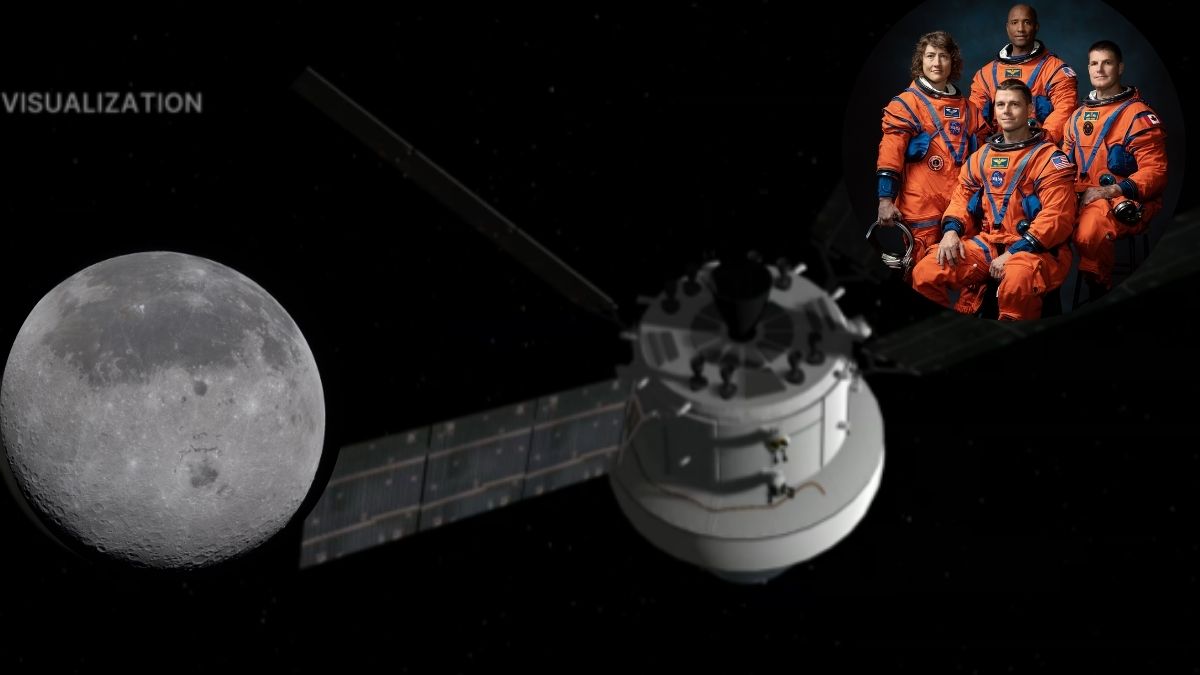
Artemis II astronauts set the record as the farthest humans from Earth during a lunar flyby promising magnificent views of the far side never before seen. Image courtesy: RNA

NASA’s Artemis II crew has officially set a new milestone in human spaceflight, becoming the farthest-travelling humans from Earth. After days of preparations and anticipation, NASA astronauts Reid Wiseman, Victor Glover, Christina Koch, and CSA astronaut Jeremy Hansen on Monday (April 6, 2026) made the record to go farthest any human has ever travelled.
Part of the Artemis II mission, the four astronauts surpassed the previous record set by Apollo 13 in 1970, as they reached a maximum distance of 252,752 miles (approx 406,778 km) from Earth. It is about 4,105 miles farther than the Apollo-era benchmark. “At 1:57 p.m. EDT, they broke the record set by Apollo 13 in 1970,” NASA Earther posted on X.
During the Apollo 13 mission, the astronauts had traveled 248,655 miles from Earth. This marks the first time in over five decades that humans have ventured this deep into space, signalling a major leap in NASA’s return-to-the-Moon programme.
Artemis II breaks Apollo 13 record: Why does it matter?
Breaking this distance record is not just symbolic, but even more critical for future lunar missions. The milestone achieved by the Artemis II crew proves that NASA’s Orion spacecraft can safely carry humans into deep space, and the systems can operate far beyond Earth’s orbit for extended periods.
Further, it also shows that astronauts can function effectively in long-duration, high-risk environments.
The mission is a key stepping stone toward Artemis III (planned lunar landing) and Artemis IV, which aim to establish a sustained human presence on and around the Moon.
What is happening during the Moon flyby?
The astronauts are currently executing a six-hour lunar flyby, closely observing and documenting the Moon’s surface. They are studying craters, ridges, and lava plains; capturing images and making visual observations; and viewing parts of the Moon never before seen directly by human eyes.
One such feature already spotted is the Orientale basin, an impact crater previously only seen via uncrewed missions. NASA scientists emphasise that astronaut observations remain invaluable. “The human eye is basically the best camera that could ever or will ever exist,” said Artemis II lead scientist Kelsey Young.
What happens when the spacecraft goes behind the Moon?
During the flyby, Artemis II will pass behind the Moon, leading to a communications blackout of about 40 minutes. This phase is both routine and crucial as it tests spacecraft autonomy, simulates conditions for future missions, and marks a moment of complete isolation from Earth.
The crew is getting a rare visual experience, as they will see the Moon appearing “like a basketball at arm’s length”, a solar eclipse from space, as the Sun moves behind the Moon, and a full-disk view of the Moon, unlike close Apollo flybys. They are also flying over the far side of the Moon, a region never visible from Earth.
How is the mission progressing right now?
The Orion spacecraft has already entered the Moon’s gravitational sphere of influence, meaning lunar gravity is now guiding its path. It will complete a “free-return trajectory”, looping around the Moon before heading back to Earth, a journey that will take about four days after the flyby.
The crew began this landmark day with a message from Apollo legend Jim Lovell, “It’s a historic day… don’t forget to enjoy the view.”
Artemis II astronauts: Meet the crew on this historic mission
The Artemis II crew represents several historic firsts:
Reid Wiseman – Commander
Victor Glover – First person of color to travel to the Moon
Christina Koch – First woman to fly around the Moon
Jeremy Hansen (Canada) – First non-American on a lunar mission
Artemis II is designed to test systems, train astronauts, and gather data for future lunar landings. Its core goals include validating Orion’s performance in deep space, preparing for human return to the lunar surface, and enabling long-term plans for Moon bases and Mars missions.
As NASA Administrator Jared Isaacman noted, the data from this mission will be “paramount” for upcoming Artemis missions.