Lasting Peace In Middle East, Independent Palestinian State: India–Arab League Criticise Pahalgam Terror Attack
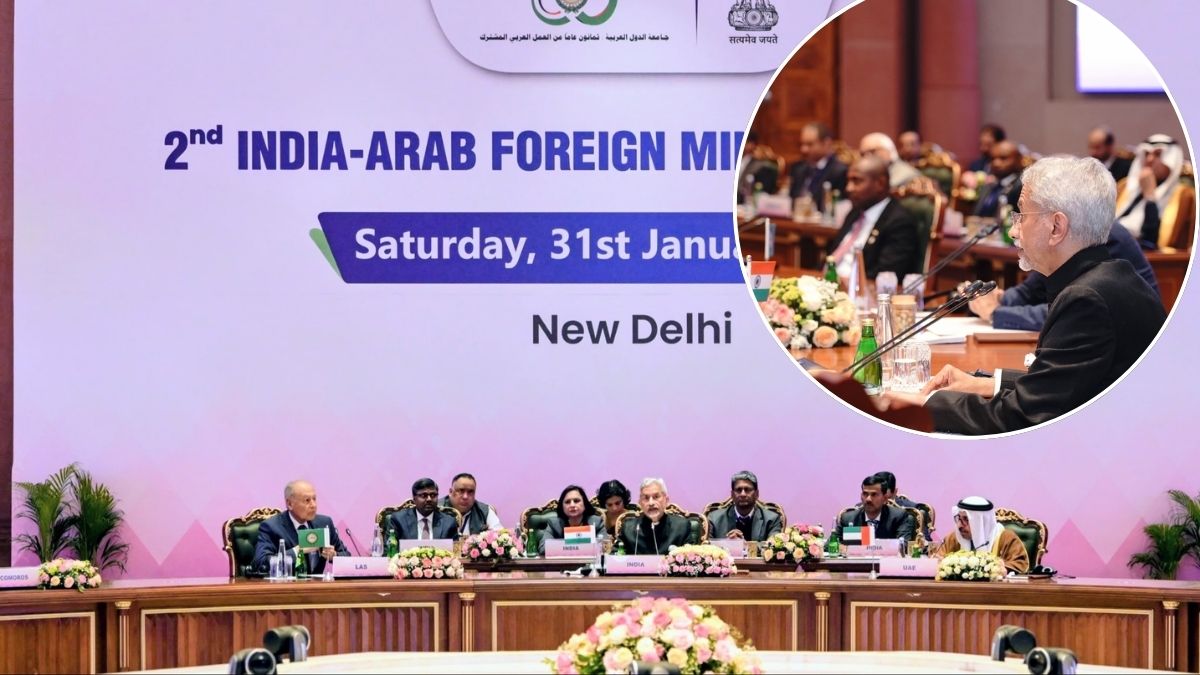
EAM Jaishankar highlighted the common threat of terrorism in all forms and manifestations; as well displaying zero tolerance towards it. Image courtesy: RNA

Held after a long gap of 10 years, the 2nd India-Arab League Foreign Ministers’ Meeting stood out not just for its timing amid deepening turmoil in West Asia, but also for the careful diplomatic messaging it produced. It was during this high-level engagement that PM Narendra Modi called the Arab world part of India’s extended neighbourhood.
On regional geopolitics, the Prime Minister reiterated India’s consistent support for the Palestinian people and welcomed ongoing peace efforts, including the Gaza peace plan.
Co-chaired by External Affairs Minister S Jaishankar, the meeting brought together foreign ministers from 19 Arab League countries, including Saudi Arabia, Egypt, Kuwait and Qatar, making it only the second such engagement since the inaugural dialogue in 2016. Notably, the meeting was held against the backdrop of the Gaza conflict, ongoing instability in Sudan and Yemen, and wider geopolitical churn.
2nd India-Arab Foreign Ministers meeting: What did the joint statement signal?
One of the most striking aspects of the joint statement was what it did not say. In a rare formulation, India and the Arab League did not criticise Israel explicitly, instead reaffirmed their commitment to a “just, comprehensive and lasting peace” in the Middle East, grounded in international law, UN resolutions and the Arab Peace Initiative.
Moreover, they reiterated support for a sovereign, independent and viable Palestinian state based on the 1967 borders, living side by side in peace with Israel, while affirming the inalienable rights of the Palestinian people. The absence of direct censure of Israel particularly comes at a moment when 2nd phase of a Gaza ceasefire remains uncertain.
How did the meeting address Gaza ceasefire and humanitarian crisis?
The joint statement welcomed the outcomes of the 2025 Sharm El-Sheikh Peace Summit, which resulted in a ceasefire agreement in Gaza. It commended the roles played by Egypt and Qatar, alongside the United States, and acknowledged Algeria’s diplomatic efforts at the UN Security Council.
India and the Arab states urged all parties to fully comply with the ceasefire and took note of the Arab-Islamic plan for relief, recovery and reconstruction in Gaza. They also underlined the urgent need for sustained and unimpeded humanitarian access across the Strip, stressing the importance of continued operations by international relief agencies, particularly UNRWA.
Terrorism condemned and why it is a win for India?
Interestingly, the Arab foreign ministers strongly condemned the terrorist attack in Pahalgam (April 2025) that targeted Indian tourists, reaffirming their “full and steadfast support” for confronting terrorism in all its forms. While it was said without naming Pakistan, it is a significant diplomatic achievement for India.
The joint statement went further, condemning cross-border terrorism and calling on all states to refrain from using terrorism against other countries. It urged collective action to dismantle terror infrastructure and financing networks and to bring perpetrators to justice without delay.
Regional conflicts also discussed
While Gaza dominated global attention, the deliberations extended well beyond it. The meeting reflected shared concern over the devastating conflict in Sudan, instability in Yemen and its implications for maritime security, and uncertainty in Lebanon, where India has troops deployed under UNIFIL.
Libya’s stalled national dialogue process and the evolving situation in Syria were also flagged as critical to the region’s long-term stability, underscoring a common interest in strengthening forces of peace and prosperity across West Asia.
What did Jaishankar emphasise about changing global order?
Addressing the gathering, Jaishankar pointed to the profound transformation of the global order driven by shifts in politics, economics, technology and demography. He said nowhere were these changes more visible than in West Asia, a region whose strategic landscape has altered dramatically over the past year.
He stressed that advancing a comprehensive plan to end the Gaza conflict, anchored in UN Security Council Resolution 2803, was a widely shared priority, even as countries pursued individual or collective policy approaches.
On terrorism, Jaishankar reiterated that cross-border terrorism is particularly unacceptable as it violates core principles of international relations. He argued that societies targeted by terrorism have the right to defend themselves and called for stronger global cooperation to combat the threat.