


Indus Waters Treaty Suspension: Pak Pushes Back, Warns India Against Violations; Rejects Jaishankar’s Remarks
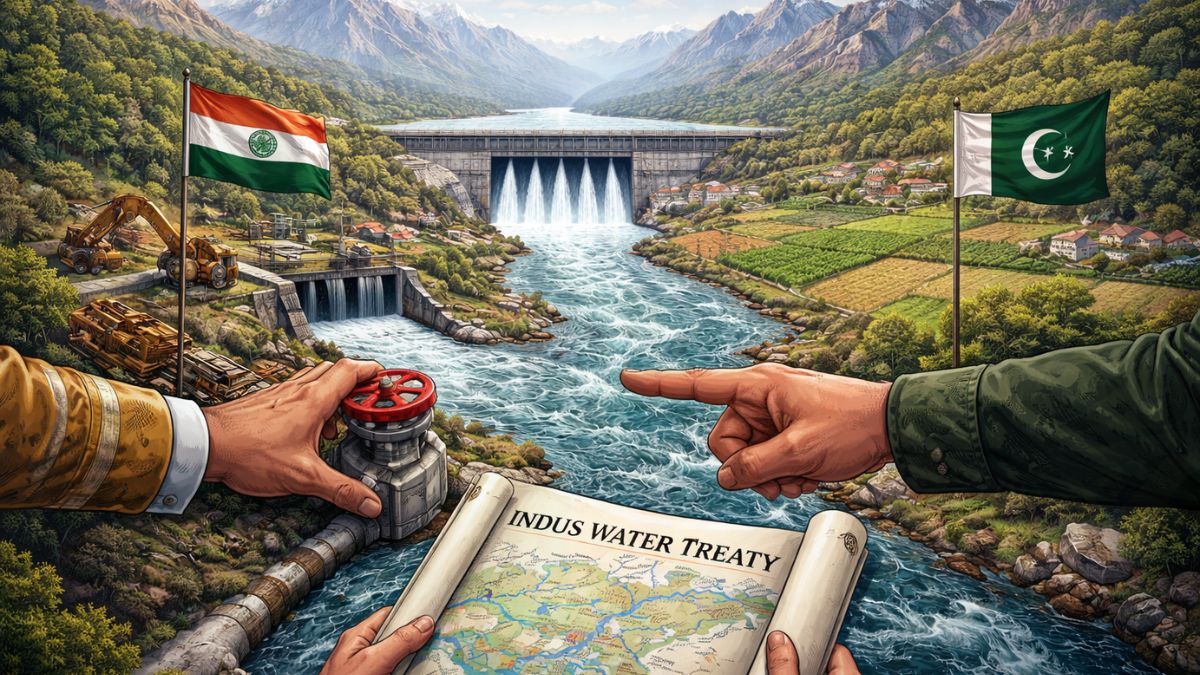
IWT has governed the sharing and use of the Indus River and its tributaries between India and Pakistan. Image courtesy: AI-generated picture via Sora

The Indus Waters Treaty (IWT) has once again emerged as a flashpoint in India–Pakistan relations, with Islamabad warning it will raise any Indian development activity on western rivers at diplomatic and political levels, amid New Delhi’s decision to keep the decades-old pact in abeyance following the Pahalgam terror attack.
Worth mentioning here is that the development comes less than a fortnight after a panel under the Ministry of Environment cleared the 260-megawatt Dulhasti Stage-II hydropower project on the Chenab river in Jammu and Kashmir’s Kishtwar district. The clearance came even as the Indus Waters Treaty (IWT) with Pakistan remains suspended.
Pakistan has now warned of taking up with issue at the political/diplomatic level if there are any developments upstream on Jhelum and Neelam. The remarks by Pak Foreign Office underline how water-sharing arrangements are increasingly intersecting with broader geopolitical tensions.
What did Pakistan say on India’s river projects?
Speaking at a weekly media briefing in Islamabad on Thursday (January 8, 2026), Pakistan Foreign Office spokesperson Tahir Andrabi said Islamabad would challenge any Indian activity on the Chenab, Jhelum and Neelam rivers that it believes violates the Indus Waters Treaty.
He asserted that the IWT remains a “binding international instrument”, and there is “no provision for abeyance” under the treaty. Pakistan will raise concerns through the Indus Water Commissioners, and if required, at political, diplomatic and international forums, Andrabi added.
“Our Indus Water Commissioner has written on certain projects on the Chenab River,” Andrabi stating, further noting that any upstream development on the Jhelum and Neelam would also be taken up with India.
Why is the Indus Waters Treaty under strain?
Since 1960, the distribution and use of the Indus River and its tributaries between India and Pakistan have been regulated by the Indus Waters Treaty, which was mediated by the World Bank. It was placed in “abeyance” as part of India’s retaliatory actions against Pakistan, following the April 22 Pahalgam terror attack.
India announced a series of punitive measures against Pakistan following the attack, signalling a tougher stance that linked cross-border terrorism with bilateral cooperation frameworks, including water-sharing agreements.
Brokered by the World Bank, the IWT has long been regarded as one of the few resilient mechanisms between India and Pakistan, surviving wars and prolonged diplomatic freezes since 1960.
How does the treaty figure in the India–Pakistan conflict?
Under the treaty, eastern rivers (Ravi, Beas, Sutlej) are allocated to India while western rivers (Indus, Jhelum, Chenab) are largely for Pakistan, with limited use permitted to India under strict conditions.
Pakistan argues that India’s suspension undermines a cornerstone of regional stability, while India maintains that continued terrorism makes “business as usual” untenable, even in treaty-based cooperation.
Jaishankar’s remarks ‘irresponsible and misleading’
During the briefing, Andrabi also rejected External Affairs Minister S Jaishankar’s remarks accusing Pakistan of running terror training camps for decades, calling them “irresponsible and misleading”. He alleged that India was deflecting attention from its own domestic issues and accused New Delhi of coercive behaviour toward neighbours
“Once again, India has sought to deflect attention from its own deeply troubling record as a neighbour,” he said, and alleged that “for smaller states in the region, India, too, has been a source of coercion rather than cooperation, while minorities within its borders face escalating intimidation and repression.”
Andrabi also raised concerns over the demolition of structures near a mosque in Delhi, describing it as part of a “systemic and deliberate campaign”
Pakistan’s regional alignments
On regional diplomacy, Andrabi said that Pakistan and China will continue using the China–Pakistan–Afghanistan trilateral mechanism, last meeting in August 2025. Moroever, terrorism emanating from Afghanistan remains Pakistan’s primary bilateral concern, with Islamabad seeking written assurances from Kabul.
A Pakistan–Bangladesh–China trilateral mechanism held last year would continue to be pursued for regional cooperation.